
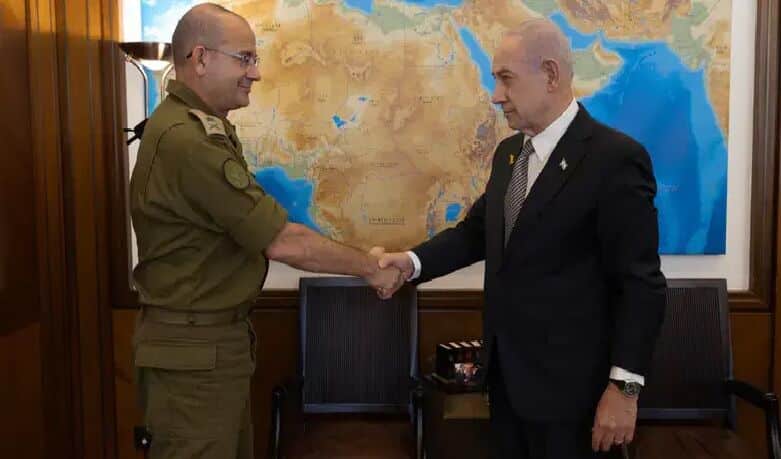
Ex-Mossad official: New chief’s appointment endangers Israeli security.
The appointment of Roman Goffman to head Mossad, one of the most sensitive security agencies in the Israeli regime, was met with a sharp reaction from security officials, including Rami Igra, a former senior official in the spy service; a reaction that was not directed at Goffman personally, but rather at Netanyahu’s political decision to select someone from outside the Mossad structure.
Igra emphasized in an interview with the Israeli Channel 11 television (Kan) that Mossad is a complex intelligence service with dozens of operational units, and that heading it requires years of field experience, knowledge of internal networks, and operational presence.
He warned that Goffman would need a long time to understand the internal structure of Mossad and recognize the power dynamics within the agency, adding: “It will take about two years to be able to trust his operational decisions and ensure that the organization is not exposed to fatal errors.”
Referring to hundreds of veteran Mossad operatives who have been involved in sensitive operations for years, the former Mossad official said that appointing someone from outside the agency could severely demoralize them. He recalled that during a similar period, when Danny Yatom was appointed to head the agency from outside in 1999, he and many other veterans decided to leave the agency. He stressed that such appointments are a direct blow to Israel’s security and the structure of the agency.
Igra also rejected the prime minister’s argument that someone with a “fresh, broad, and different perspective” was needed to enter the agency, saying that operational decision-making in the agency is only possible with experience, deep knowledge, and a security presence.
He went on to point to an incident in which Goffman was involved, describing it as “catastrophic,” an incident that he said showed Goffman made decisions without understanding the consequences of the event.
Igra warned: When it comes to Mossad, a small mistake can turn into a major crisis.
According to IRNA, the selection of Roman Goffman as head of Mossad is considered a reflection of political considerations and Netanyahu’s need to consolidate his control over Israel’s security structures, rather than the result of a professional process within the organization.
According to informed sources, several factors played a role in this choice:
1. Netanyahu’s desire for greater control over Mossad
In recent years, Mossad has played a pivotal role in the Iran case, various military operations in the region, and security coordination with the United States. Analysts believe that Netanyahu prefers to place someone at the head of this organization who is close to him and who acts in coordination with the Prime Minister’s Office in making sensitive decisions.
2. Distrust of some senior Mossad commanders
Reports indicate that Netanyahu has had disagreements with some of the senior Mossad staff and considered some of the internal options to be “non-aligned” or “critical.” Choosing someone outside the Mossad structure could be a way to bypass these officials.
3. The need for a loyal person during a period of security crises
With Israel simultaneously facing security challenges on various fronts in Gaza, Lebanon, Syria, and Iran, Netanyahu has been looking for someone who is fully aligned with him on the political and security levels and who will show full support at important junctures.
4. The possible role of circles close to the Prime Minister’s Office
Some Hebrew media outlets have reported that those close to Netanyahu, including his wife, Sara Netanyahu, have not supported the internal options of the Mossad. Although his direct involvement has not been confirmed, political sources say he usually has a say in sensitive appointments, and the possibility has been raised in the case of Goffman.
However, the decision has caused a wave of discontent among the veteran Mossad body, with many operational forces and veteran commanders seeing it as a sign of the prime minister’s distrust of the organization’s internal structure. Critics warn that appointing someone from outside the Mossad, in the complex security situation in the region, could seriously undermine the organization’s internal cohesion and have serious security implications.