
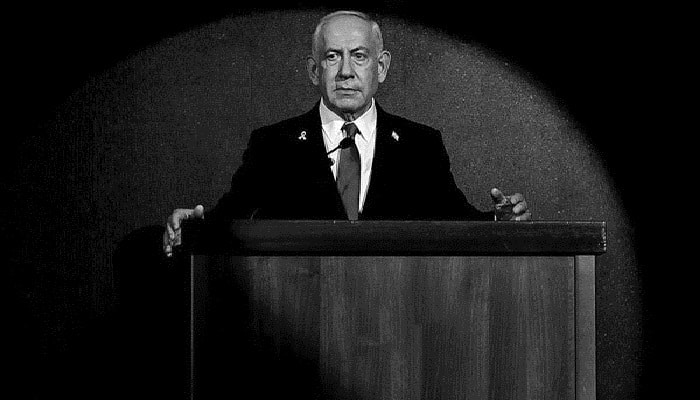
PNN – Netanyahu’s formal request for a pardon from corruption charges has intensified the political dispute in the occupied territories at a time when the regime is facing its peak political crisis.
According to the report of Pakistan News Network, quoting Al Jazeera, Benjamin Netanyahu’s request for a pardon from Isaac Herzog, the president of the Zionist regime, has turned into a severe political and judicial dispute in the occupied territories.
Some sources in the office of the president of the Zionist regime considered Netanyahu’s request unusual and with major implications, stating that Herzog, despite unprecedented internal and external political pressure, will review all legal opinions before making a decision.
Netanyahu’s move to request a pardon has been described by his opponents and political analysts as a fatal blow to the credibility of the judiciary and the authority of law enforcement. They believe that pardoning Netanyahu would mean legitimizing corruption, and that Netanyahu is seeking political immunity through a pardon so he can remain in power without accountability.
Read more:
Estimates on Netanyahu pardon from Herzog; has tomorrow’s meeting been canceled?
Opposition leaders such as Yair Lapid and Yair Golan warned against granting any pardon without Netanyahu stepping down from power and explicitly admitting to the charges. On the other hand, Naftali Bennett, stressing that Israel is on the brink of internal collapse and civil war, called for Netanyahu’s honorable political retirement to end the crisis that the Zionists have been struggling with for years.
In contrast, cabinet parties quickly supported the request for a pardon and claimed that the corruption cases against him were fabricated. Support from Defense Minister Yisrael Katz and Finance Minister Bezalel Smotrich were two examples of these endorsements.
Gidi Weitz, the Zionist journalist who first exposed the corruption cases attributed to Netanyahu, criticized the recent pardon request and called it a corrupt scheme that represents the peak of Netanyahu’s assault on the law enforcement system.
In an article in Haaretz, Weitz sharply criticized Herzog and accused him of aligning with Netanyahu to help him escape trial.
Weitz believes that the pardon request shows that Netanyahu does not intend to withdraw from the political scene but is instead planning for “the criminal’s return to the scene of the crime.”
According to Weitz, the act of requesting a pardon goes beyond legal and political disagreement, because it reveals the depth of the crisis in the political system of the Zionist regime and reflects an unprecedented level of internal division. This move also indicates the dangerous use of the pardon tool to weaken the rule of law and entrench a culture of corruption in Zionist political life.
Moran Azulay, political affairs correspondent for Yedioth Ahronoth, wrote in another report that the pardon request, despite prior preparations and coordination with U.S. President Donald Trump, caused widespread shock in the judicial and political systems of the Zionist regime.
According to this Zionist analyst, Netanyahu seeks complete exoneration without admitting to the charges, expressing remorse, or even resigning from his position, while given the events of October 7, his suitability to continue serving as prime minister is shrouded in uncertainty.
Azulay adds that if Herzog accepts the request, Netanyahu will gain his greatest leverage in his battle with the judiciary. But if the request is rejected, Netanyahu will return to his usual political stance and the upcoming elections will be held with far more tension than expected.
Azulay concluded by emphasizing that the Zionist regime is at a decisive moment, because this issue is not just a corruption case, but a struggle over the identity and future of the political system and the extent of the rule of law in the face of political influence.