
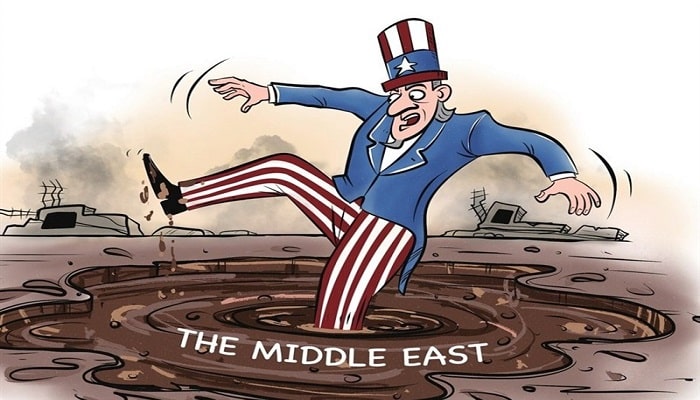
PNN – The initial attacks on Iran, designed for a quick victory, have now turned into a full-blown quagmire.
According to the report of Pakistan News Network, the Global Times newspaper, in an article titled “Is America sinking into the quagmire of another uncontrollable war?”, examined the new war against the Islamic Republic and wrote: The conflict between the US, Israel and Iran has entered its fourth week. What initially began as lightning “lethal strikes” against Iran aimed at achieving a quick victory is now turning into a full-blown quagmire.
The US has postponed attacks on Iranian power facilities, citing “constructive” talks to end the war, according to CGTN. However, observers are wary of the move, considering it merely a temporary measure; the White House appears to be reluctant to escalate the conflict at this point. As of press time, Tehran has not confirmed any talks with the US.
On Monday, mainstream American media outlets expressed deep concern that Washington could lose control of the war. The Associated Press reported that the United States is considering a range of difficult options to resolve the Strait of Hormuz crisis, from trying to secure the waterway to lifting sanctions, to even directly threatening civilian infrastructure in Iran.
The Economist has also explicitly stated that the US has “four bad options” in a war with Iran. Negotiation is considered the most unlikely option, as the two sides have almost no trust in each other and are unwilling to make concessions. A unilateral declaration of victory would leave Iran in a position to continue to block the Strait and access its stockpile of enriched uranium.
Continuing airstrikes for several more weeks could lead to an Iranian attack on critical infrastructure in the Persian Gulf. Escalating the conflict, including an amphibious operation to seize Kharg Island, also carries additional risks. The bottom line is that none of these options will necessarily end the war.
In the past four weeks, missiles have been fired, oil prices have soared, civilians have died, and there is still no clear vision of an end to the war. Washington can threaten to attack and then postpone it, but there is no sign of a concrete plan of action for a ceasefire.
The initial “suppressive” strikes on Iran on February 28 were initially seen as a “decisive victory” for the United States, but the situation has now changed. Analysts point to a paradox: on the one hand, the strikes were “too successful,” as they eliminated key figures and made the path to negotiations more difficult; and on the other, they were “not successful enough,” as the IRGC’s command structure remained intact. This has allowed for continued missile and drone strikes, targeting infrastructure, and pressure on the Strait of Hormuz, pushing the United States and Israel toward a war of attrition.
Even if Washington seeks to exit the situation, it will still need Iranian-Israeli coordination. Iran sees the conflict as a vital battle for survival and has lost confidence in negotiating with the United States after assassinations and heavy casualties. In contrast, Israel continues to escalate its attacks, which observers say limits the possibility of a quick American withdrawal.
In Washington, the debate over ground operations in Iran is in full swing. At least 2,000 Marines from the 31st Marine Expeditionary Unit, based in Japan, have been deployed to the Middle East, and another 2,500 from the 11th Marine Expeditionary Unit, based in California, are scheduled to deploy aboard the USS Boxer in April. There have also been reports that the 82nd Airborne Division is preparing to deploy to the region.
The United States is reportedly eyeing Kharg Island, a key hub for Iranian oil exports. The Wall Street Journal reported, citing experts and former officials that seizing the island could be used as leverage to reopen the Strait of Hormuz.
However, the plan has faced opposition within the United States. Former counterterrorism official Joe Kent has warned that such a move would effectively leave American forces vulnerable to attack.
Whether a limited operation in Iran could achieve the results Washington seeks remains to be seen. However, historical experience is significant: In 2003, the United States invaded Iraq, claiming it had weapons of mass destruction, but after a swift military victory, no such weapons were found, and the resulting instability lasted for more than two decades, with heavy political and reputational costs.
Regarding Iran, the United States is now facing a complex situation; on the ground, Iran is resisting with great determination, and domestically, public support has declined and some allies are distancing themselves.
Ultimately, the United States faces a strategic dilemma: on the one hand, it is concerned about being drawn into a full-scale war, while on the other hand, it is unwilling to lose its influence in the Middle East; on the one hand, it seeks to completely weaken Iran, while on the other, it avoids the costs of it. Starting a war may be easy, but ending it is an entirely different matter.