
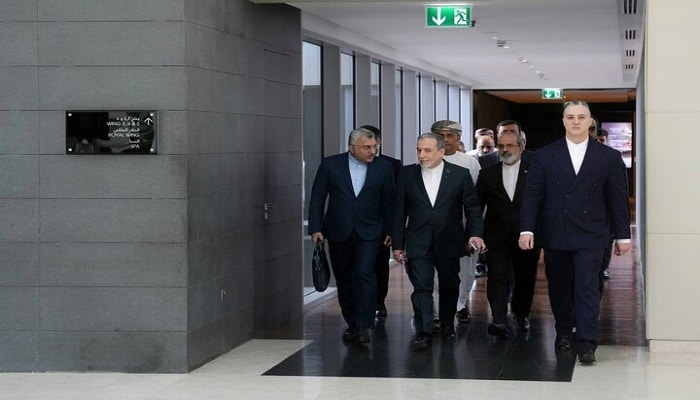
PNN – The United States is negotiating with Iran in Muscat over something it had previously claimed to completely destroy, and in return, Iran has not caved in to pressure from the other side.
According to the report of Pakistan News Network, Al-Mayadeen News Network, referring to recent regional tensions resulting from US threats against Iran and the start of Muscat talks, wrote that After the 12-day war, Tehran realized that its nuclear, political, and military capabilities, along with its regional and strategic support, gave it a wide margin and allowed it to determine the scope of the talks at its table.
Therefore, the 12-day war redefined the power equation between the two sides and imposed Iran’s conditions and influence on the regional balance of power.
Al-Mayadeen added that today the US is negotiating with Iran over something it previously claimed to have destroyed. On the other hand, Israeli Prime Minister Benjamin Netanyahu also knows that he has lost the 12-day war as “Israel’s existential battle.” In this arena, the Islamic Republic of Iran has turned its nuclear program into an effective lever of pressure and has the ability to play an active role in indirect international negotiations with Washington in Muscat. Tehran’s strategy forces Washington to sit at the negotiating table on its terms, thus challenging the military pressure and sanctions that Washington imposes on it.
Therefore, Iran’s insistence on limiting the scope of negotiations to the nuclear issue is a negotiating position to facilitate the lifting of US sanctions. This is effectively pursued by preventing the expansion of the negotiation scope to include other issues such as regional allies and its missile program.
On the other hand, the Islamic Republic of Iran’s position as a party willing to negotiate and advance diplomatic paths exposes Washington to increasing international pressure for any hardline action against Iran.
Why are Iranian missiles out of the scope of negotiations?
After discussing the impact of the 12-day war on Iran’s power structure and the imposition of Tehran’s condition on the nuclear file in the negotiations, the question may arise as to why Iran does not accept the presence of its missile program in the negotiations at all.
According to Al-Mayadeen, the nuclear dossier is a structured negotiating framework that is linked to existing international agreements and clear mechanisms that allow for the linking of nuclear commitments to the lifting of US sanctions against Tehran. In contrast, Iran considers its missile program part of its defense doctrine and national sovereignty and refuses to put it on the negotiating table because it directly jeopardizes its national security.
Furthermore, bringing the missile program into the negotiations expands the scope of the US-imposed conditions and complicates the path to understanding, while limiting the discussion to the nuclear issue limits the scope of negotiations within a single diplomatic arena.
Has Iran excluded the issue of regional allies from the negotiations?
The US option of negotiating with Iran regarding its regional allies is considered a blackmail card and an infringement on Iran’s sovereignty, and for this very reason, Tehran has not included it in the framework of the negotiation files. As long as the relationship between Tehran and its allies is based on shared ideological approaches and strategic choices, Washington’s attempt to treat Iran’s allies as “pressure cards or negotiation files” is a wrong and tension-generating option.
Why is Iran limiting negotiations to the nuclear issue?
The failure of America’s ongoing efforts to change Iran’s governance, or to make fundamental changes to it, especially in light of the recent armed uprisings, has given Iran a greater ability to enter into negotiations.
Limiting negotiations to the nuclear issue redefines Iran’s powerful position in terms of sovereignty, both domestically and internationally, and is a challenge to the influence of the United States, which always seeks to impose its conditions on others.
Al-Mayadeen concluded by stating that whatever result is reached from these negotiations, it will lead to a fixed truth, which is that the Islamic Republic of Iran succeeded in imposing its conditions, resisting various pressures, and ultimately reaching a clear equation.