
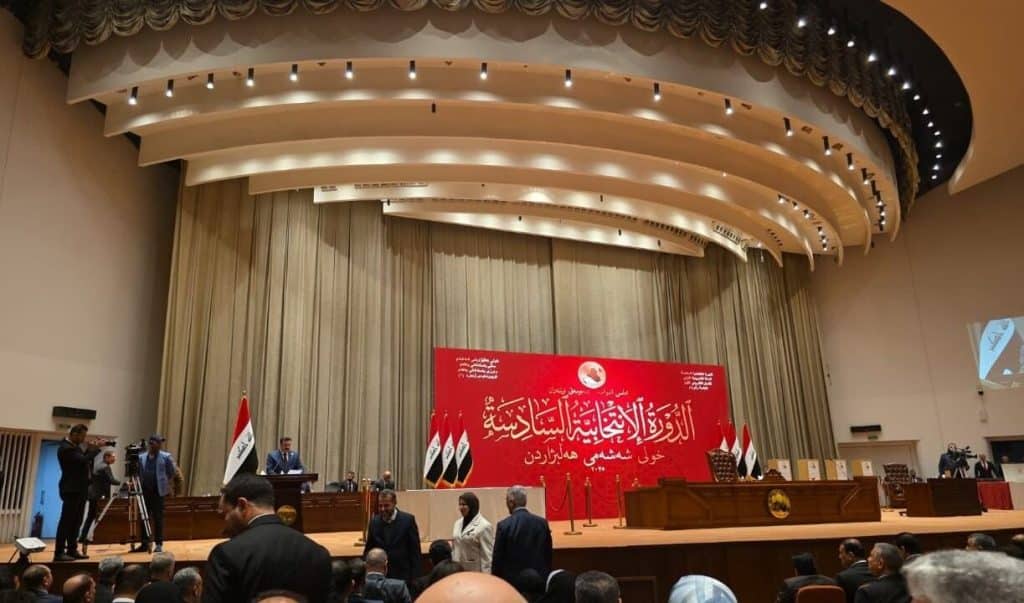
How is the Iraqi president elected by parliament?
According to Al-Ma’alumah News Agency, Mahmoud Khoshnaw, a member of the Patriotic Union of Iraqi Kurdistan, said: The main Kurdish parties, the Patriotic Union and the Democratic Party, have not yet reached an agreement on a candidate for the presidency.
He added: Efforts are underway to bring the views closer and determine the presidential candidate in line with the timetable set out in the constitution.
Khoshnaw continued: The Patriotic Union has two options: first, the Democratic Party supports the Patriotic Union candidate, which we hope will happen, especially since it will also pave the way for the formation of a regional government; second, there should be serious mobilization to support our candidate through internal political groups in parliament.
Al-Tamimi: The candidate who gets 220 votes is the president
On the other hand, Iraqi legal expert Ali Al-Tamimi said: The election of the Iraqi president primarily depends on political agreements between political groups. The law has set a clear time limit for determining the presidential candidate, and it should not be disrupted.
He described the presidential election as a major obstacle and added, “There is little time for Kurdish parties to nominate a candidate for the presidency. The candidate who gets 220 votes in parliament will become president.”
Al-Tamimi emphasized: “Clarifying the position of the president paves the way for completing the process and ending the political stalemate in the country.”
The role of political understandings in completing the presidential election
On the other hand, “Susan Mansour,” a former member of the Iraqi parliament, said: “The deadline for nominations for the presidency ends today, Monday. Political understandings are certainly important in determining the position of the presidency.”
She added: “The Patriotic Union of Kurdistan is aware of the position of the presidency, so it will nominate a capable person for this position to strengthen Iraq’s position and its pivotal role in the region.”
The process of electing the Iraqi president in parliament
The parliament will hold a special session to elect the president. For the session to be legal, the presence of two-thirds of the parliamentarians is required.
In the first round of voting, the candidate must obtain two-thirds of the votes of the deputies present, as required by the Iraqi constitution.
Second round of voting (if necessary): If no candidate wins in the first round, the race goes to a second round, and the two candidates with the most votes compete against each other. In this round, the candidate with the most votes becomes president.
After obtaining a majority of votes, the new president is declared and officially takes office by taking the constitutional oath.
The presidency is traditionally a Kurdish political office. The presidential term is four years and can be renewed for only one more term.
According to the Iraqi constitution, the president must be elected by a two-thirds vote of the parliament; a quorum of 220 votes out of a total of 329 seats, which requires broad consensus among political blocs.
This mechanism allows political rivals to delay or obstruct the election process.
According to the post-2003 political convention, the presidency is reserved for Kurds, the prime minister for Shiites, and the speaker of parliament for Sunnis. However, the entry of several independent Kurdish candidates into the race has raised doubts about the ability of the Kurdish bloc to agree on a single candidate.
After the president is elected by parliament, he or she is required to appoint the candidate of the largest parliamentary faction to form a government within 30 days. The proposed cabinet must then receive a vote of confidence from parliament.