
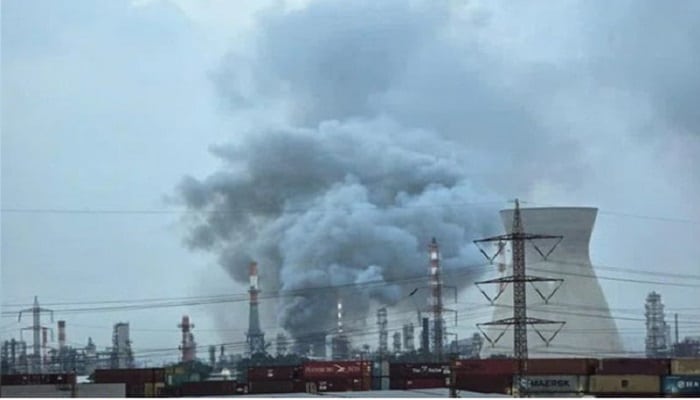
PNN – Tensions between Iran and Israel have accelerated as targeting moves to the heart of critical facilities, with images showing a massive fire at the Haifa refinery, while Israeli accounts have been contradictory and talk of media censorship regarding the extent of damage has increased.
Israeli media reported a direct hit by an Iranian missile on the refinery, while the Israeli military confirmed shrapnel had landed in the north of the country. The developments coincided with a wave of rockets being fired towards Haifa, Tel Aviv and Ashkelon, amid the continuous sounding of emergency sirens.
In this context, Al Jazeera’s correspondent announced that images released from inside Israel show a large fire in the heart of the Haifa refinery, one of the most important strategic facilities related to the energy and petrochemical industries. The refinery is on Iran’s list of specific targets and has previously been the target of similar attacks, especially with an increased focus on the Haifa Bay area, which includes vital industrial infrastructure and a strategic port.
The latest attack has a new qualitative characteristic, using fragmentation or cluster missiles, which cause multiple warheads to land in and around the city, rather than just one. These types of missiles confuse Israeli air defense systems because they are very difficult to intercept completely, allowing the warheads to hit multiple targets even if the missile is partially intercepted.
Sensitive oil infrastructure
The bombing has also spread to other sensitive areas, with sirens sounding in Ashdod and its port, as well as in Ashkelon, where the oil terminal is located. This indicates a systematic targeting of energy infrastructure in Israel.
The targeting of Ashkelon is linked to the oil pipeline that runs from Eilat to the coast, a historic pipeline used to transport oil imported from Iran before the 1979 revolution. In addition to its strategic importance, the choice of this target also has a symbolic dimension.
In analyzing the nature of this escalation, it can be said that Iran has switched from the tactic of “missile saturation” to “precise and effective attacks,” such that now a single missile can cause widespread destruction.
The gap between the reality of field injuries and the Israeli narrative
However, the striking point is not limited to the nature of the attacks, but also to the “gap between the reality on the ground and the official Israeli narrative,” in a situation where military censorship limits the publication of details of the damage. Past experience has shown that Israel has been slow to acknowledge some sensitive attacks, such as those targeting air bases and Ben-Gurion Airport, and some damage has only become apparent days later.
The incomplete data available indicates the accumulated volume of damages; so much so that more than 12,000 compensation claims have been registered so far, indicating the extent of damage to property.
High cost of damages
To date, approximately 8,000 buildings have been damaged by rocket attacks, most of which are concentrated in the Tel Aviv and Ashkelon metropolitan areas, a matter that represents a high financial cost and places significant pressure on the Israeli economy and society. Of course, these figures are still preliminary, as the responsible institutions have not yet been able to conduct a complete assessment of the damage; therefore, there is a possibility that the extent of the damage will increase as field surveys continue. In this regard, the continued targeting of critical facilities and infrastructure will increase domestic pressure, not only in economic terms, but also in terms of public confidence in the capabilities of the defense system.
In contrast, Israeli Energy Minister Eli Cohen described the damage as limited and insignificant, and spoke of the power being restored, in an attempt to contain the fallout from the attacks on Israeli public opinion. However, the Israeli media’s focus on damage to residential areas, compared to the lack of detail about military and strategic sites, reinforces the hypothesis of “selective censorship” regarding the damage to Israel.