
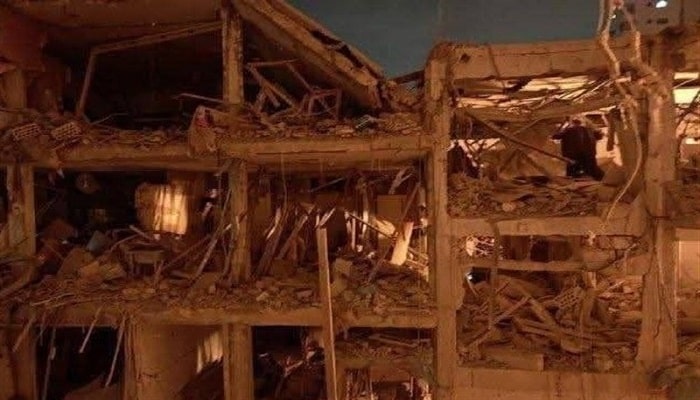
PNN – Iran’s devastating attacks on the most protected areas of the occupied territories destroyed the myth of Israel’s “absolute security.”
According to the report of Pakistan News Network, the fragility of the sense of security on the Israeli home front has been revealed again with the fall of an Iranian missile in the heart of a densely populated neighborhood in the city of Arad in the south of the occupied territories last Saturday, where extremist Zionists live.
Anger and despair on the Israeli home front after Iran’s missile attacks on Dimona and Arad
The intense Iranian missile attacks, which targeted Dimona in addition to Arad, resulting in widespread casualties and the destruction of homes, exposed a deep gap between the Israeli military’s assessments and the realities on the ground. These attacks, especially given the continued and escalating Iranian missile attacks, which contradict the claims of the occupation regime and US President Donald Trump that Iran’s missile capabilities have been destroyed, raised serious questions about the regime’s ability to protect settlers.
In this context, the Hebrew newspaper Yedioth Ahronoth reported growing frustration within the Israeli military establishment due to their previous bets on a quick victory that would curb Iran’s missile capabilities.
Israeli military officials, speaking to the newspaper, expressed their disappointment that these bets had not been fulfilled and criticized the intelligence assessments. This comes as questions have begun to arise about the IDF’s ability to prevent a repeat of its failures to intercept missiles, especially after the Iranian attack on Arad, which sent shockwaves across the city, turning it into a scene of destruction and fear.
According to the Israeli accounts, a missile that landed among settler buildings resulted in 182 injuries and the destruction of an entire neighborhood, while hundreds were forced to flee to hotels in the Dead Sea area, Al-Akhbar reported. It should be noted that these figures are not accurate, as Israel maintains a strict media silence on the results of the Iranian attacks and the army has tight control over the media.
The shelter is no longer safe for the Zionists.
A settler in the city of Arad recounted the initial moments of the attack: I chose a corner that I thought was the safest, before I heard a huge explosion. The house shook and the windows flew over my head. I was paralyzed and could not move, but I realized that I was not injured. But the anger did not subside… They prevented me from returning to collect my belongings, while politicians rushed in to take pictures.
The settler, named Amos, expressed concern that he would suffer the fate of refugees from previous rounds of conflict who were caught up in complicated bureaucracy, and wondered whether the authorities would learn from this experience this time.
He emphasized that the situation in the shelters was no better.
Another settler who was in a shelter when the city of Arad was bombed described the explosion as unprecedented and warned that the loss of confidence in warnings could be fatal, as some people did not even go to shelters after losing faith in the effectiveness of repeated warnings.
On the other hand, Zionist experts and analysts considered what happened in Arad and Dimona a sign of the fragility of the civil defense system. According to reports by Israel’s Channel 12 and Channel 14, the Israeli army did not clarify the nature of the interception system that failed to intercept the missiles, describing the incident as a “statistical error,” while the facts point to a significant military and technical failure.
Amir Bouhbut, a Zionist military analyst, strongly criticized the discrepancy between the statistics provided by the army and the field reality, saying: The army’s claim about a 92 percent success rate in intercepting missiles and the field reality are very different; moreover, the feeling of security is not measured by these statistics and percentages, but rather by the ability of citizens (settlers) to survive in times of danger.
There is no safe place in Israel.
Zionist satirist Amir Sheparling, for his part, expressed the shock felt by the residents of the city of Arad, saying: For months during the war, Arad was peaceful and quiet… and now it has been added to the list of target cities, and the feeling is that we have lost the protection of the city.
The Hebrew press also showed scenes of settlers shouting at officials, including a woman in Arad who, during Itamar Ben-Gwer’s visit to the city, reflected the occupation’s internal security presence, where the Zionist woman told Ben-Gwer: You only sow death! Get out of our city.
Activists and social media users also angrily accused the Zionist leaders of “deceiving the people” and placing them in a repeated cycle of danger, pointing to the decline in public trust in the cabinet’s ability to make effective decisions to protect them.
But in Dimona, which was hit by Iranian missiles, several residential buildings were destroyed and dozens of settlers were injured, confirming that the danger is no longer limited to specific areas, but has now spread to cities that were considered relatively safe.
Haifa Mayor Yona Yahav described the situation as a “ticking time bomb” and called for the closure of oil refineries to ensure the safety of residents. Zionist analysts argued that the attack exposed a weakness in balancing public security demands with political interests.
Despite statements by Israeli Prime Minister Benjamin Netanyahu about his readiness to continue the operation and protect the home front, nearly a thousand displaced residents of the two towns expressed a sense of collapse and loss of trust in the government institutions even hours after the attack. Opposition leaders, including Yair Lapid, also strongly criticized Netanyahu’s government and its establishment.
On the economic front, Israel continues to incur significant costs in this war. Official estimates indicate that the cost of a single day of operations against Iran is between 1.5 and 3 billion shekels (Israeli currency), especially given the huge amount of ammunition and interceptor missiles consumed, compared to the previous 12-day war with Iran.
According to Hebrew sources, the Israeli cabinet has so far allocated approximately 28 billion shekels to finance its operations, with another 4 billion expected to be added. The defense budget also needs approximately 33 billion more shekels to continue the war this year. It should be noted, however, that these figures do not include any potential ground operations in Lebanon.