
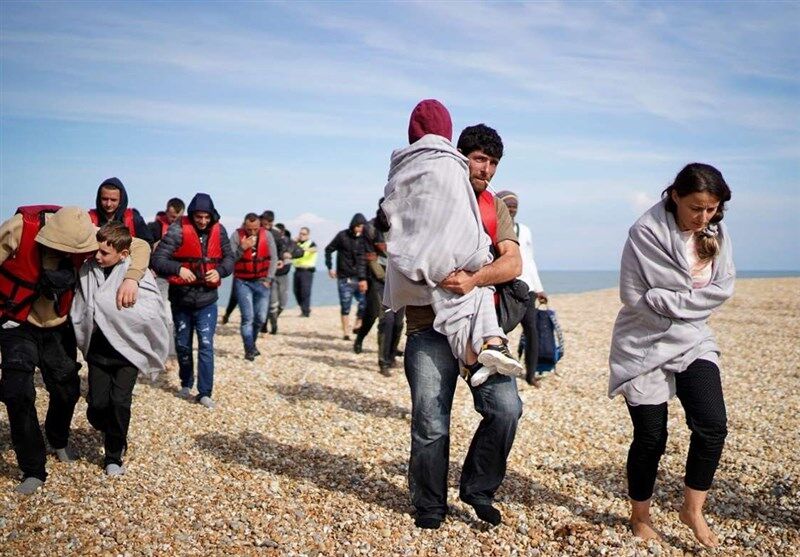
Little desire among Syrians to return to their country.
According to the newspaper Die Welt, the review of Syrian nationals’ cases is part of what the Berlin government calls a major shift in immigration policy, with the federal and state governments preparing deportation flights to Damascus and the Interior Ministry even negotiating with the Syrian interim government.
Last Tuesday, for the first time since the start of the civil war in Syria in 2011, a Syrian criminal was deported from Germany and handed over to the authorities in his country. Since the end of September, the Federal Office for Migration and Refugees, on behalf of the Interior Ministry, has been processing thousands of Syrian asylum applications in Germany, of which several hundred have been rejected so far.
German Interior Minister Alexander Dobrindt has emphasized the deportation of refugees and border controls, saying, “Who else but the Syrians should rebuild Syria?”; a sentence that expresses the basic approach of the German government, but do Syrians living in Germany share the same view?
There are currently around 950,000 Syrians living in Germany, and they seem to be less inclined to return to their war-torn homeland.
According to Die Welt, by the end of October, only around 3,000 Syrians had left Germany voluntarily and with financial assistance. It seems that many are waiting to see whether the security situation in their country will stabilize. In addition, anyone who travels to their homeland may put their residency status in Germany at risk, so it is primarily Syrians of German origin who travel to their homeland. They can return at any time without jeopardizing their status.
Around 250,000 Syrians have received German passports in recent years, and more are expected to join this group in the coming years.
What does the Syrian doctor say about his country?
Firas al-Aseel, 52, who lives in Dortmund, Germany, came to the country in 2005 to train as a specialist and refused to return to his homeland when Syria was engulfed in civil war.
He opened a clinic in Dortmund in 2020 and has been practicing medicine since then, receiving German citizenship and raising his children there. For more than a dozen years, he followed news from his war-torn homeland only from afar.
Now the orthopedic surgeon, who is traveling with his family to his country, says he wants his children to know about his family roots and plans to apply for Syrian passports for them.
In February of this year, he traveled to his hometown of Abu Kamal in eastern Syria, near the Iraqi border, for the first time.
The Syrian-born doctor says terrorist groups have long dominated the area, which is “still very insecure.”
Using the donated funds, Al-Aseel has provided 80 beds for a local hospital. A member of the German-Syrian Association of Aid Organizations, he has started working with Syrian institutions to help his country’s healthcare sector.
“The healthcare system in his country is in ruins, and the conditions are like medieval times,” he adds. People are deprived of the most necessary necessities of life, and many heart patients need surgery.
So far, they have been able to equip one floor of the hospital, where eight doctors work. Their salaries are paid through donations, and the interim government still does not pay regular salaries.
According to a report by the German Bundestag published at the end of August, the situation in Syria is fragile and still resembles a “powder keg” after the civil war.
The report states that “the massacres of the Alawite, Druze and Kurdish minorities in Syria have occurred repeatedly and that the involvement of soldiers of the current Syrian army, government-affiliated militias and Syrian security forces in massacres and human rights violations is a common occurrence.”
Die Welt had previously reported that border controls had been re-established at all German land borders from September 16, 2024 (25 Shahrivar); a situation that had previously existed at some borders.
The German Interior Ministry has ordered that the country’s borders be strictly controlled to further curb the illegal entry of refugees. These controls were initially imposed for a limited period, but these strictures have been extended again until mid-March 2026 (Faryab).
Immediately after taking office in May 2025, German Interior Minister Alexander Dobrindt tightened controls imposed under the previous coalition government, ordering the country’s police to no longer accept asylum seekers except for members of vulnerable groups, such as the sick or pregnant women.