
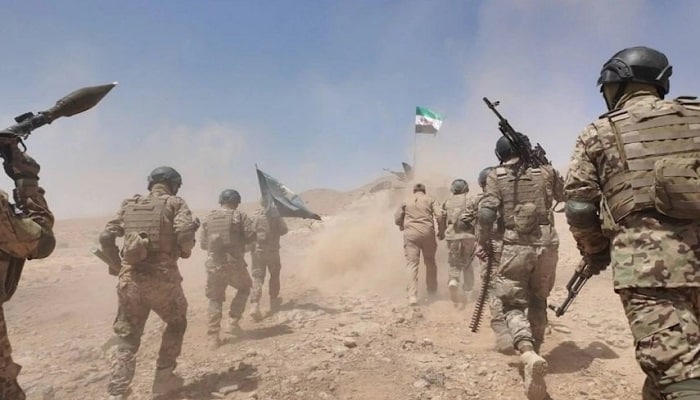
PNN – Since the coming to power of the interim president of Syria, Abu Muhammad al-Julani (former leader of the Hayat Tahrir al-Sham, an offshoot of the al-Qaeda terrorist group), news has occasionally been published in the media regarding the new Syrian government’s intention to launch a military attack on Lebanon or participate in a possible attack by “Israel.”
According to the report of Pakistan News Network, the electronic publication Al-Akhbar published an analytical article written by Firas Al-Shufi, writing: Since the coming to power of interim Syrian President Jalani, news has periodically appeared in the media regarding the new Syrian government’s intention to launch a military attack on Lebanon or participate in a possible Israeli attack. These reports have recently become widespread media campaigns and stem from the waning control of the Kurdish militia known as the “Syrian Democratic Forces” over Hasakah province and the city of Kobani in Aleppo, as well as government control over western Aleppo, Raqqa, and Deir Ezzor.
The rapid takeover of areas controlled by the Syrian Democratic Forces by the Golani government has led some to conclude that these forces have the military capability to carry out large-scale operations of this type, and that US President Donald Trump’s support for his government, amid Iran’s threat of war, may be international cover for an attack on Lebanon and targeting Hezbollah from the eastern borders.
Furthermore, Golani’s negative view of Lebanon and its calls for reform of previous agreements are undeniable.
But the point is that these narratives ignore the concrete realities on the ground in Syria. The Syrian interim government lacks the capacity to carry out a large-scale military operation. An examination of the events in the coastal region in March 2025, in Sweida in July 2025, and in Aleppo and the Syrian island region in January 2026 shows that the Syrian government itself did not take action with its heavy weapons and formations, but rather the tribes, and especially the “Sunni forces” who consider themselves the shield of the new government, did so.
Compared to the various armed forces of the former Syrian regime, the current Golani forces are no more than a fifth of the former armed forces – equivalent to approximately one hundred thousand people. They are scattered across most of Syria, with the exception of parts of Sweida and Hasakah. Most of these forces (except for former members of Hayat Tahrir al-Sham) are newly recruited forces who have undergone short and rapid training courses and are not capable of conducting large-scale military operations.
In addition, there is a severe shortage of weapons and ammunition, especially artillery, tanks, and air power in Syria. Turkish support has been limited to light armored personnel carriers, and Russia has yet to provide ammunition or spare parts to maintain the weapons remaining from the former Syrian army.
Although Trump continues to support Golani and even recently stated that he has effectively appointed him, his stance stems from a desire to silence criticism until a full withdrawal of US forces from Syria allows him to declare another success in achieving peace and ending another war.
In this context, American media reports that the complete withdrawal of American troops will take two months. Will Trump still need to defend Golani from criticism after that?
The deployment of military forces along Lebanon’s eastern border is one of the most important indicators of the importance of this front for the army and its supporters, especially England and the United States, in terms of the military power needed to defend the eastern flank. The border watchtowers and ground regiments were initially formed under conditions of high military risk, especially after the attack by Jabhat al-Nusra and other groups on the Arsal region. The project continues with the aim of expanding control of the entire border with watchtowers, up to the slopes of the Jabal al-Sheikh mountain, supported by a significant military presence in terms of personnel and artillery, and continued US and British support for the ground border regiments.
Therefore, any military action by Golani-backed forces would be in conflict with a regular fighting force defending these locations against attacks by groups similar to the current Syrian government forces.