
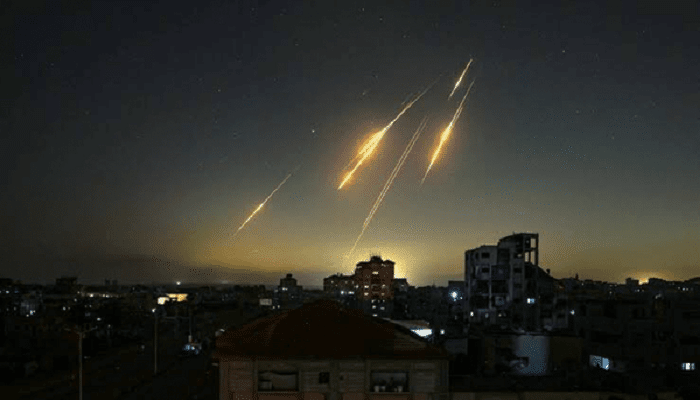
PNN – The barrage of missiles that Iran uses in its attacks on the occupied territories and in response to the Zionist regime’s aggressions disrupts the defenses of the occupied territories, expands the conflict zone, and turns the home front into a scene of continuous psychological and material erosion.
According to the report of Pakistan News Network, the Lebanese newspaper Al-Akhbar, wrote that since the beginning of the Zionist-American war against Iran in early March, the Iranian armed forces have used more advanced ammunition (missiles and drones) in terms of quality and quantity in military operations against the Zionist regime. Field facts show that on March 9, Iran used rocket launchers for the first time in bombing the occupied Palestinian territories, during which an Iranian rocket launcher targeted the Jewish city near Tel Aviv, killing two settlers and wounding several others.
Since then, several such rocket launches have been recorded; on March 15, at least two rockets equipped with cluster munitions were reported to have been fired, injuring eight settlers in different areas. Last night, Israeli surveillance systems failed to detect one of the cluster munitions over Tel Aviv, and its small cluster bombs were scattered over a wide area, killing two settlers and damaging a major train station, buildings and vehicles.
Military reports indicate that Iran uses a number of ballistic missiles capable of carrying warheads, including the Khorramshahr, Emad, Ghadr, and Zolfaghar.
It is believed that the “Khoramshahr” missile is the most dangerous type in this regard – given that it has been used the most in firing at the regime so far – due to its long range and large payload; such that it can carry a warhead weighing between one and two tons and is capable of dispersing a large number of small bombs over a wide area.
It is also reported that some of these warheads are detonated at high altitudes, about 7 km from the target area, to disperse the small bombs they contain over an area of approximately 8 km in diameter, resulting in a relatively wide area of targeting. The weight of each of these small bombs usually ranges from less than 3 kg to around 5 or 7 kg, and they do not cause as much damage as they do to fortified buildings, but they are very effective against people, vehicles and unsecured installations, and may also cause fires, potholes and extensive damage. This was clearly evident in the recent targeting of the Tel Aviv area, where extensive damage and fires were recorded and small fragments were scattered widely.
As for the difficulty of intercepting this type of missile by Israel, the main problem lies in the moment when the warhead opens and a single projectile is transformed into dozens of small targets, i.e. cluster bombs. Therefore, to achieve effective interception, the missile must be intercepted before it breaks up, that is, in the early stage and at high altitude, which makes the Israeli “Haits” system more suitable for this type of threat, given that its missiles are heavy, few and very expensive. However, if the missile reaches the breakup stage, the small bombs become very numerous and scattered, which weakens the ability of radars and traditional systems, including the “Iron Dome”, to deal with them individually.
Therefore, cluster munitions are more complex than conventional missiles for Israeli air defenses, as they force the defenses to achieve early and accurate interception. In contrast, a significant portion of cluster munitions will pass through the various layers of interception and explode on the ground, causing significant casualties. Even if Iron Dome could intercept falling cluster munitions – which it has not yet done – this would mean using dozens of expensive Iron Dome missiles to neutralize the payload of a single cluster munition, without guaranteeing complete results.
Thus, a barrage of missiles does not produce a single moment of fear, but a series of fear loops that begin with sirens, then running for shelter, then waiting for interception, then observing the scattering of shrapnel and small bombs, and finally being wary of unexploded objects after the wave ends. For this reason, Tel Aviv authorities have begun “educating” Zionists about the dangers of these munitions, since “leaving shelters prematurely or approaching their remains can be fatal.”