
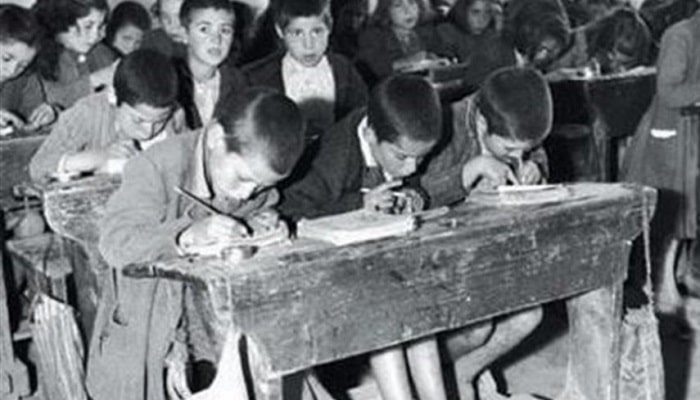
PNN – If there is one big lie to be told about Pahlavi’s record, it would be literacy and education development. The image that is created today of Iran in the 1940s and 1950s substitutes a few frames of a few stylish schools in northern Tehran, postcard-like mothers and students, and a few limited universities for the entirety of Iran; while the official statistics of the Pahlavi regime itself say something different.
After Reza Shah ascended the throne, the government attempted to establish compulsory public education nationwide and submitted a bill to parliament. The parliament allocated half a percent of the land tax revenue to primary education, and then, on the recommendation of the Supreme Council of Education, the French school system was accepted as the model for the country’s schools.
In this model, students had to complete two six-year courses: primary and high school. An office called the General Writing Office was established to compile and publish textbooks, but the designed educational system lacked efficiency and did not meet the needs of Iranian society. The courses offered were very heavy and numerous, and ultimately the education system experienced little growth and was transformed from the old schools into preparatory colleges, and the number of these colleges reached 36.
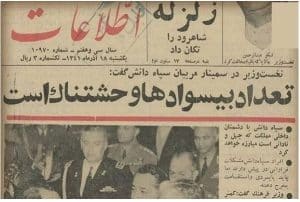
The situation reached such a point that Ayatollah Kamarai, a group of scholars and clerics in Tehran, opposed Mohammad Mossadegh, who was preparing a plan to require voters to be literate, and said: Only 15 out of every 100 people in the country are literate! The headline of an information newspaper shows how dire the illiteracy situation was. The newspaper wrote in its headline: The number of illiterates is terrifying.
The appalling state of illiteracy was also mentioned by then-Prime Minister Asadullah Alam, who said: On one of our trips, we realized that the ratio of literate to illiterate people was appalling. Of course, officials at the Ministry of Culture were also aware of this fact. If we were to wage a fundamental fight against illiteracy, we would need huge amounts of funding, which unfortunately was beyond the country’s means, especially since an extraordinary budget has been added to the Ministry of Culture’s expenditures to increase teachers’ salaries, which was very appropriate.
One of the most scandalous parts of the Pahlavi era was the status of women’s literacy. Less than 18 percent of Iranian women were literate, and the literacy gap between women and men remained in double digits. In rural areas, the majority of women were virtually illiterate, and this was at a time when the government was using media maneuvers to present itself as the standard-bearer of women’s liberation.
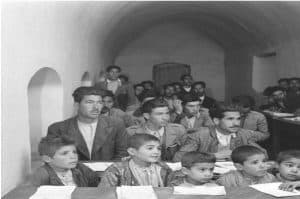
After the Islamic Revolution, however, this educational track changed. The literacy movement, the development of rural schools, nomadic education, and the expansion of universities changed the course. Educational coverage in villages and deprived areas became significant, and the capacity of higher education multiplied.
Pahlavi nostalgia zooms in on the images and hides the numbers, but the numbers don’t lie. Widespread illiteracy was one of the clearest evidences of Pahlavi’s failure to build a nation. A failure that cannot be hidden even with today’s media hype.