
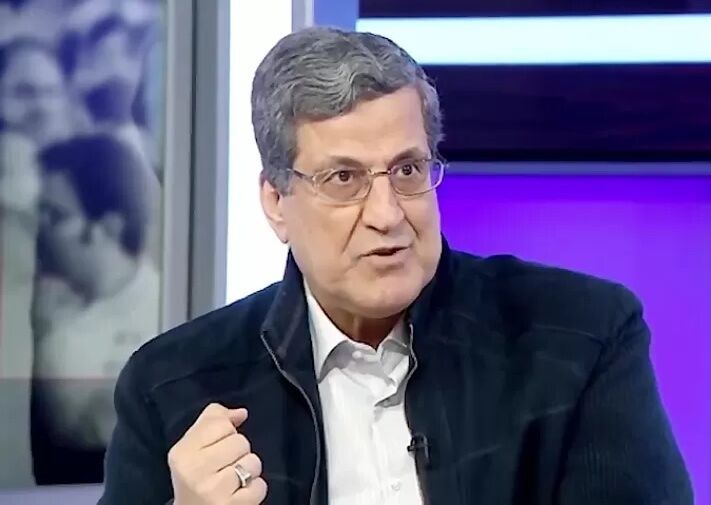
Najah Mohammad Ali: Soleimani contained crises in West Asia.
In London, he stated: “The assassination of General Soleimani in January 2020 was not a tactical event, but a political step with a clear message.” He added that the operation occurred at a time when separatist plans in the region were retreating, and terrorist groups were in a state of obvious weakness and erosion; for this reason, its consequences go beyond the elimination of a field commander.
This analyst of West Asian affairs expressed his perception of the developments of the last two decades as follows: “The developments of the last two decades in West Asia have mainly taken the form of proxy wars and cross-border terrorist networks, not classic wars between countries. A process that exploited social and religious divisions and put pressure on the structure of regional governments.” In this context, he said that the role of martyr Soleimani stood out because he saw security not as a separate issue from politics and society, but as an “interconnected system” in which events in one capital could change the equations of other capitals.
Referring to the US invasion of Iraq in 2003, Mohammad Ali said that from that point on, the region entered a period in which balances were disrupted, state institutions were eroded, and out-of-control armed groups rose to power. In such an environment, the issue was not simply “security” but “existential” in nature. According to him, in that chaotic environment, everything was tied to one question: “Will the state remain stable or will it fall apart and be replaced by fragile and hostile actors?”
The London-based analyst continued that what distinguished Soleimani’s experience was that he “did not treat security as a purely military issue” and instead tried to reconcile the needs of the field with the need to maintain state and governance frameworks.
In explaining this approach, he added that in Iraq, when ISIS overran large areas in 2014, the main danger in his view was not simply the advance of a terrorist group but “the complete collapse of the state, an issue that could plunge the country into a cycle of failed states and pave the way for chronic instability.
Regarding the way in which the crisis was faced, Mohammad Ali said that Soleimani’s role in Iraq did not mean replacing the state, but supporting the state and strengthening it in the field, and this support was pursued through “direct coordination with the state, the military establishment, and the religious authority.” A path that, he said, prevented the repetition of scenarios that led to the collapse of official structures and the spread of chaos in some parts of the region. He emphasized that this difference in approach led to the consolidation of the idea of preserving the state and preventing the security crisis from turning into a state crisis.
The political analyst continued by saying that, contrary to the patterns that lead to the explosion of informal armed forces and uncontrollable competition, Martyr Soleimani sought to regulate the activities of popular groups within clear frameworks; frameworks that, he said, were later embedded in official Iraqi mechanisms. Muhammad Ali, noting that “the legalization of the Popular Mobilization Forces as an official institution affiliated with the Iraqi government after 2016” was a turning point in containing informal forces, explained that this experience showed that it is possible to strike a balance between the necessity of social mobilization against terrorism and the necessity of maintaining the monopoly of government decision-making.
He described another part of Soleimani’s experience as “preventing the conflict from spreading to the regional level,” and said that in a situation where multiple fronts and intersecting provocations could have pushed the region towards an all-out war, he emphasized managing the scope of the crisis and controlling the level of friction. “Despite the multiplicity of fronts, he emphasized keeping the conflicts within limits that would prevent them from sliding into a full-scale regional war,” added Mohammad Ali, and this approach helped reduce the likelihood of major clashes at times.
In another part of the conversation, the London-based analyst addressed the Syrian case, saying that “the challenge was different there, a state threatened with disintegration, dozens of armed groups, and direct regional and international interventions.” He added that Soleimani’s role in Syria was focused on “preventing the collapse of the center” rather than “managing the endless war,” a path that, according to him, aimed to protect the government’s core infrastructure and prevent Syria from becoming a model similar to Libya. A model in which “central power was completely absent” and its consequences continued for years.
Explaining the concept of “interconnected security,” Mohammad Ali said that one of the most important intellectual and practical contributions of Martyr Soleimani was the redefinition of regional security based on continuity; a view in which threats, due to their networked and transboundary nature, cannot be contained by purely local solutions. Stating that “countering terrorism cannot be local while networks are transboundary,” he added that this understanding was applied in the field and played a role in decision-making in successive crises before it became popular in the form of academic theorizing.
The political analyst also said that international reactions to the martyrdom of General Soleimani showed that the elimination of a key player can disrupt fragile security balances. Noting that at the time, “official European and UN statements” expressed concerns about the consequences of the operation on regional stability, he added that these concerns indirectly reflected the magnitude of the role it played in preventing a widespread explosion.
If the experience of martyr Soleimani can be called “unexciting,” Mohammad Ali said, his main legacy is not in the number of battles but in the “crisis management model” that was based on striking a balance between “power and politics,” between “deterrence and restraint,” and between “supporting local actors and preserving state sovereignty.” The London-based analyst emphasized that a region still grappling with the aftershocks of the chaos must study this experience to understand its future; an experience