
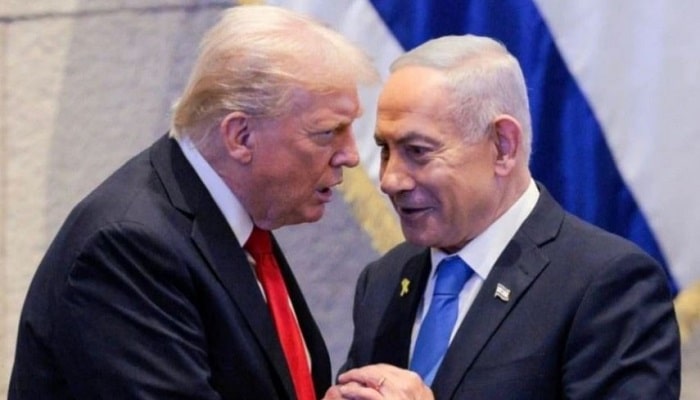
PNN – The Israeli Prime Minister is visiting the United States today (Wednesday) to understand what is going on in American circles regarding Tehran. However, the goals of this trip are not limited to this issue, but rather an attempt by him to exploit his personal relationship with Trump and pressure him to resort to a military option against Iran.
Israeli Prime Minister Benjamin Netanyahu’s goal in traveling to the United States is to influence President Donald Trump’s decisions regarding Iran in line with the regime’s interests, but it seems that Washington ultimately prioritizes its own interests over Tel Aviv’s interests regarding Iran.
The Lebanese newspaper Al-Akhbar published an article written by Yahya Dabouq and wrote: Netanyahu has traveled to Washington with the aim of understanding what is going on behind the scenes in American circles regarding Tehran. However, the goals of the trip go beyond this, and he seeks to use his personal relationship with Trump to advance his preferred option against Iran.
The current ambiguity in the US position towards Iran is not only due to the US government’s desire to not reveal its intentions, but also due to the possibility that a decision regarding Iran has not yet been finalized in the White House’s decision-making circles.
On the other hand, Israel acknowledges that it is trapped in a state of strategic impotence that prevents it from engaging in a full-scale conflict with Iran without full American support. Even the smallest Israeli military operation against Iranian targets is dependent on at least three American conditions. These three conditions are: intelligence capabilities to penetrate Iranian defenses, logistical and operational management to carry out the attack, and the ability to contain any response from Tehran.
Therefore, Netanyahu’s trip to Washington is a preemptive attempt to influence the decision-making process in Washington and an attempt to impose Israeli conditions on the negotiating table, because any agreement that does not take these conditions into account would, in Tel Aviv’s view, be a “security disaster” for it.
Although Netanyahu has room to maneuver to influence Trump based on his personal relationships and political achievements, this influence is still conditional on two conditions: first, the alignment of Israel’s demands with American interests, and second, the assessment that the benefits outweigh the costs, especially the political cost to Trump and his standing in America.
In any case, while carefully considering the interests of its ally Israel, the United States ultimately does not base its foreign policy on Israeli calculations. Therefore, the decision—whether war, negotiation, or a combination of the two—will remain fundamentally American, a fact that Netanyahu understands well.
While Israel sees Iran as an “existential” threat that requires a “decisive and comprehensive” stance, the United States may decide to pursue “gradual” or limited solutions (with Iran) that serve its broader interests.