
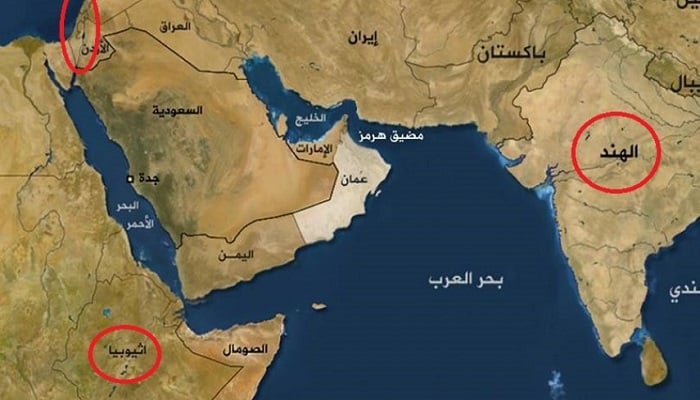
PNN – The ancient dream of Zionism has always been tied to the slogan “From the Euphrates to the Nile”; a slogan that symbolizes the greed for domination of the heart of the Middle East and expansion of influence in the region; but today, it seems that this slogan has changed in the political discourse of the Israeli regime.
This change not only reflects the expansion of the Zionist regime’s expansionist plans in the region’s geography, but also represents a fundamental transformation in the regime’s approach from occupying territories to controlling global networks of power, resources, and strategic routes.
In his recent speeches, Israeli Prime Minister Benjamin Netanyahu has used the slogan “From India to Kush,” a phrase that reflects not only a geographical shift, but also a strategic shift in the Israeli regime’s perspective.
The phrase “from India to Kush” is not just a geographical shift, but rather an implicit declaration of a new strategic vision for the Zionist occupation regime.
This phrase links India as a technological and defense power in East Asia and “Kush” or Ethiopia as a region rich in mineral and water resources in southern Africa.
“Israel,” meanwhile, introduces itself as the connection point and communication corridor of this network, and in fact, this phrase indicates the transition of the approach of the leaders of the Zionist regime from the logic of state-centered restriction to the logic of controlling global networks of resources and nations.
Is the Kingdom of “Cush” a Symbol of the Torah’s Dream or a Threat to Humanity?
In biblical texts, “Cush” is not just a peripheral territory, but a symbolic and vast space associated with the water resources and natural wealth of this planet.
In the Book of Genesis, the Jewish nation of Cush is introduced as part of the founding geography, and in the Book of Isaiah, it is described as a remote land connected by rivers and water sources; therefore, Cush is not just southern Africa, but the biblical borders for the Torah dream.
It is worth noting that the use of the biblical name “Cush” instead of its modern name, Ethiopia, in recent remarks by Israeli Prime Minister Benjamin Netanyahu indicates a shift in the regime’s approach from a political map to a “civilizational map” where geography is understood as a vast space beyond national borders.
It is important to note that, in today’s geopolitical reading, “Kush” encompasses the water resources of the Nile River, gold and precious minerals, as well as the features of the Horn of Africa and the Red Sea. This issue is very sensitive for Egypt, because the Nile is not only an economic resource, but also the existential backbone of this country.
Any influence or strategic presence of the Zionist regime in the territory of “Kush” could indirectly affect the water, energy equation, and stability of Egypt’s population.
But India, as a growing power in technology, defense, and artificial intelligence, is considered Israel’s new strategic partner.
“Israel”, meanwhile, introduces itself as a connecting point and a historical and communicative corridor between natural resources and technology; and in fact, this phrase transforms from a geographical description into a strategic-symbolic narrative that indicates a transition from logic of limited sovereignty to logic of control over global networks of human resources.
The breadth of great powers
Of course, this expansion of influence cannot be understood outside of the competition between great powers, because the Chinese have been rewriting the map of global trade for more than a decade with the “Belt and Road” project, focusing on ports and sea routes in East Africa and the Red Sea.
China’s presence in Pakistan, Djibouti, and East African ports has made it a central player in the equation of connecting Asia and Africa.
In this context, India plays an important role as Beijing’s geopolitical rival in South Asia, and this is where the role of expanding the Zionist regime’s relations with India becomes more and more important, and just when “Israel” stands next to India, it enters the equation of a broader balance against China’s expansion; therefore, the phrase “from India to Kush” is part of the global competition over communication routes and networks, and not just a change in the Zionist regime’s regional position.
America’s role in the logic of controlling global resource networks
This stance cannot be separated from the US strategy to contain China and redistribute its responsibilities in the Middle East; within this framework, Israel, as a center of advanced military technology and a connecting point between the Mediterranean Sea and the Persian Gulf, is able to integrate into a broader network of Indo-Emirati-Western alliances.
Therefore, “From India to Kush” should also be interpreted as part of the American network to rearrange the balance of power in a multipolar world.
The Torah and the Bible’s view of the term “Kush” and its fundamental difference from political discourse
It is worth noting that the Zionist regime’s slogan “From the Euphrates to the Nile” belonged to the era of domination and occupation of the land, but the regime’s new slogan “From India to Kush” belongs to an era in which dominance is measured by controlling political, military, and economic flows; as well as data and information technology, energy resources, sea routes, artificial intelligence, and water resources.
Of course, the biblical dimension of the phrase “Kush” in the new slogan of “Israel” has not only not been eliminated, but has been redefined to give symbolic depth to the contemporary project.
“Kush” is invoked not as a territory, but as a name with historical and symbolic significance, to give internal legitimacy to the political discourse of the Zionist occupation regime and to show that this expansion is not a temporary policy, but a historical continuation.
It should be noted that, according to the Christian Bible, the migration of humans to other parts of the world began in the city of Babylon in the land of Shinar, which is now called Iraq. The descendants of Japheth migrated to the continents of Europe and Asia, and the descendants of Ham went to Africa.
Netanyahu and the changing framework of thinking and problem-solving
It is worth noting that by expanding its expansionist plans, the leaders of the Zionist regime are not only seeking to expand the geographical area and region under their occupation, but also are seeking a fundamental transformation at the level of the “international law-based order”, from competition over borders to competition over flows, from military geography to transcontinental network geography.
Also, in the slogan “From India to Kush,” the difference is not in the distance of regional geography, but in the nature of control over global networks of power, from borders that are seized to networks of resources that are managed, from the geography of the Torah that is reclaimed to the strategic geography that is redefined at the heart of the new world order.