
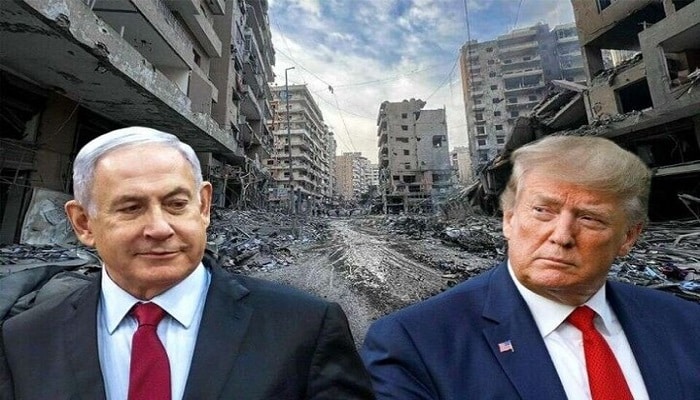
PNN – The “Gaza Peace Commission” initiated by Trump has become a symbol of the complexities of international politics, the crisis of legitimacy of international institutions, and the competition between global powers, rather than a practical solution to the Gaza crisis.
In recent years, the Gaza crisis, as one of the most complex regional conflicts in the world, has always been the focus of attention of politicians and international institutions. However, official efforts to consolidate the ceasefire and rebuild the region have often been met with failure and widespread criticism. In this context, the formation of the “Gaza Peace Commission” was initiated by۔
Donald Trump has been presented not only as a peacemaker but also as a symbol of power competition and the crisis of legitimacy of international institutions. The delegation was introduced with the official goal of rebuilding Gaza and advancing peace, but from the very beginning it was met with negative reactions, regional and international skepticism, and serious criticism from local stakeholders. An examination of the structure, composition of members, goals, and outcomes of this initiative provides a picture of the complex challenges of international politics and the limitations of unilateral tools for resolving regional crises.
Board structure and composition
The Gaza Peace Commission, officially recognized as an international body, is comprised of prominent political, economic, and diplomatic figures. The commission is headed by President-for-life Donald Trump, and includes Marco Rubio, Jared Kushner, and Tony Blair on its executive board. The presence of Tony Blair, due to his role in the 2003 Iraq War, has sparked serious debate and public outcry. This combination shows that the delegation is effectively under direct American influence, with decisions being made based on the approaches of one country and a few figures close to Trump.
Another notable point is the absence of Palestinian representatives in key positions on the delegation. The Palestinians are present only as a committee of technocrats to manage the executive activities, but do not play a direct role in strategic and security decisions. This structure clearly demonstrates unilateralism and the concentration of power in the hands of the United States, and reduces the legitimacy of the delegation among the Palestinians and international observers. Furthermore, the requirement for permanent membership and the payment of $1 billion, which is allegedly intended to be spent on the reconstruction of Gaza, has raised the issue of “commercializing peace” and is an obstacle to the broad participation of other countries.
Declared goals and operational differences
Officially, the Peace Commission is tasked with rebuilding Gaza, consolidating the ceasefire, and advancing peace. However, an analysis of its formation process and the statements of its influential members show that its real goals go beyond these. The head of the delegation has explicitly stated that the council’s activities will not be limited to Gaza and can be expanded to other global conflicts. This approach shows that the delegation has transformed from a technical and limited body to monitor ceasefires into a political tool to redefine international relations and increase American influence.
The transfer of missions such as disarming Hamas, monitoring security, and temporarily managing Gaza to an entity outside the UN framework has raised serious legal and political concerns. Such a move could undermine the multilateral order and formal international mechanisms and reduce trust among regional and global actors. In other words, the concentration of power in an institution with a limited composition and without representation of key stakeholders is more of a tool for exerting political and economic influence than a solution for peace.
Palestinian reactions and criticisms
Before the delegation officially began its activities, the reaction from Palestinians and regional analysts was very negative. The Islamic Jihad movement considered the composition of the delegation “in accordance with the wishes and interests of Israel” and presented it as a sign of political intentions to impose future arrangements. Dr. Munir Al-Barash, Director General of the Gaza Health Ministry, stated in an emotional tone that “they divide peace among themselves and we divide the tents,” describing the council as a symbol of the gap between diplomatic rhetoric and the real humanitarian situation. Palestinian writers and analysts have also warned that the panel may gradually remove the Palestinian issue from the international agenda.
Israel’s reaction and internal divisions
Israel’s response to the Gaza peace delegation was also complex and contradictory. Benjamin Netanyahu’s office said the composition of the delegation was uncoordinated with the country and contrary to its official policies. Some Israeli ministers, such as Itamar Ben-Giver and Bezalel Smotrich, explicitly called for direct war or Palestinian displacement and warned against handing over security roles to a foreign entity. These differences show that even America’s closest ally has doubts about the mission’s purpose and direction, and its domestic legitimacy has been questioned in the region.
Another important point is the objection to the presence of representatives from Türkiye and Qatar on the executive board; countries that are considered staunch critics of Israel’s performance in the Gaza war. This highlights Israel’s internal conflicts and the complexity of crisis management in Gaza, and shows that making decisions about security and reconstruction in the region without the participation of key stakeholders will lead to an escalation of political tensions.
International reactions and divisions
The international level also faced mixed and different reactions. Some countries, particularly in the Arab world and some close allies of the United States, agreed to accept membership or cooperate with the body; but European countries such as France, Sweden, and Norway, concerned about weakening the United Nations and the legitimacy of multilateralism, refused to join it. Some countries have also taken a cautious approach, postponing their final decision until the future. The high membership fees ($1 billion) are another factor that has raised concerns and prevented wider participation. This issue has also raised criticisms about the “commercialization of peace” and the possibility of the mission becoming an economic-capital-oriented institution. Analysis shows that without transparency, accountability, and true representation of stakeholders, this delegation has become a stage for great power competition and a test of the legitimacy of international institutions, rather than a practical solution to the Gaza crisis.