
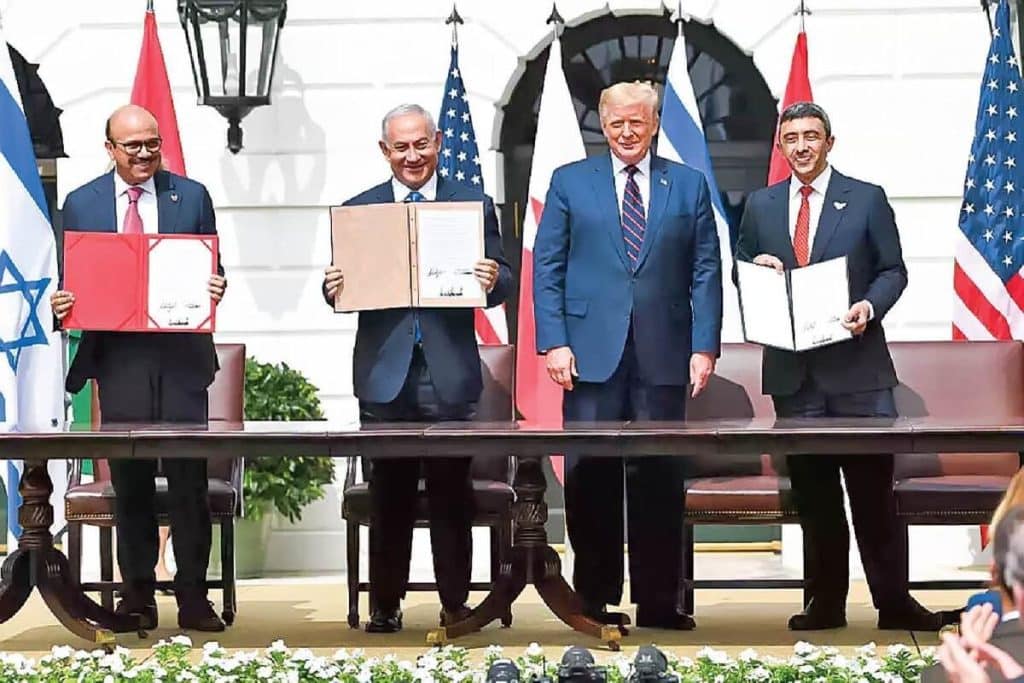
Opposition hinders Israel’s economic normalization in the Arab world.
From the Lebanese newspaper Al-Akhbar: In the cooperative relations between the countries of the region, the focus is usually on three main areas: trade exchanges, joint investments, and the movement of people and goods. However, when it comes to normalizing Israel’s economic relations with the Arab countries surrounding it, Tel Aviv’s priority went beyond these three areas, and the main goal was to break the wall of Arab embargo; an embargo that had caused heavy damage to the Israeli economy in the decades before the Wadi Araba and Oslo agreements.
According to Al-Akhbar, Israel’s main problem was the “veto” that followed its Western companies, which caused many of these companies to avoid establishing any relationship with Israeli institutions in order not to lose a consumer market with a population of about 250 million Arabs; in favor of a small market with only 3 to 4 million consumers.
According to this report, in terms of time and politics, the process of normalizing economic relations between Arab countries and Israel can be divided into two main stages: the first stage is related to the pre-Abraham Peace Accords, which itself is divided into two periods: the Camp David Accords in the late 1970s and the Oslo and Wadi Araba periods in the early 1990s. The second stage began with the wave of normalization known as the Abraham Accords.
In the first stage of normalization, which lasted more than 15 years, the Israelis were unable to establish any significant economic influence in Egyptian society; a society that played the greatest role in limiting relations to what was later called the “cold peace”. Despite the signing of the first trade agreement between Cairo and Tel Aviv, the volume of trade exchanges remained very small compared to the two sides’ trading partners, to the extent that data on the value of these exchanges during the 1980s is very limited. This trade stagnation was primarily due to the popular stance against political and economic normalization in all its forms, as well as the caution of the Egyptian political system at the time, which feared the intensification of the Arab embargo against the country and its impact on the business environment and Egypt’s trade ties with Arab and Islamic countries in the region.
The report continues: These factors made the presence of Israeli goods in Egyptian markets almost impossible. On the other hand, in the field of exporting Egyptian goods to “Israel”, none of the commercial and industrial companies were willing to enter into a “losing” confrontation with Egyptian and Arab consumers. Even the travel of trade delegations faced difficulties; to the extent that the presence of an “Israeli” passport stamp in the passport of an Egyptian businessman was not only considered an abomination in Egypt, but also a “stain” that made its holder an undesirable person in many countries in the region and the world.
According to this report, although the signing of the Oslo and Wadi Araba Accords in 1993 and 1994, with the joining of the second Arab country, Jordan, to the “peace” process, and the recognition of “Israel” by the Palestine Liberation Organization, increased the opportunities for economic normalization, these hopes did not last more than two years (1994-1996); because Benjamin Netanyahu formed his first government and adopted a strict discourse towards the peace process.
According to Al-Akhbar, in this short period, economic normalization officially witnessed a kind of opening: Jordan immediately after “Wadi Araba”, agricultural and industrial trade expanded, joint industrial zones were established, and then “licensed industrial zones” (QIEZ – 1996) were formed, which allowed Jordanian and Egyptian goods from the common market with “Israel” to enter the US market without paying customs duties. Meanwhile, the Palestinian Authority signed the “Paris Economic Agreement,” which regulated the movement of goods, customs, crossings, labor, etc. Several Arab countries (Qatar, Oman, Morocco, Tunisia, and Mauritania) also established trade or liaison offices with Israel, and Turkey increased its trade and military cooperation with Tel Aviv. This cooperation was not limited to the bilateral level, but also expanded to designing programs to link Israel with regional projects.
The Lebanese newspaper continued: However, with the beginning of the new millennium and the outbreak of the second Palestinian intifada, any attempt to expand economic normalization was lost. In the first decade of this century, this trend remained at its lowest level, and only some limited trade exchanges continued, along with the continuation of the boycott by the Arab private sector. During this period, only three countries in the region maintained official economic relations – at different levels and volumes – with Israel: Egypt, Jordan, and Turkey.
The report continues that after the discovery of gas resources in the Eastern Mediterranean since 2011, new economic channels have been formed: Jordan signed a gas contract with Israel in 2016, and Egypt signed several gas agreements with Israel in 2018 and 2019. The “Two Seas Canal” project to connect the Red Sea to the Dead Sea, with the participation of Jordan, Israel, and the Palestinian Authority, has also been raised once again.