
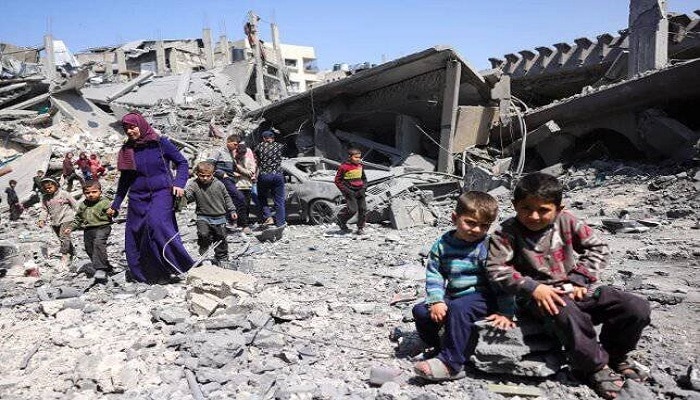
PNN – Waseem Saeed, a writer from Gaza, tells the Tehran Times that his testimony began amid the ruins of Beit Hanoun and continued through renewed attacks and famine.
In the midst of the destruction in Gaza—where neighborhoods have completely disappeared and the international community has largely remained silent—the young Palestinian writer Waseem Saeed has become one of the clearest voices documenting a genocide as it unfolds.
His book, A Witness to the Inferno of Genocide, is not a memoir written after survival; it is a moment‑by‑moment testimony written amid bombardment, starvation, and repeated displacement.
After the January 2025 ceasefire, when he briefly returned to his destroyed hometown of Beit Hanoun, he began writing his “journey into hell”—but was again forced to flee.
In this interview, Saeed speaks with the Tehran Times about writing under fire, resisting erasure, and preserving truth for future generations. Below is the full text of the interview with this young Palestinian writer:
Read more:
Gaza, hell on earth; alarm over running out of medical supplies.
What made you write your testimony during an ongoing genocide rather than after it?
I began writing after the January 2025 ceasefire when I returned to Beit Hanoun in northeastern Gaza. I wanted to narrate my journey through hell. I imagined that the war would end and that I would finally return to Beit Hanoun and my home—even if it had turned into a mound of rubble, even if bulldozers had flattened our land. Its air, its soil, and other things cannot be described by words.
I wanted to describe how my soul suddenly felt at peace there; how my tears soaked the ruins of my home and its soil; and how seeing my grandfather kiss the ground affected me.
But just as I began writing, the genocide started again and I had to flee once more—this time even more brutally. My only reason for continuing to write was to leave behind a testament, so that the monsters could not erase me.
How did you manage to continue writing under the constant threat of death, starvation, and bombardment?
Writing was extremely difficult. But what frightened me most—and forced me to keep writing—was the fear of being killed and erased, of becoming just a number; someone whose suffering would be forgotten.
Your book reflects the resilience and moral fabric of Gazan society under siege. How do you view the role of solidarity and cultural resistance in the survival of the community?
The moral fabric of Gazan society has cracked under the intensity of genocide, starvation, and repeated displacement. Yet I believe history will remember our people as among the greatest: a people who endured, supported one another, and showed unmatched patience in the face of the most criminal army in the world.
But regarding “resilience,” what frightens me is romanticizing resistance. The situation is catastrophic in every sense. Today, after what they call a “ceasefire,” I still cannot return to my city—a city completely destroyed. A few days ago, rain flooded my tent and ruined it. I only hope this hell ends soon.
What impact do you hope your moment‑by‑moment documentation of genocide will have on global readers and international reaction?
I hope the truth reaches the world and becomes part of the recorded history preserved for future generations, so that it may help change the suffering that Palestinians continue to endure.
Can you share a particularly impactful story from your experience that reflects the spirit of hope and resilience?
There are countless stories of solidarity, compassion, and mutual support—of people who, in the midst of famine, shared a handful of flour with others. As I said, my community is truly remarkable.
But I believe that highlighting these stories sometimes contributes to romanticizing resistance. These narratives may create the illusion that we are “coping with this hell,” numbing the audience from taking any moral or human action against this genocide.
What is your message to the global community and those who have remained silent or complicit in these crimes?
My message to the world is this: this is the truth. This is what the monsters have done to us. And to those who stayed silent or became accomplices, I say that history will not forget them. They will be remembered as participants in the greatest genocide of the 21st century. Future generations will curse them.
In how many countries has your book been published so far? Have you received any feedback from readers or publishers?
The book has been published in Arabic and English and will soon be published in Italian, Spanish, and Greek. It is available in Arab countries, Europe, and the United States.
All my hope is that my voice and the voice of my people reach the world: our genocide, our blood, the starvation of our children, the tears of our mothers, and the stories of our martyrs who were killed by the monsters. I hope all of this reaches the world so that the truth about these monsters and their crimes is recorded and preserved for future generations, so it is never repeated again.