
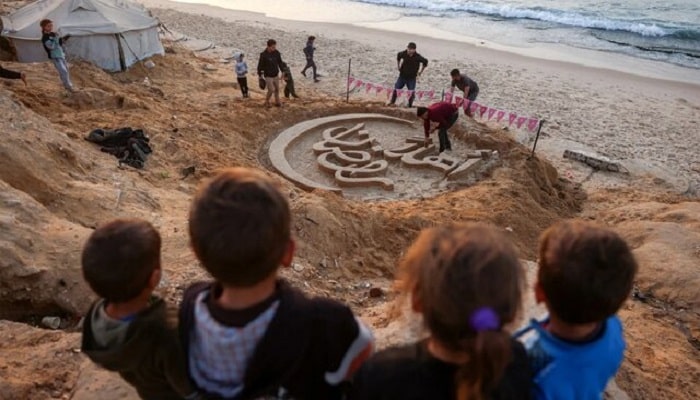
PNN – As world leaders gathered in Washington for the first meeting of US President Donald Trump’s controversial peace council and pledged billions of dollars to rebuild Gaza, residents of the devastated region say the strip is still riddled with casualties, displacement and intermittent bombardment, and for the third year in a row, people in the region have begun the holy month of Ramadan in displacement.
According to the report of Pakistan News Network, Middle East Eye wrote in a report: A similar ceasefire established in January last year collapsed during the holy month of Ramadan after the Israeli regime unilaterally violated it and resumed attacks, leaving many uncertain about what lies ahead.
This year, the families of more than 72,000 Palestinians who have been martyred in the merciless Israeli bombardments since October 2023 are forced to face the month of Ramadan in an atmosphere of sadness and loss.
A displaced Palestinian from northern Gaza said from his makeshift tent in the Nusirat refugee camp: There is no real difference between the current Ramadan and Ramadan during the war. The only difference is that some of the killing and bloodshed has stopped.
Despite a relative lull in the widespread bombing, the attacks have not completely stopped. In the first two days of Ramadan, the Israeli army killed two Palestinians and wounded four others across the Gaza Strip.
Since the ceasefire agreement in October, at least 603 Palestinians have been killed and 1,618 others injured, according to the Gaza Health Ministry.
Most of the casualties occurred in bombings and shootings near the Yellow Line, while others were martyred in Israeli attacks on areas that were supposed to be safe.
For many families, the ceasefire has changed the intensity of the attacks, but the reality of grief, displacement and shattered communities that continue to shape daily life in Gaza has not.
Ramadan in the tent
For the past two years, Palestinians across the Gaza Strip have spent Ramadan under Israeli-imposed starvation, during which Israeli forces killed hundreds of Palestinians waiting for aid in Gaza City in Operation Flour Massacre.
This Ramadan, while Gaza’s markets are back to pre-war times and shelves are filled with goods, for many in Gaza, these items are largely out of reach and unaffordable amid the complete devastation of the impoverished strip’s economy.
Many Gaza residents still have to use firewood for cooking, and access to safe drinking water remains an impossible dream.
A resident of the Gaza Strip said: Today, we have the goods on the shelves but we cannot buy them for our children. We have lost all our money on displacement, buying tents and moving from one area to another. When Ramadan arrived, we were completely unprepared.