
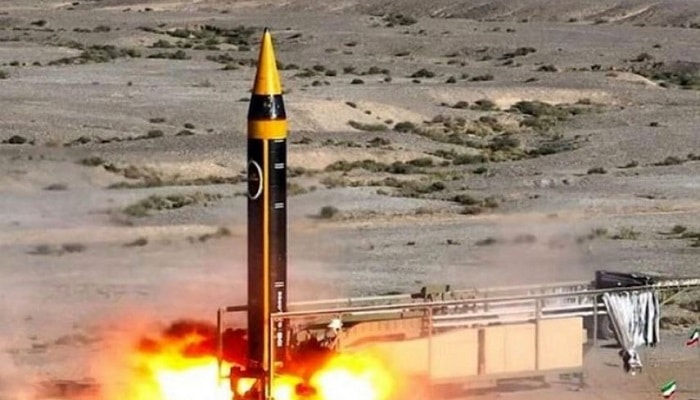
PNN – Reuters reported on Wednesday evening that Iran has issued a notice to airspace (NOTAM) announcing its intention to launch missiles in areas south of the country on Thursday from 03:30 to 13:30 GMT.
According to the report of Pakistan News Network and Reuters, Iran has held naval exercises in the Strait of Hormuz this week and is scheduled to hold a joint naval exercise with Russia on Thursday.
The NOTAM system provides vital safety information to pilots, flight crews, and other airspace users.
Unveiling of the “Khoramshahr 4” missile / a missile that can be converted into 80 missiles
According to Al-Alam, during the unveiling of the new missile city of the Islamic Revolutionary Guard Corps Aerospace Force, one of Iran’s most advanced ballistic missiles, the “Khoramshahr 4”, was seen among the operational equipment deployed in the complex.
“Khoramshahr 4”: One Arrow and Several Iranian Badges
The unveiling of this missile city, at a time when overt and covert threats to Iran’s national security are increasing, shows that Khorramshahr 4 is an active part of the Islamic Republic of Iran’s defensive-offensive formation; a formation that is based on the principle of “active deterrence” and a decisive response to any aggression.
The “Khoramshahr-4” missile, also known as “Khyber”, is one of the most advanced long-range missiles of the Islamic Republic of Iran, with an operational range of approximately 2,000 kilometers.
Advanced propulsion and different structural design
The Khorramshahr-4 uses the advanced “Arvand” engine, which operates using hypergolic (self-igniting) fuels. The use of this type of fuel increases the speed of the missile’s operational readiness and reduces dependence on complex ignition processes.
One of the important innovations in the design of this missile is the placement of the engine inside the fuel tank, which, in addition to increasing structural stability, reduces the missile’s length and improves the diameter-to-length ratio; an issue that plays an important role in increasing ballistic stability and accuracy of hit.
Supersonic speed and reduced enemy reaction time
The missile reaches speeds of Mach 16 outside the atmosphere and about Mach 8 inside the atmosphere. Such speeds mean that the missile’s flight time from the moment of launch to hitting the target is about 10 to 12 minutes; a short period of time that effectively deprives many missile defense systems of the opportunity to respond effectively.
Three flight phases of “Khoramshahr 4”: from takeoff to precise hit
The Khorramshahr-4 missile has three main flight phases. In the first phase, the missile, after launching from a mobile platform, adjusts its altitude, initial speed, and overall flight path.
In the next stage, which is considered the intermediate phase, the warhead, after separating from the body, enters the ballistic trajectory, and the engines embedded in it are responsible for eliminating the disturbances caused by separation and correcting the flight path.
This stage is considered the most important part of missile guidance and minimizes possible errors during the long flight path.
In the third phase, the warhead prepares to enter the Earth’s thick atmosphere. At this stage, the missile’s speed decreases from Mach 16 to about Mach 8, but this speed is still considered too high for defense systems to intercept.
Maneuverable warhead with guidance system based on tactical engines
The Khorramshahr-4 missile warhead, also known by its operational name “Khyber”, is one of the most advanced maneuverable warheads (MaRV) in Iran’s missile arsenal.
According to published technical information, this warhead uses a set of eight auxiliary motors, four of which are responsible for adjusting the attitude, stabilizing the stability, and creating the initial rotation of the warhead, and the other four motors are used to correct the lateral trajectory and increase the accuracy of the hit.
This advanced control structure gives the Khorramshahr-4 warhead high maneuverability and remarkable accuracy in the final phase of flight.
Intermediate guidance: a factor in increasing accuracy and overcoming electronic warfare
One of the most important features of the Khorramshahr-4 is that it performs main guidance in the middle phase of flight; an issue that causes the electronic guidance systems to be turned off after the warhead enters the atmosphere and the missile to become a completely mechanical system.
This feature minimizes the likelihood of enemy electronic warfare effectiveness and significantly increases the missile’s survivability and penetration.
Reducing radar cross-section and increasing maneuverability
In the design of this missile, efforts have been made to minimize its radar cross-section. Removing conventional wings and replacing them with a thrust vector control system is one of the important measures in this area, which, in addition to reducing air friction and flight distortion, has increased the missile’s maneuverability.