
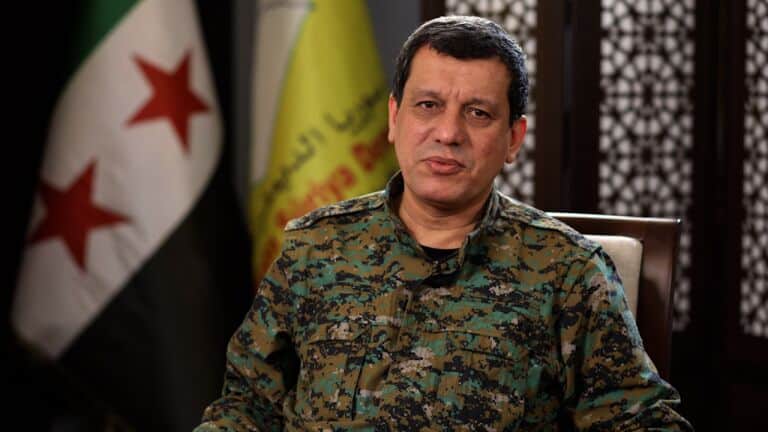
SDF Commander: The only solution to Syria’s problems is federalism.
From the Rudaw network, Abdi added: Political decentralization that includes the division of powers between the center and the provinces is the only solution to the problems and guarantees the future of Syria.
He considered the possibility of the failure of the negotiations between the SDF and the interim government to be weak, saying: This scenario is weak and the failure of the negotiations will be to the detriment of the entire Syrian nation.
Abdi added: Direct and indirect talks with Damascus have not stopped despite the existence of violations, and the agreement signed with the head of the interim government does not have a specific time limit for implementation.
He continued to express optimism about the possibility of progress in cases such as security and crossings, saying: The wealth and resources of the country belong to all nations and must be distributed fairly among them.
The SDF commander clarified: The return of Kurdish refugees to areas such as Afrin and Ras al-Ain, despite the understandings with Damascus, faces obstacles because this requires real guarantees for the dignified and safe return of citizens.
Abdi finally warned against Damascus’s prosecution of Kurdish self-government employees, calling it a tension-inducing move.
According to IRNA, as the deadline set in the agreement between the Syrian interim government and the Syrian Democratic Forces (SDF) approaches, political and field developments in Syria have entered a critical and decisive stage; a stage that, along with increasing pressure from Damascus and Ankara, has been accompanied by signs of escalating tensions in the north of the country, casting the future of the agreement in a cloud of uncertainty.
The “Al-Khaleej Online” website wrote in a report on developments in Syria: While only a few days remain until the deadline for implementing the March agreement between Damascus and the SDF, recent diplomatic and military moves show that the patience of the main players, especially Turkey, is coming to an end.
In this context, a high-level delegation of Turkish officials to Damascus, including the foreign minister, the defense minister, and the head of the country’s intelligence agency, visited at a time when the implementation of the agreement’s provisions had faced a serious impasse.
The visit, which observers see as a direct message to the SDF, was accompanied by explicit statements from Turkish officials. Turkish Foreign Minister Hakan Fidan, in a joint press conference with his Syrian counterpart, Asaad Hassan al-Shaibani, emphasized that there is no sign of the SDF’s real will to integrate into the Syrian government structure and that continuing this process poses a serious threat to the unity and stability of Syria.
Along with these political pressures, developments on the ground in and around Aleppo have complicated the situation; as heavy clashes on Monday between the Syrian army and SDF forces in some northern areas of Aleppo resulted in the deaths and injuries of several civilians and forces from both sides and led to a wave of displacement.
In this regard, official Syrian sources announced that SDF forces had targeted some vital routes and security points; an action that Damascus interpreted as an attempt to thwart the March agreement.
Following these clashes, the Syrian Ministry of Defense and the SDF command were forced to announce a reduction in tension and an order was issued to stop mutual operations, but observers believe that this calm is fragile and temporary, and the root of the crisis still remains.