
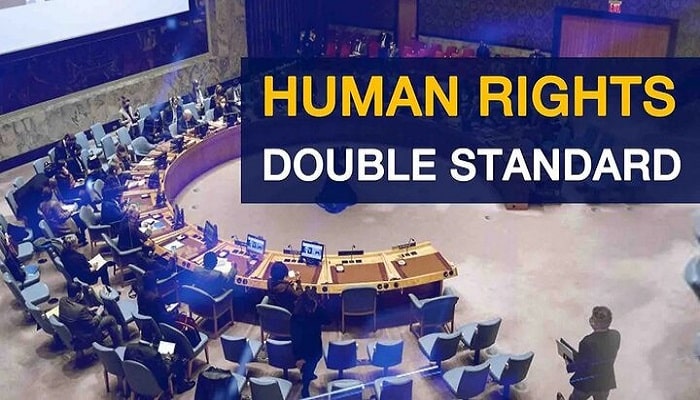
PNN – Recent resolutions by the European Parliament and debates at the UN Human Rights Council once again raise a fundamental question: Where is the line between “defending universal values” and “interference in national sovereignty”?
The adoption of a new resolution against Iran in the European Parliament and the call on the Council and the European Commission to expand targeted sanctions have once again revived the old but fundamental debate of “national sovereignty” versus “moral interference.” At the same time, the recent session of the UN Human Rights Council in Geneva was also accompanied by a vote on the human rights situation in Iran; an action that, from the perspective of Tehran and many analysts, is not considered human rights, but part of a broader political conflict between Iran and the West.
In recent years, the European Union has repeatedly issued resolutions or imposed sanctions against Iran, citing concepts such as “human rights,” “freedom of expression,” and “women’s rights.” In the most recent case, the European Parliament has called for the expansion of targeted sanctions and accused some domestic Iranian institutions, including the Audiovisual and Broadcasting Regulatory Authority (SATRA), of violating media freedom.
These actions are taking place in a purely political context, especially as the differences between Tehran and the West have intensified in areas such as the nuclear issue, regional policies, and the war in Ukraine. From their perspective, human rights in this context are a “tool of pressure” rather than a neutral and universal principle.
The principle of national sovereignty; a basis of international law
In modern international law, the principle of “equal sovereignty of States” is one of the most fundamental principles of the UN Charter. According to this principle, each state has the right to regulate its legal, cultural, and social system based on its own values and internal structure. But the approach of some European institutions is based on the assumption that countries’ domestic laws must align with Western liberal standards, from cultural coverage and policies to media regulations. This approach, although expressed in the language of human rights, is in practice a kind of “normative rewriting from the outside” that conflicts with the principle of non-interference in the internal affairs of countries.
The example of Satra and the freedom of speech controversy
One of the areas of criticism of the European Parliament is Iran’s media policies and restrictions on the depiction of alcohol consumption, smoking, or the veil in theatrical works. In European statements, these cases have been introduced as examples of restrictions on freedom of expression.
In contrast, each legal system frames itself based on its own cultural norms and values. Just as some European countries have strict restrictions on hate speech, specific historical symbols, or denial of certain historical events, Iran has its own cultural regulations. From this perspective, boycotting an institution like SATRA for implementing domestic laws is not considered a defense of freedom of expression but rather an intervention in a country’s legal mechanism.
Double standards and the media issue
Critics also point to what they call a “double standard.” They say the European Union accuses some Iranian institutions of violating media freedom while terrorist media outlets like Interfax operate freely on European soil and have highly political and biased positions.
There has also been controversy over hosting groups such as the MKO, a group that was previously listed as a terrorist group by the West and has killed thousands of Iranians, but was later removed from the list. The political support of some Western figures for this group is interpreted as a sign of Europe’s selective approach.
Human rights pressure or political leverage?
The simultaneous escalation of human rights pressures with sensitive political moments, including the current negotiations with the United States or regional developments, has led some analysts to consider these measures part of a multi-layered pressure strategy. From the perspective of these analysts, human rights in this framework become a “complementary tool to economic and diplomatic sanctions”; a tool that creates moral legitimacy and reduces the political cost of punitive measures for Western public opinion.
The problem of moral credibility of the West
One important issue is the “moral credibility” of the West. Before issuing resolutions against other countries, Westerners should also look at their own record: from the history of colonialism in Africa and Asia to the wars in Iraq and Afghanistan.
Domestically, the cases related to Jeffrey Epstein and the widespread revelations about the sexual abuse network and its connections to some influential figures are presented as examples of moral crises in Western societies. The relative silence of European institutions regarding some of their allies’ domestic crises, along with their intense focus on Iran, is indicative of their “selective approach.”