
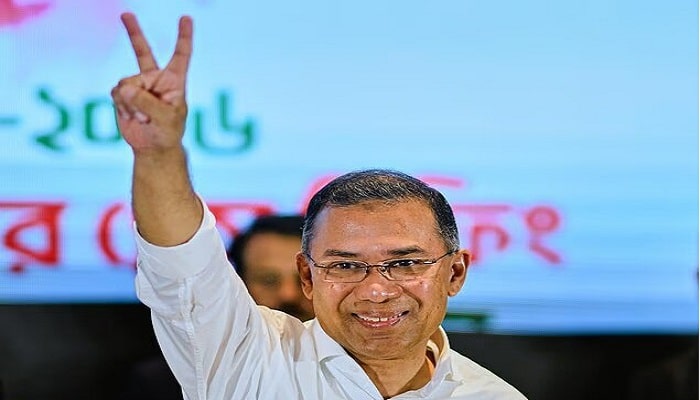
PNN – Tariq Rahman was sworn in as the new Prime Minister of Bangladesh, marking a major political shift in the Asian country following his party’s landslide victory in the first parliamentary elections since the 2024 uprising.
According to the report of Pakistan News Network, the inauguration ceremony of Tariq Rahman as the 23rd Prime Minister of Bangladesh was held in Dhaka, and he officially took over the leadership of the country’s new government.
This transfer of power is the first peaceful transfer of power in Bangladesh since the widespread uprising of 2024 that led to the fall of the government of Sheikh Hasina, the former Prime Minister and the most powerful woman in the country’s history.
The inauguration ceremony was held under the supervision of Bangladeshi President Mohammad Shahabuddin, while Tariq Rahman, son of former Prime Minister Khaleda Zia and former President Zia-ur-Rehman, took office as the first male prime minister of the Asian country in 35 years.
Since Bangladesh returned to democracy in 1991, the post of prime minister has alternated between Khaleda Zia and his bitter rival, Sheikh Hasina.
Khaleda Zia, who became Bangladesh’s first female prime minister in 1991 and then waged a fierce rivalry with Sheikh Hasina for decades, died on January 29 at the age of 80 after a long illness.
Last Thursday’s parliamentary elections in Bangladesh are considered a turning point for the political future of the country of 170 million people after years of fierce competition and electoral disputes. During these elections, Tariq Rahman’s Bangladesh Nationalist Party and its allies won 212 of the 350 seats in parliament. In contrast, an 11-party coalition led by the Jamaat-e-Islami, Bangladesh’s largest Islamist party, will be the main opposition in parliament with 77 seats.
This coalition also included a newly formed party called the National Citizens Party (NCP), formed by student leaders of the 2024 Uprising, which won 6 seats. In Bangladesh’s electoral system, 300 representatives are directly elected by the people, and the remaining 50 seats are reserved exclusively for women, distributed proportionally among the winning parties.
Tariq Rahman, who returned to the country after 17 years of self-imposed exile in London shortly before his mother’s death last December, emphasized in a speech his commitment to working for democracy in Bangladesh.
The elections were held under the supervision of the interim government led by Nobel Peace Prize laureate Muhammad Yunus, which came to power after the ouster of Sheikh Hasina in the 2024 uprising and was responsible for holding the elections. The vote was largely peaceful and was deemed acceptable by international observers.
The inauguration ceremony on Tuesday was attended by dignitaries and delegations from various countries, including the President of the Maldives, the Prime Minister of Bhutan, and delegations of officials from India, Nepal, and Sri Lanka. Prior to this ceremony, the Bangladesh Election Commission chairman had also separately invited all newly elected representatives to take the oath.
In a significant development, the Bangladesh Awami League, led by Sheikh Hasina, was barred from the contest. The caretaker government led by Yunus has also banned all activities of the party, which ruled the country for 15 years.