
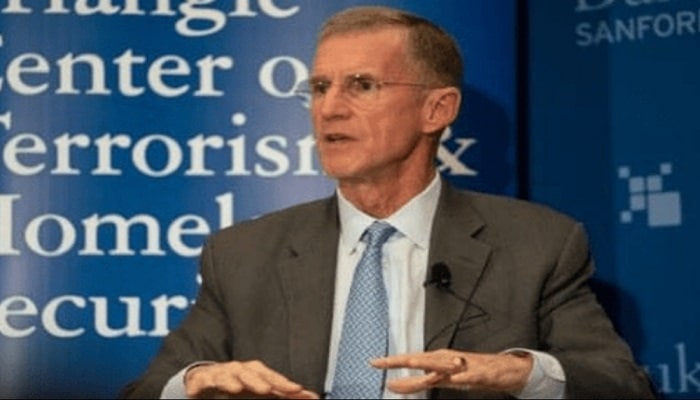
PNN – General McChrystal, former commander of the US Joint Special Forces, believes that Iran’s deep civilizational roots and strong religious beliefs have made it a very capable opponent on the battlefield and politically so powerful that it has remained stable in the face of decades of continuous threats and attacks.
According to the report of Pakistan News Network, General McChrystal, former commander of the US Joint Special Forces, believes that Iran’s deep civilizational roots and strong religious beliefs have made it a very capable opponent on the battlefield and politically so powerful that it has remained stable against decades of continuous threats and attacks; therefore, such an actor can never be defeated through bombing or even extensive ground attacks.
Retired General McChrystal, referring to the history of American interventions and attacks in Iran, analyzed the current war in light of this history and emphasized that Iran is a very powerful opponent on the battlefield, because its decisions are made not solely based on material calculations but also by considering religious beliefs and civilizational history, and confronting such a cohesive society is beyond the military capabilities of the United States.
General Stanley McChrystal is the former commander of the US Joint Special Operations Command, where he led critical operations in Iraq and Afghanistan. McChrystal resigned after publishing a controversial interview and harsh criticism of Biden and his administration officials. The general is highly regarded by independent media in the US for his in-depth analysis of the battlefield, taking into account the cultural and social structure and context of target communities.
On the battlefield, Iran is a very powerful opponent.
After referring to the historical record of direct and indirect US interventions and attacks on Iranian interests, General McChrystal turns to his field experience and that of American forces in Iraq and explains why, in the minds of many American military personnel, Iran is not just considered a political rival, but a capable operational and direct enemy. McChrystal, referring to the years of the Iraq war, says that American forces faced a network of Shiite militias backed by Iran, who were using sophisticated roadside bombs, asymmetric warfare, and other lethal means to inflict serious blows on the United States. From this perspective, for a generation of American soldiers, Iran was not simply an analytical or diplomatic issue, but an actor they faced on the battlefield and who understood the full cost of confronting such an adversary.
Iranians’ historical memory is full of bitter memories of America’s attacks on their country’s interests.
However, McChrystal emphasizes that this military experience should be used to understand the Iranian side’s logic. According to him, to understand the current war, one must also look at developments from the perspective of Iran, a country that carries with it the memory of foreign intervention, repression under the Shah, the attrition war with Iraq, and years of feeling threatened and surrounded. He says this historical and psychological background plays a fundamental role in shaping Iran’s decisions today, and without understanding it, neither the extent of Iran’s resistance nor its response to external pressures can be understood. McChrystal warns that to understand this confrontation, the roots of this hostility must be sought in the historical memory and experience of Iranians.
Iranian society has become more cohesive throughout history in the face of foreign invasion.
The retired general cautiously points to the domestic situation in Iran, explaining that although there are signs of social discontent, this discontent does not necessarily mean the existence of a coherent, organized opposition with clear leadership; so much so that it is difficult to even identify a reliable alternative current or figure who can play the role of national leadership. Therefore, he does not believe in the idea that external pressure or war can quickly lead to the collapse of the regime or a widespread popular uprising. In completing this view, McChrystal points to Iran’s historical experience and emphasizes that this experience has shown that in war situations, Iranian society has always moved towards strengthening national solidarity and reducing internal divisions, because the sense of survival and collective defense overcomes political and social differences.
Strong religious beliefs and civilizational history are the basis for decision-making in Iran.
McChrystal believes that one of the common errors in American strategic calculations is the miscalculation of the other side’s resilience, especially in the case of Iran, which he says is a country with a long history of war, external pressure, and prolonged crises. He explains that bombing and military pressure do not necessarily break the political will and spirit of resistance of a society, and even large-scale attacks may strengthen the motivation for resistance rather than cause surrender, because the final decision-making, especially in Iran, is not based on material calculations, but on religious beliefs, civilizational identity, and collective emotions.
Referring to the nationwide solidarity in Iran, the general concludes that increasing military pressure can never bring Iran to the negotiating table.
The human costs of this war will be unbearable for America.
McChrystal, emphasizing the human dimension of war, warns that focusing on economic costs obscures the real reality, namely the increasing casualties of American soldiers; especially since wars usually begin with a less costly phase, but gradually enter complex, terrestrial, and attrition phases in which forces come into direct contact with threats and casualties increase significantly.
He explains that in the confrontation with Iran, this process will be more intense because Iran and its allies are highly skilled in asymmetric warfare and can inflict a permanent cost on American forces with sporadic, sustained, and unpredictable attacks, without the need for a classic confrontation; so that even a low but sustained level of conflict can lead to significant casualties.
In addition, he also points to the domestic consequences, saying that in a long war, increasing casualties among a limited segment of society that bears the burden of military service can fuel social discontent and internal divisions; therefore, the combination of a war of attrition, the lack of a decisive advantage, and the difficulty of a quick withdrawal, in McChrystal’s view, creates a situation where the human cost for the United States will be very heavy.