
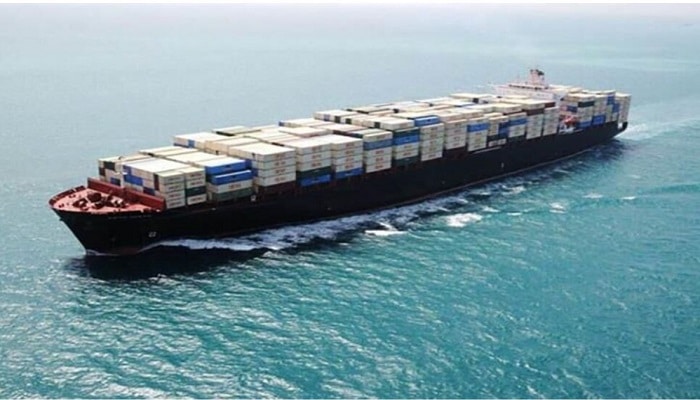
PNN – A senior researcher at the Russian Academy of Sciences announced that the US and Israeli military aggression against Iran has disrupted the world’s maritime logistics network, and major ports such as Shanghai, Singapore, Busan, Rotterdam, and Abu Dhabi have faced increased ship delays and changes in the route of shipping fleets.
According to the report of Pakistan News Network, Maxim Abramov added in an interview (Wednesday): Changes in global maritime logistics began on February 28, 2026 (simultaneously with the start of the military aggression against Iran).
He added: Of the 81 container ships heading towards the Strait of Hormuz that day, 43 ships were diverted to other ports in the Persian Gulf, and the rest left the Persian Gulf completely.
Referring to the US and Israeli military aggression against Iran and its subsequent consequences in the form of Tehran’s response to the aggressors, the Russian expert said: These events have caused the most damage to ports located in the Persian Gulf, and the world’s largest centers have felt this impact as a ripple effect that has spread throughout the entire maritime logistics system.
Situation in the Port of Shanghai
Regarding the situation of the Chinese port of Shanghai affected by recent developments, Abramov said: The port does not appear to have been harmed by recent developments, but its operations are showing signs of increasing disruption.
He added: From March 14 to 19, 2025, the average ship delay time at the port of Shanghai increased to approximately 2.23 days.
Port of Singapore
The head of the Applied Artificial Intelligence Laboratory at the St. Petersburg Federal Research Center also said: After the recent events in the Persian Gulf, the Port of Singapore also continued to operate, but it was among the ports that attracted part of the global logistics congestion.
He added: At the beginning of March 2025, the average waiting time at the Port of Singapore was about 1.25 days, and more than 85% of the container loading points at this port were full.
Abramov clarified: Simply put, the Port of Singapore has withstood the impact of the events in the Gulf region, but it is operating at very high capacity, which is typical for a transport hub that is starting to manage some of the transformed transit flows.
Port of Busan
The senior Russian researcher added: On the contrary, the South Korean port of Busan seems to have been one of the most resilient ports to the wave of global logistics changes.
He continued: At the beginning of March 2026, the average ship delay at Busan Port was about 1.5 days, but by the middle of this month, it had decreased to about 1.2 days.
Port of Rotterdam
This specialist of technical sciences stated: The port of Rotterdam (as the largest port in Europe, located in the Netherlands) also felt the effects of the global logistics disruption.
He added: At the beginning of March, the average ship delay there was about 1.23 days, but by the middle of this month it had increased to almost 1.8 days.
Abramov noted that this situation was influenced not only by events in the Middle East, but also by local weather factors such as fog and high occupancy rates at the cargo terminal.
Abu Dhabi port
The senior Russian researcher said: The most direct impact of the recent clashes can be seen in the port of Abu Dhabi in the United Arab Emirates.
According to him, port authorities officially announced that due to the reduction in traffic through the Strait of Hormuz, the number of ships berthed at Port Khalifa (Abu Dhabi) is expected to decrease, although the port itself will continue to operate normally.
Abramov added: The activity of the Abu Dhabi port is perhaps the most telling example of the changes in global logistics after the military aggression against Iran, in a way that the port has not been closed, but its operations have declined.
The joint military aggression by the United States and the Zionist regime against the Islamic Republic of Iran, which resulted in the martyrdom of Ayatollah Khamenei, the Leader of the Islamic Revolution, began in the early hours of February 28, 2026; this action took place while indirect negotiations between Iran and the United States were underway with the mediation of some regional countries.
Previously, Iranian Foreign Minister Seyyed Abbas Araqchi, referring to the consequences of the military aggression of the United States and the Zionist regime on the economy, security and stability of the region, and maritime safety in the Strait of Hormuz, stated: The insecurity imposed on the Strait of Hormuz is a direct result of the military aggression of the United States and the Zionist regime, and the Islamic Republic of Iran has adopted a series of measures in accordance with international law in this waterway in order to defend its sovereignty and territorial integrity.