
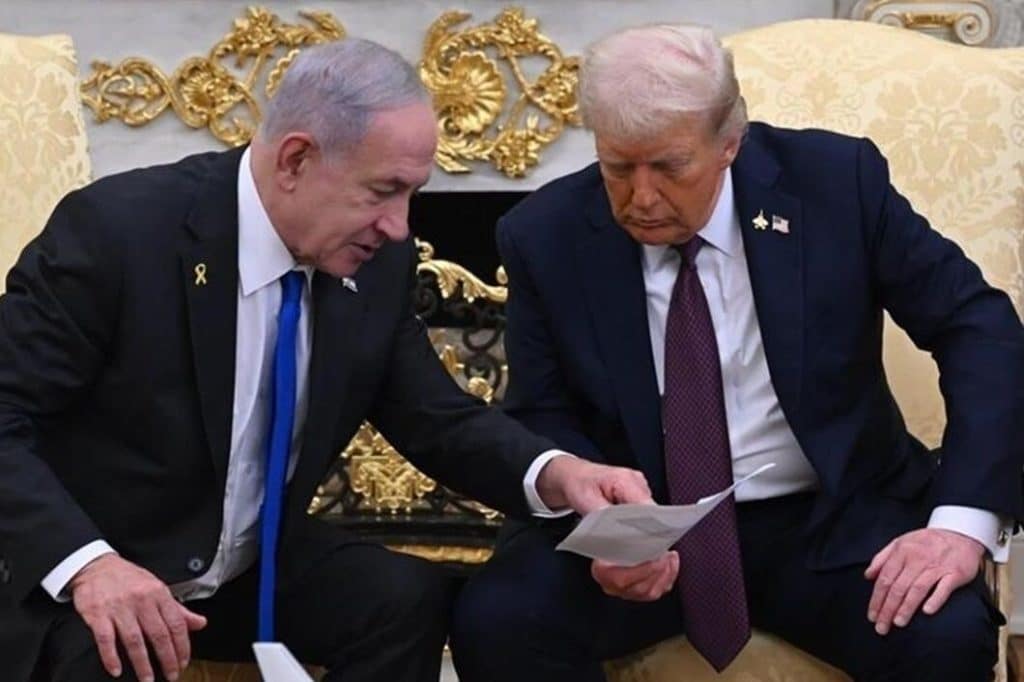
Trump’s plan to end the Middle East conflicts is doomed to failure.
According to Al-Arabi Al-Jadeed News Agency, the concept of “peace through force” has existed since the beginning of America. George Washington (the first president of the United States) told Congress in 1793, “If we are to secure peace, which is one of the most important means of our growing prosperity, it must be clear that we are always prepared for war.”
According to Al-Arabi Al-Jadeed, the concept of “peace by force” that Donald Trump proposes is different from that of his predecessors, including Ronald Reagan, who advanced this theory against the Soviet Union. Trump specifically applies this theory to the Middle East; therefore, he does not speak of “peace through force” but of “peace imposed by force”; a peace that must be imposed on the parties to the conflict, especially the Arab parties, and specifically Syria and Lebanon, meaning that if you move towards normalization with “Israel,” the matter is over.
According to the report, Trump’s rush to end this conflict is evident in various aspects, the most important of which are strengthening the position of “Israel” once and for all (in his imagination) as a bludgeon over the heads of the nations of the region, the US and “Israel” encroaching on their wealth and resources, completing the process known as the “Abraham Accords,” normalizing relations with Saudi Arabia, the Persian Gulf countries, Syria, Lebanon, and perhaps Iraq, and claiming to isolate Iran and eliminate its influence in some frontline countries.
The news site continued its report, emphasizing that there is no precedent in history for a peace that has been imposed on nations by force to last.
Al-Arabi Al-Jadeed continued: Trump’s plan is of a kind of urgency because the United States is on the verge of another economic recession, and if it does not quickly plunder more of the world’s resources, it will not be able to maintain its precarious position, as Washington’s reckless attacks against Venezuela and its oil and assets are a clear example of this claim.
Will “peace by force” really lead to peace?
According to Al-Arabi Al-Jadeed, Trump believes that absolute support for “Israel” will deter its enemies and that the Palestinians must first accept settlements determined by the imposed reality, not through equal negotiations. Trump’s theory of “peace by force” is linked to the idea of normalization; in his view, peace will be achieved neither through long negotiations (in the Clinton style) nor through just solutions, but by demonstrating the invincible power of “Israel” and weakening the Palestinians on the political and regional levels so that they practically have no power to protest.
According to the report, for Arab and Gulf countries, security and armament incentives (from their own pockets) are offered in return for accepting “Israel” as a reality. Therefore, “force” is a tool to create conditions that force the parties to normalize, rather than to achieve a sustainable and balanced peace, and the method of operation also fluctuates between enticements—such as the sale of advanced weapons, including F-35 fighter jets, to Saudi Arabia and the UAE—and threats, such as political and financial pressure on Sudan and its removal from the list of terrorism.
Pressure on Syria and Lebanon
The Arab New News website added: In Syria, pressures continue in various forms, including the destruction of infrastructure, infiltration into the country’s territory, and clashes that reveal the future course of the conflict, such as the recent events in Beit Jinn. In Lebanon, pressures are also innumerable, especially due to the presence of Hezbollah; financial, economic, political, and diplomatic pressures are being exerted on the entire country.
The implicit message from the United States is: your country has no future without peace and normalization with Israel, and without ending the resistance project.
As a result, according to Trump and “Israel,” if Hezbollah is defeated or weakened, many of its opposing political forces in Lebanon believe that an “opportunity” has been provided to further link Lebanon with the Western-Gulf axis, especially Saudi Arabia.