
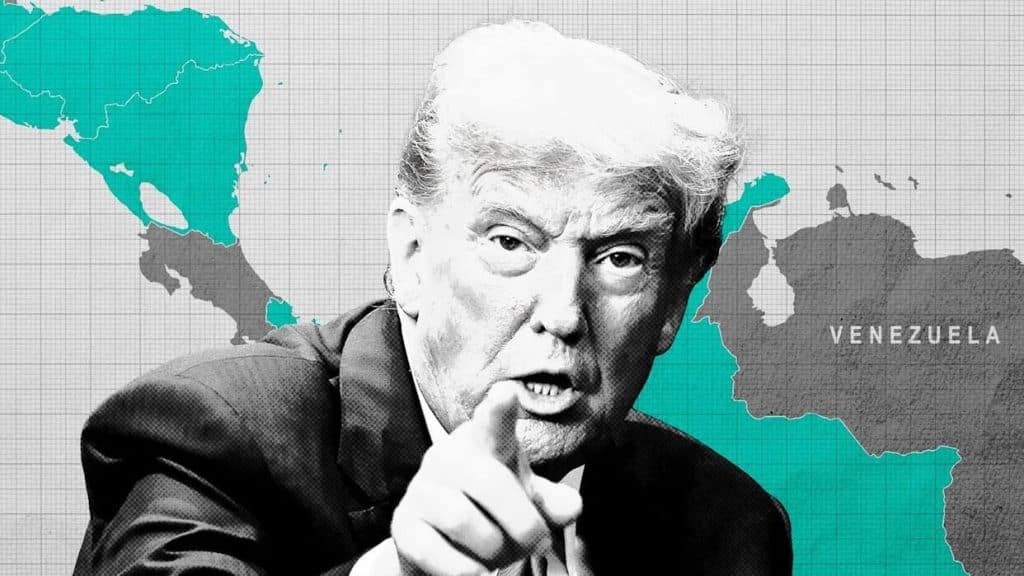
Trump’s Venezuela strategy: What is achieved?
In recent months, the US president’s behavior towards Venezuela has taken on a form that resembles less a clear policy and more a deliberate engineering of uncertainty. In this model, Trump not only uses the tools of hard power, but also combines narrative construction, ambiguity, double signals, and intermittent threats to keep the playing field murky, slippery, and unpredictable for all actors (from Caracas to regional capitals and even US security agencies).
The practical basis for this behavior is precisely what he has publicly announced: from the “symbolic closure of Venezuelan airspace” to the “approval of covert operations in Caracas.” But the real value of these actions, beyond their relationship to reality, must be found in the generation of surrounding ambiguity. The strategy of operational ambiguity is a trump card for Trump, who is keen to appear both unpredictable and able to reconsider any policy.
From Public Threat to Practical Ambiguity
In this context, Trump’s behavior pattern towards Venezuela has created an unprecedented combination of public threat and practical ambiguity; an approach that has been repeated many times in his speeches and now forms the basis of his strategy in the Venezuela case. The Republican politician has declared in aggressive language that “the airspace of Venezuela and its surroundings is completely closed” and has asked airlines and pilots to consider this area “closed”. Along with this show of power, Trump has confirmed that he personally authorized the CIA’s covert operation inside Venezuela and said that the main reason for this action is “to empty Venezuelan prisons and send people to the United States” as well as “the massive influx of drugs”.
In explaining this operation, the US president has not spoken about its scope, nor its tactical or strategic goals, nor how far it will go. This type of controlled information, in which the existence of the operation is confirmed but its nature is hidden, is part of a strategy of psychological pressure and is designed to keep the government of Nicolás Maduro and the Venezuelan people in a constant state of expectation, insecurity and uncertainty.
While emphasizing that he “does not rule out any options” and that “the situation in Venezuela must be taken care of,” Trump has repeatedly told reporters not to “read too much” about his recent moves. On the one hand, he leaves open the possibility of a ground operation, saying “we are also looking at the ground,” but on the other hand, he emphasizes that “I cannot say what the decision is,” and only says that “I have made my decision to some extent.”
This calculated duplicity, opening up the possibility of military action while simultaneously concealing the ultimate conclusion, is part of the same pattern of behavior seen in his foreign policy toward rival countries: making a grand threat without revealing when, how, or whether it will be carried out at all.
Reaping the fruits of war without firing a shot
This behavior toward Venezuela is also noteworthy in another way: Trump ostensibly opposes “endless wars,” but now he uses the deployment of carriers, the authorization of covert operations, and air warnings to build a framework of multilayered pressure. This apparent contradiction is part of his tactic, because he does not pay the political cost of accepting a new war, but gains the psychological and geopolitical benefits of “the threat of war.” This situation is more dangerous for the other side than a precisely defined policy, because it makes it difficult to respond appropriately, and any miscalculation can have huge costs.
Putting these hypotheses and possibilities together, we can understand that Trump is deliberately establishing a model that can be called maximum threat, along with maximum ambiguity. He creates real military mobilization, from the deployment of aircraft carriers and fighter jets to attacks on suspicious boats and the announcement of covert operations. But he keeps the real meaning of this mobilization hidden. He raises the threat openly and openly, but leaves the final decision hidden and ambiguous. He creates a crisis, but retains control of the narrative and interpretation of the crisis.
This combination has effectively caused Venezuela, its regional allies, and even part of the US security apparatus to remain permanently in a state of “waiting for something bi,g”; an event that may not ultimately exist or may only be a bargaining chip. This strategy creates deterrence for Trump without having to pay the political, military, or international costs of real action immediately, and it is precisely this complex nexus of threat and ambiguity that has become the main axis of the Washington-Caracas equation today.
Killing with the fear of death; a long-term scenario
It is now quite clear that Trump intends to determine the fate of the Venezuelan case once and for all in his second term. He does not appear to be announcing any specific path, but the sum of the threats, the ambiguity, the references to covert operations, the closure of airspace, and even the generalization of the scope of threats to other countries in the region, including his recent warning about the possibility of action against Colombia, all show that for him the “end result” is more important than the means to achieve it. In this context, Trump’s desired result could take two forms: either changing the structural behavior of the Maduro government and placing it in Washington’s favor, or, in a more extreme scenario, the complete removal of Maduro and a rearrangement of power in Caracas.
This is where Trump’s approach differs from previous US presidents: he wants to apply maximum pressure by putting all options on the table, but pays the least direct cost in practice. This constant raising and lowering of the threat level, from “anything is possible” to “don’t take it now,” allows him to keep the other side from immediately engaging in a costly conflict.