
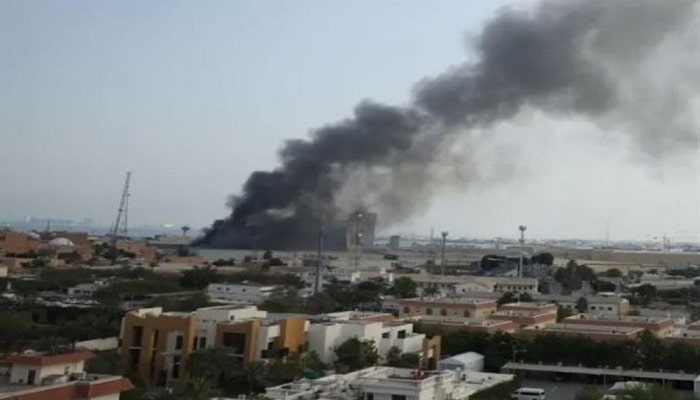
PNN – Instead of serving as a “protective umbrella,” US military bases in the Persian Gulf have become “ticking time bombs.”
According to the report of Pakistan News Network, citing CGTN, Recently, as the US and Israeli military strikes against Iran entered their third week, Iran retaliated by launching attacks on US military bases in several Middle Eastern countries, fanning the flames of conflict across the Persian Gulf region. This conflict has exposed, in the most profound way possible, the fallacy behind the US narrative of “trading bases for security.”
The US military bases scattered throughout the Persian Gulf, instead of acting as a “protective umbrella” to protect their host countries, have become “time bombs” and have forced the Persian Gulf countries to pay a heavy price, facing the threat of jeopardizing their sovereignty and halting their development by igniting security crises and destroying economic arteries.
The United States has military bases in nearly 80 countries around the world, and the Middle East is a central region for American bases worldwide due to its strategic importance as an energy hub. Countries such as Qatar, Bahrain, and the United Arab Emirates have ceded part of their territorial sovereignty to the United States in exchange for “security guarantees,” a partnership built on a pattern of dangerous nature.
In the recent US and Israeli attacks on Iran, US bases in the Middle East played a vital role in command and logistical support and thus became the main targets for Iranian retaliation. Iran has explicitly stated that its attacks are against the US military presence in these countries and not the host countries. This situation places the host countries in a dangerous predicament. Even if they publicly declare their absence from the conflict, the mere presence of US military bases on their soil makes it almost impossible for the fire of war to inevitably spread to their territory, thereby directly endangering the internal security and well-being of their people.
On the economic front, the military conflict in the Middle East has delivered multifaceted shocks to the Gulf States, which are heavily dependent on energy exports, affecting vital sectors such as energy, investment, shipping, and finance. The energy industry, as the cornerstone of the region’s economy, has been the most affected, with Iraq’s oil exports, for example, disrupted by the hostilities, directly undermining the country’s ability to generate revenue.
In addition, the increased risks of shipping through the Strait of Hormuz have increased insurance premiums and jeopardized the stability of supply chains. This situation is particularly damaging to countries whose economic life depends almost entirely on the oil and natural gas trade. The ongoing conflict has also eroded investor confidence. The prevailing instability has led to capital flight and delays in construction projects, thereby hindering the long-term economic development plans of these countries.
In addition, the conflict has had significant secondary economic consequences, with the countries involved having to allocate significant public funds to repair damaged infrastructure and strengthen national defense, resources that could otherwise be allocated to vital sectors such as public welfare, education, and infrastructure development. At the same time, the presence of US military bases is often associated with issues such as extraterritoriality and environmental burden, which place additional pressure on local social order and economic ecosystems.
On the surface, “security bases” are seen as a form of low-cost cooperation; however, in reality, host countries may be asked to bear significant economic consequences resulting from the military operations of major foreign powers. This asymmetrical balance of cooperation will undoubtedly result in the economic development of the Gulf States being constantly overshadowed by conflict.