
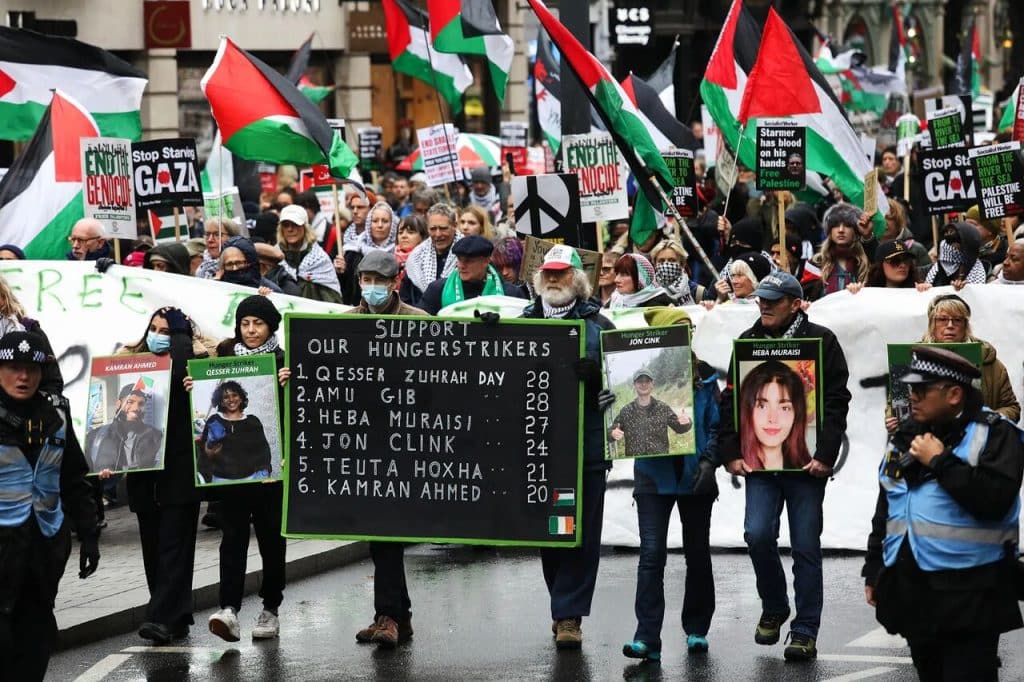
UK prison hunger strike by Palestinian supporters continues, despite waning human rights concerns.
Several pro-Palestinian activists, who are being held in various British prisons under the name of the “Prisoners for Palestine” campaign, are spending the last days of 2025 on a long hunger strike, with reports of their repeated transfers to hospital, doctors warning of the risk of organ failure and even possible brain damage, and families concerned about the lack of adequate medical supervision.
The British media describes the hunger strike as the longest and most widespread strike in the country’s prisons since the 1980s and the era of Bobby Sands (Irish fighter and member of the Irish Liberation Army). The prisoners are mainly detained for their alleged involvement in the raid on the facilities of Elbit Systems, a major Israeli defense contractor, and an attack on a Royal Air Force base in Oxfordshire. They have been held without trial for months. Some of them have been behind bars for more than a year.
A significant portion of the charges have been brought under the umbrella of property damage and trespassing. However, since the designation of Action for Palestine as a terrorist organisation, the case has effectively been handled under a security and terrorism-related framework. This change in framework has paved the way for longer extensions of pre-trial detention and stricter prison restrictions.
The UK government’s decision to designate Action for Palestine as a so-called terrorist organisation was a turning point in the confrontation. The move was implemented through a legal order under the Terrorism Act 2000, making membership in the group, or even expressing support for it, a punishable offence. Critics say that including an unarmed activist network alongside such labels is a sign of the politicisation of definitions of terrorism in the UK.
A group of MPs in the House of Commons have tabled a motion condemning the government’s decision to designate Action for Palestine as a terrorist organisation, calling it a dangerous escalation of the crackdown on civil liberties. In the text of the motion, the signatory representatives mentioned the Quakers and the Suffragettes, recalling the history of disruptive but unarmed protests in British history.
The Quakers were a pacifist religious-social movement in England that played a role in various periods, especially in anti-war and anti-slavery campaigns, and the Suffragettes were women’s suffrage activists who, in the early 20th century, launched widespread protests through civil disobedience and even property destruction to force the government to retreat politically.
In this motion, the British parliamentarians emphasized that damage to public or private property should be dealt with within the framework of ordinary criminal law, because adding the label of terrorism to a protest campaign leads to creating an atmosphere of fear for its supporters.
Several pro-Palestinian activists, who are being held in various British prisons under the name of the “Prisoners for Palestine” campaign, are spending the last days of 2025 on a long hunger strike, with reports of their repeated transfers to hospital, doctors warning of the risk of organ failure and even possible brain damage, and families concerned about the lack of adequate medical supervision.
The British media describes the hunger strike as the longest and most widespread strike in the country’s prisons since the 1980s and the era of Bobby Sands (Irish fighter and member of the Irish Liberation Army). The prisoners are mainly detained for their alleged involvement in the raid on the facilities of Elbit Systems, a major Israeli defense contractor, and an attack on a Royal Air Force base in Oxfordshire. They have been held without trial for months. Some of them have been behind bars for more than a year.
A significant portion of the charges have been brought under the umbrella of property damage and trespassing. However, since the designation of Action for Palestine as a terrorist organisation, the case has effectively been handled under a security and terrorism-related framework. This change in framework has paved the way for longer extensions of pre-trial detention and stricter prison restrictions.
The UK government’s decision to designate Action for Palestine as a so-called terrorist organisation was a turning point in the confrontation. The move was implemented through a legal order under the Terrorism Act 2000, making membership in the group, or even expressing support for it, a punishable offence. Critics say that including an unarmed activist network alongside such labels is a sign of the politicisation of definitions of terrorism in the UK.
A group of MPs in the House of Commons has tabled a motion condemning the government’s decision to designate Action for Palestine as a terrorist organisation, calling it a dangerous escalation of the crackdown on civil liberties. In the text of the motion, the signatory representatives mentioned the Quakers and the Suffragettes, recalling the history of disruptive but unarmed protests in British history.
The Quakers were a pacifist religious-social movement in England that played a role in various periods, especially in anti-war and anti-slavery campaigns, and the Suffragettes were women’s suffrage activists who, in the early 20th century, launched widespread protests through civil disobedience and even property destruction to force the government to retreat politically.
In this motion, the British parliamentarians emphasized that damage to public or private property should be dealt with within the framework of ordinary criminal law, because adding the label of terrorism to a protest campaign leads to creating an atmosphere of fear for its supporters.