
Ukraine Supporters’ Backing for Trump’s Peace Plan: Genuine Coalition or Troubled Alliance?
Although Washington’s plan to end the war in Ukraine has not yet been officially published, leaked versions in Western media suggest that it is based on the transfer of more parts of eastern Ukraine to Russia, limiting the size of Kiev’s armed forces, Ukraine’s permanent commitment not to join NATO, and an agreement on a form of military neutrality; a package that promises in return the lifting of a significant part of anti-Russian sanctions, the release of the bulk of Moscow’s frozen assets, and the allocation of some of them to the reconstruction of Ukraine. At the same time, reports indicate that the text was drawn up in the framework of secret consultations between Washington and a Russian official close to the Kremlin, and many European capitals became aware of its details after the plan was finalized.
In remarks that were widely covered by European media, Zelensky described this period as “one of the most difficult moments in Ukraine’s history” and warned that his country was faced with an impossible choice between preserving national dignity on the one hand and the risk of losing a major partner on the other. Referring to the deadline set by Trump around Thanksgiving in the US (December 25), he stressed that Kiev is considering efforts to amend the text and work with US and European national security advisers to set the path to peace in a way that is “workable”, but at the same time he said that no decision should lead to the violation of Ukraine’s sovereignty and dignity.
In London, a significant part of the high-circulation newspapers have brought headlines about the US president’s unprecedented pressure on Ukraine to accept the plan on their front pages, often oscillating between the duality of “end of the war” and “heavy price of peace”, indicating European concerns about the security and political consequences of the agreement. One such headline, referring to Trump’s deadline, warned that if the plan is rejected, Washington’s aid to Kiev may be reduced or subject to review.
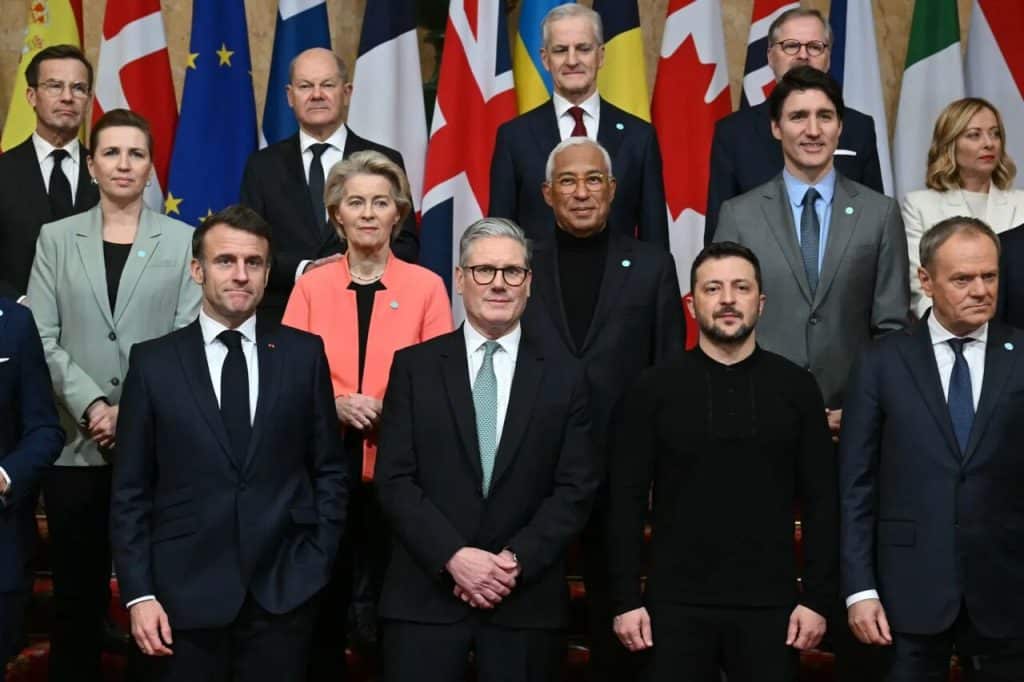
Meanwhile, the British Prime Minister, the French President, and the German Chancellor spoke by phone with Zelensky yesterday, emphasizing their “unwavering commitment” to a “just and lasting” peace, and stressed that any political solution must involve Ukraine’s full participation, preserve its sovereignty, and ensure its long-term security. The leaders of the three European countries, along with the Ukrainian President, have agreed to hold a separate meeting on the sidelines of the G20 summit in South Africa, focusing on the Ukrainian war and the US peace plan. In the eyes of observers, this is more an attempt to coordinate Europe’s response and prevent the coalition from becoming marginalized in a process that is now being played out between Washington, Moscow, and Kiev.
It is worth noting that the coalition, which is now known as the “Coalition of the Willing,” was launched in March of last year after the London summit under the slogan “Securing the Future” at the initiative of Britain and France. This initiative, which was initially formed with the participation of a number of European and Commonwealth countries and the presence of representatives of the European Union and NATO, officially declared its goal to provide strong security guarantees to Ukraine in the event of a ceasefire or peace agreement with Russia. These guarantees were supposed to go beyond previous commitments, such as the 1994 Budapest Memorandum, and to somehow fill the void caused by the impossibility of immediate Ukrainian membership in NATO.
Within the framework of this initiative, several meetings were held in London, Paris, Brussels, and Kyiv in recent months, and European leaders spoke of the formation of a multinational force called the “Assurance Force” to be deployed on Ukrainian territory after the end of the war. This force was supposed to prevent repeated Russian attacks and ensure the security of a possible agreement through land, sea, and air operations. At the last meeting of this coalition, Emmanuel Macron announced the commitment of 26 countries to provide security guarantees after the war and the readiness of a number of them to send forces as part of this security umbrella.