
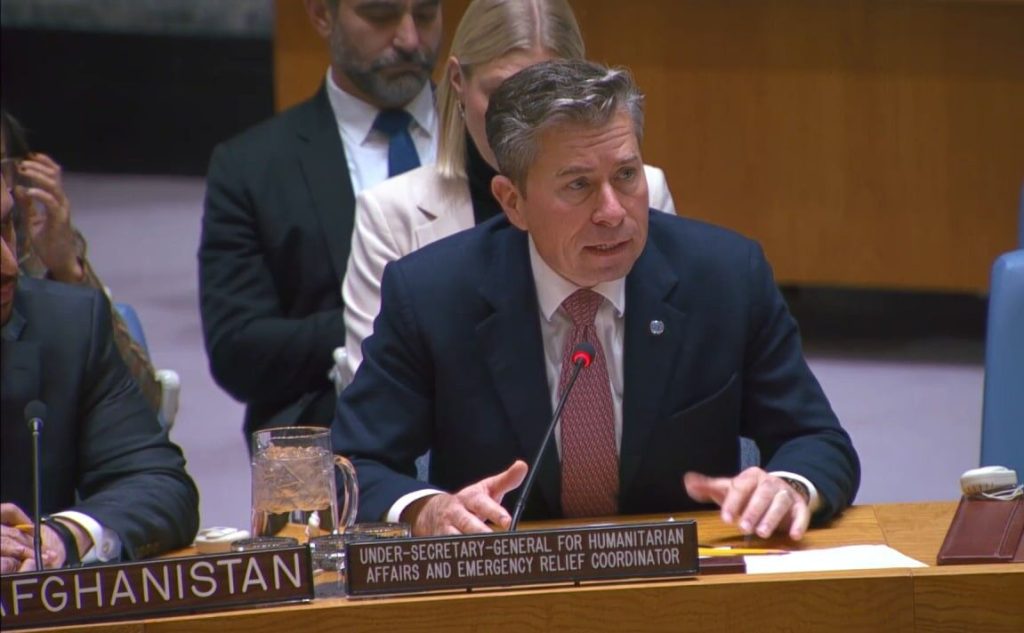
UN warns of humanitarian crisis in Afghanistan.
Tom Fletcher, the Under-Secretary-General for Humanitarian Affairs and Emergency Relief Coordinator, also criticized the increasing restrictions on UN women staff in Afghanistan and the sharp reduction in international funding at a Security Council briefing today (Wednesday local time), stressing that without financial support and lifting restrictions, millions of lives are at risk.
He added: Nearly 22 million people will still need humanitarian assistance in 2026, a figure that ranks third after Sudan and Yemen.
The UN Under-Secretary-General said: Our request is $1.7 billion to help 17.5 million people. We have prioritized our plan more than ever to cover 3.9 million people in urgent need, for which we need $375.9 million.
Fletcher emphasized: For the first time in the past four years, the number of people facing hunger has increased and now stands at 17.4 million. Basic services, already inadequate and unbalanced, have reached breaking point with the unprecedented return of Afghan refugees to Afghanistan.
He continued: “More than 2.6 million Afghans have returned in 2025, bringing the total number of returns in the past two years to more than four million. The situation of those who have returned is fragile; many are entering societies that are themselves in crisis and economies that cannot meet their needs. Women and children make up 60 percent of those who have returned, while they are returning to a country where women and girls are denied education, work and, in some cases, even health care.”
The UN Under-Secretary-General added: “With 2.5 million Afghans in Pakistan, a large proportion of whom have recently lost their legal status, the prospect of wider returns is deeply concerning.” In addition, drought conditions have gripped the country and are continuing into winter, directly affecting 3.4 million people, reducing crop production and accelerating groundwater depletion.
The senior UN official said: “Increasing human rights restrictions, particularly against Afghan women staff, have made life more difficult for many and placed additional burdens on our operations. In early September, Afghan female UN staff were barred from entering UN compounds. Three months on, these restrictions remain in place. Both male and female colleagues continue to assist affected communities, but the absence of women in the workplace is another tragic reminder of the unacceptable restrictions on Afghan women.
In late October, another restriction was imposed; almost all Afghan female UN staff working in humanitarian settings were barred from working at the Islam Qala reception centre on the Iranian border, where thousands of returns are reported daily. This has limited women’s access to vital protection and health services.”
“We have been able to resume the work of a small number of female health workers, and limited critical medical services have been restored, but other operations remain temporarily suspended,” said the UN Deputy Secretary-General.
Fletcher added: “I reiterate the UN Secretary-General’s call for the Afghan interim authorities to lift these restrictions and allow female workers to work safely, fully, and meaningfully in all humanitarian sectors. We need them, and Afghanistan needs them.”