
US National Security Strategy 2025: Trump & India relations.
From the analytical website Eurasia Review, with the publication of the US National Security Strategy 2025, speculation has increased about Washington’s change in approach towards Asia. The content of the document shows that the US is no longer keen on confrontation with China and has even accepted the influence of “bigger, richer and more powerful” countries as an enduring reality in international relations; a change that implicitly introduces China and Russia as no longer a direct threat to the rules-based international order, but rather as accepted players in the global power structure.
This policy shift has placed America’s Asian allies and partners, including Japan, South Korea, and Australia, in a fragile position and has also directly affected India-US relations. Relations between New Delhi and Washington have noticeably soured in recent months, partly due to the Trump administration’s imposition of new tariffs on India and its repeated criticism of New Delhi’s imports of Russian oil and gas, despite Western sanctions.
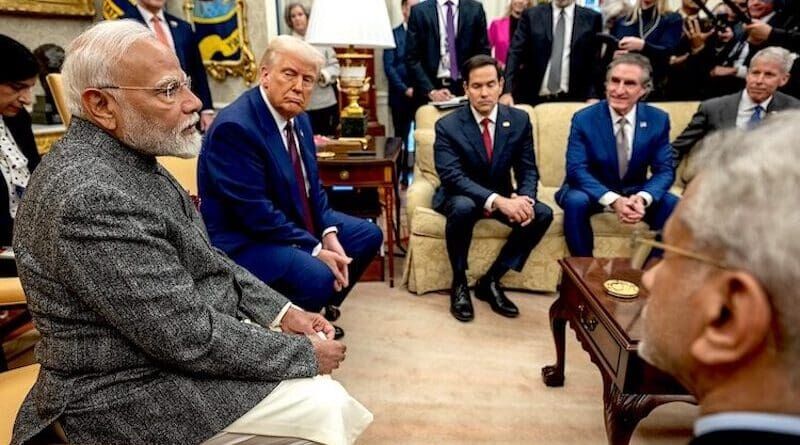
This situation is a significant departure from previous expectations from the second term of Donald Trump’s presidency. In Trump’s first term and also in the Joe Biden administration, India was defined as a key strategic partner and the main pillar of US policy in the Indo-Pacific. Now, however, India is faced with unilateral trade measures and harsh positions from Washington; a development that seemed unthinkable a year ago, given Trump’s close relationship with Indian Prime Minister Narendra Modi.
The National Security Strategy 2025 consolidates this change of direction. India’s name is mentioned only a few times, mainly in the form of general regional frameworks, while China has a stronger contribution in the document and is mentioned mostly with an economic approach. Russia is also mentioned mainly in the context of strategic stability and Europe’s inability to manage relations with Moscow. This pattern indicates Washington’s distancing itself from a policy of open confrontation and moving towards a more pragmatic view of great powers.
Signs of this shift were visible even before the document was officially released, including Trump’s social media mention of a “Group of Two” mechanism ahead of his meeting with Chinese President Xi Jinping on the sidelines of the Asia-Pacific Economic Cooperation summit. This new approach has also placed other regional partners, such as Japan, more within narrow regional frameworks without a clear geopolitical definition.
Overall, America’s strategic focus has noticeably shifted back to the Western Hemisphere, with less attention paid to the Indo-Pacific, a shift that is not necessarily due to India’s declining importance, but rather reflects Trump’s redefinition of priorities in the form of an “America First” policy. However, the National Security Strategy continues to call for New Delhi to play a role in Indo-Pacific security and mechanisms such as the Quad; A sign of Trump’s dual and volatile relationship with India, in which Washington can neither completely ignore New Delhi nor maintain it in its previous position.
Despite the verbal emphasis on partnership, recent US actions, including the tariff war, have led to the weakening of bilateral relations and regional security. Analysts believe that a strategy that does not clearly define threats and leaves the future of partnerships ambiguous limits the traditional role of the US in the Asian security architecture.
In this context, efforts to restore the approach of assimilating India and Pakistan or the desire for arrangements such as the “Group of Two” could exacerbate the concerns of regional partners. While China remains a serious challenge to the security of the US, India, and its allies, ignoring this reality and marginalizing partners such as India, observers believe, could ultimately harm Washington’s interests and increase tension and polarization in the region.