
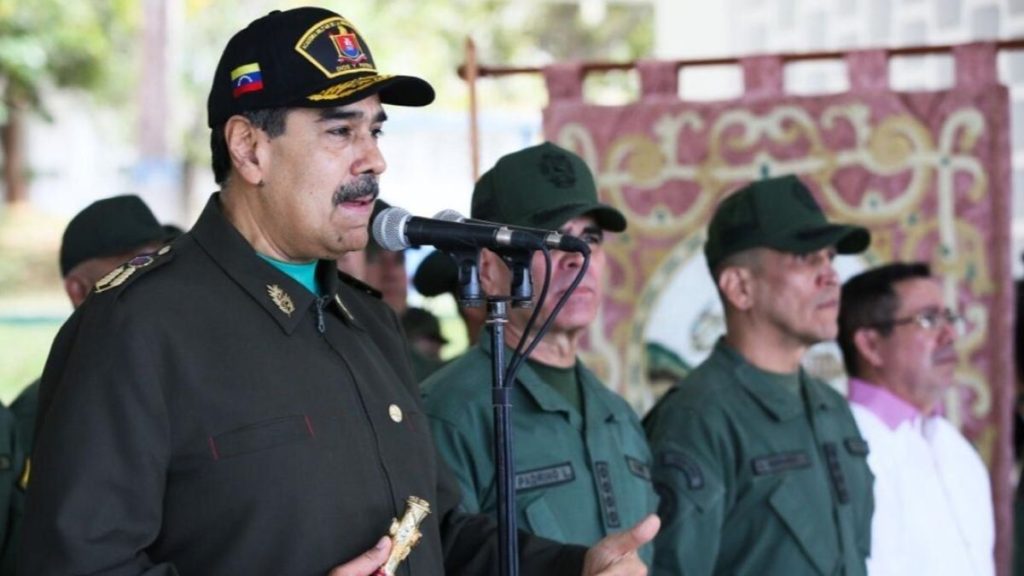
US strikes Venezuela, captures President Maduro, and charges him with drug offenses.
The US Air Force carried out a series of airstrikes on targets in Venezuela on Friday morning, accompanied by explosions in Caracas. Hours later, Donald Trump announced that US forces had captured and deported Nicolas Maduro and his wife Cilia Flores, the first time in modern times that the US has publicly announced the capture of a sitting president.
The operation was part of a maximum pressure campaign against Maduro’s government that has seen an increased US military presence in the waters around Venezuela since September, airstrikes on suspected drug-trafficking boats, the seizure of Venezuelan oil tankers, and widespread economic pressure. Rights groups have said dozens of people have been killed in the attacks and have warned of possible violations of international law.
Venezuelan authorities have accused the US of trying to seize control of the country’s vast oil reserves. From their perspective, Washington’s main goal is not to fight drug trafficking but to change the balance of power and gain direct access to Venezuela’s energy resources.
The tension between the two countries has long roots and dates back to the presidency of Hugo Chavez, when Caracas became a serious opponent of Washington’s policies in the region by adopting anti-American positions and close ties to countries such as Cuba and Iran. These tensions have intensified during the term of Nicolas Maduro, and the United States has called his government illegitimate.
In recent years, disputed elections, the suppression of the opposition, and a deep economic crisis have severely weakened Maduro’s domestic position. However, his sudden arrest, without an immediate collapse of Venezuela’s government and military structures, has raised new questions about the country’s political future.
According to many experts and a writer for the Guardian newspaper, the arrest of Nicolas Maduro cannot be analyzed simply as a limited military operation or an action within the framework of the fight against drug trafficking. This event marks a shift in the tone and tools of American foreign policy, particularly during the second term of Donald Trump’s presidency, a period in which the direct use of military force to impose political will has once again become a legitimate option in Washington’s official discourse.
What makes this action even more striking is that it coincides with the publication of the so-called “Trump Annexation” doctrine. This document explicitly emphasizes the US right to control the political, economic, and military aspects of the Western Hemisphere and to use military power to secure access to energy resources. From this perspective, Venezuela is not simply a belligerent state, but a symbolic example of the application of this new doctrine.
However, previous US experiences in the region show that “removing the leader” does not necessarily lead to stability or democratic transition. The power structure in Venezuela, especially the deep links between the security institutions, the military, and the economic networks affiliated with the state, remains intact. In such circumstances, Maduro’s arrest could pave the way for internal conflicts, power fragmentation, and an escalation of the humanitarian crisis, rather than a rapid collapse of the political system.
On the other hand, this move also has transregional consequences. The arrest of a sitting president without international consensus could undermine the rules of international law and the legitimacy of multilateral institutions, setting a dangerous precedent for future interventions.
Ultimately, the main question is not whether Maduro will be removed, but rather what image the United States will present of its desired political order in Latin America after this move: one based on stability and political reconstruction, or one that reproduces chronic instability by relying on hard power. The answer to this question will determine the fate of Venezuela and perhaps the entire region in the years to come.