
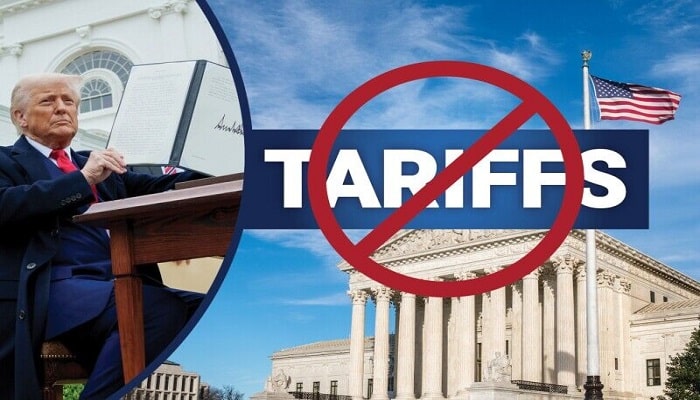
PNN – The US Supreme Court’s ruling against Trump’s tariffs has taken his administration’s trade policy into a new and more complex phase, one whose outcome depends on decisions made in both domestic courts and international negotiating tables.
According to the report of Pakistan News Network, the United States Supreme Court ruled 6 to 3 that US President Donald Trump does not have the authority to unilaterally impose tariffs under the International Emergency Economic Powers Act (IEEPA), a decision that nullifies a key pillar of the Trump administration’s tariff strategy.
The Atlantic Council, a think tank, has used its expert opinions to assess the ruling, which could have far-reaching implications for Washington’s trade policy, corporate lawsuits, and international trade negotiations.
Josh Lipsky, head of international economics at the think tank, believes that with this ruling, the Supreme Court told the president that the main pillar of his international economic agenda is unconstitutional.
Barbara C. Matthews, a nonresident senior fellow at the Center for Geo-economics, also said the court’s ruling was “both clear and simple,” emphasizing that “no part of the IEEPA can be interpreted to authorize the imposition of tariffs in response to any national emergency.”
According to former Deputy US Trade Representative L. Daniel Mulaney, this decision could lead to a more active role for Congress in the area of tariffs. He believes this could lead to a more active Congress, which has previously shown cautious disapproval of the Trump administration’s use of unilateral tariffs.
Mullaney also described the timing of the ruling, just before the president’s annual address to Congress, as a “bold move” and perhaps “a sign of the court’s independence.”
Yesterday’s ruling drew an immediate response from Trump, who announced that he would impose a global tariff of 10 percent under other legal authority. However, analysts say the legal tool is only temporary, lasting 150 days, unless Congress extends it. The president also announced the launch of a new investigation into unfair trade practices that could lead to more tariffs.
Lipsky said: The Supreme Court’s ruling does not end Trump’s tariffs; it only opens a new chapter. He predicted that there would be “more uncertainty and greater volatility for businesses” compared to the first year of the Trump administration.
Meanwhile, Matthews stressed that the government now has to follow “normal practice,” which requires formal proof of trade missteps by foreign countries to justify imposing tariffs. He said it would be “a slow bureaucratic process.”
At the same time, Mullaney believes that the loss of previously broad authority may not be a negative for the White House overall. He said that Trump’s sweeping tariffs have been problematic for the administration’s agenda in some respects, and that a more targeted approach may be more appropriate for Washington.