

PNN – Massive U.S. investments in artificial intelligence and data centers in the Persian Gulf are more vulnerable to the fallout of war than other assets.
According to the report of Pakistan News Network; during a conflict involving the United States and the Zionist regime against Iran, Iranian drones and missiles struck Amazon data centers in Bahrain and the United Arab Emirates. This marked the first instance of a data center being deliberately targeted in a military engagement, signaling the dawn of a new era: cloud infrastructure is now considered a legitimate target and a theater of warfare.
These devastating and crushing blows occurred against a backdrop where American tech giants—such as Microsoft, Nvidia, and OpenAI—have invested hundreds of billions of dollars in the Persian Gulf states over the past decade; should tensions flare up again, these investments could emerge as potential targets for Iran in future conflicts.
In recent years, Persian Gulf states—such as the United Arab Emirates, Saudi Arabia, Qatar, and Bahrain—have been experiencing an unprecedented wave of digital infrastructure development. This surge is driven by Washington’s decision to transform the Persian Gulf into the “most significant hub for artificial intelligence computing outside the United States,” as well as the Gulf nations’ own desire to break free from their dependence on oil. However, the conflict that erupted earlier this year demonstrated a stark reality: when a data center provides computing power that serves both the economy and military objectives, it can no longer be classified as a “civilian facility.”

Artificial Intelligence Infrastructure in the United Arab Emirates
Almost all major American tech giants are actively involved in the artificial intelligence sector in the United Arab Emirates. The UAE aims to become a primary hub for artificial intelligence outside of the United States. The total announced investments by these companies in Abu Dhabi and Dubai exceed $100 billion. For instance, Microsoft has committed to investing $15.2 billion in the country by 2029—$4.6 billion of which has already been deployed into AI and cloud data centers. Amazon maintains several availability zones in the UAE, and Oracle has established its own cloud regions in Abu Dhabi and Dubai. Yet, amidst this array of facilities, one project stands out above the rest: the UAE’s “Stargate.”

This artificial intelligence park in Abu Dhabi is the result of collaboration between OpenAI and the Emirati group G42. The entire complex targets a capacity of 5 gigawatts and, once completed, could house millions of AI processors. The value of the project’s first phase alone is estimated at nearly $30 billion, with OpenAI, Nvidia, Microsoft, Oracle, and Cisco serving as the key players. Nvidia is supplying the processors, Oracle and Microsoft are building the cloud infrastructure, and OpenAI acts as the primary operator. The facility is located near Abu Dhabi, in close proximity to the Al Dhafra Air Base—which hosts U.S. military personnel.
Prior to the 40-day conflict, the plan was to construct a massive, centralized campus in Abu Dhabi; however, the strategy has since shifted toward dispersing facilities across more secure and remote locations. Nevertheless, this adjustment does not alter the fundamental reality: existing facilities cannot be relocated, and projects currently under construction will not be halted.
Artificial Intelligence Infrastructure in Kuwait
The scale of artificial intelligence infrastructure in Kuwait is significantly smaller than that of the UAE; yet, even this more limited investment opportunity has not escaped Washington’s notice.
For instance, Microsoft, in collaboration with ZainTech—the digital arm of the Zain Group, Kuwait’s largest telecommunications operator—plans to establish the country’s first AI-enabled Azure cloud region, while also exploring the creation of an AI innovation center. ZainTech will handle local integration and regulatory compliance, while Microsoft will provide Azure and Copilot capabilities. This initiative is aimed at Kuwait’s government and its small and medium-sized enterprises (SMEs), in alignment with the “Vision 2035” framework.

The exact investment amount for Kuwait has not been disclosed as clearly as the figures for the UAE; however, Kuwait is one of four Gulf states included in Microsoft’s investment package—valued at over $10 billion—set for September 2026. For a nation like Kuwait—characterized by its limited land area yet highly sensitive strategic location—even a medium-sized data center would become a critical, high-value target in the event of a conflict.
Artificial Intelligence Infrastructure in Saudi Arabia
Spearheaded by the company HUMAIN—a subsidiary of the Public Investment Fund (PIF)—Saudi Arabia is developing its artificial intelligence roadmap. Amazon, Microsoft, and NVIDIA are partners of HUMAIN, while Google is also engaged in a joint project with the Saudi Ministry of Communications. Riyadh’s objective aligns with that of Abu Dhabi: to transform computing power into an exportable commodity—alongside oil—within the framework of “Vision 2030.”
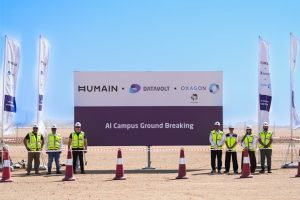

A key difference between Saudi Arabia and the UAE in the artificial intelligence sector is that while the construction of data centers in Saudi Arabia began somewhat later, its plans are more ambitious. Collaboration between HUMAIN and Amazon is valued at approximately $5 billion, and both NVIDIA and AMD have secured licenses to export a large number of advanced AI chips to Saudi Arabia in 2025. Unlike Amazon’s facilities in Bahrain and the UAE, these installations have not been subjected to direct attacks—such as those that occurred during the 40-day war.

Artificial Intelligence Infrastructure in Bahrain
In 2019, Amazon established its first cloud region in West Asia in Bahrain. In March 2026, these facilities were damaged during attacks. In September, Amazon officially confirmed that access to the Bahrain data center could not be restored, and that one of the three availability zones in the UAE had also been lost. In its announcement, Amazon advised customers to migrate all accessible resources to other regions and to recover inaccessible data from backups.

The incident in Bahrain revealed an overlooked reality: while the physical value of a data center—comprising servers, cooling systems, and the facility itself—may amount to only a few hundred million dollars, the data stored within it, along with the banking, payment, and government systems that rely on it, hold a value far exceeding that of the hardware. In Bahrain, Amazon hosted not only commercial clients but also workloads associated with a cloud contract for the U.S. Department of Defense.
Why attacks on data centers are considered legitimate military targets?
In its analysis of this year’s attacks on data centers, the United Nations Institute for Disarmament Research (UNIDIR) explicitly stated that the reliance of modern militaries on commercial cloud service providers has inextricably intertwined military applications with civilian digital infrastructure. The very same data center that processes e-commerce orders by day might be used at night to analyze satellite imagery or train target-recognition models. When a facility serves both the economy and the war machine simultaneously, it can no longer be classified as purely “civilian.”

Data centers typically benefit from advanced cyber-security measures and disaster recovery plans; however, these safeguards are designed to counter hacking attacks and natural disasters—not cruise missiles. UNIDIR notes that such facilities are “on the scale of a small city—difficult to conceal and exceptionally hard to defend against kinetic threats.”

Overall, it appears that the artificial intelligence infrastructure built by the Persian Gulf states using petrodollars is evolving into a peculiar strategic asset: it serves simultaneously as an extension of American technological hegemony beyond its borders and as a lever that Iran could use—without engaging in direct confrontation—to inflict maximum damage on the adversary at minimal cost. The destruction of a single data center would not merely harm the balance sheets of companies like Amazon or Microsoft; it would also cripple the banks, government portals, logistics systems, and military communications that rely upon it. This is precisely why American firms are currently re-evaluating their ongoing investments in the Persian Gulf.