
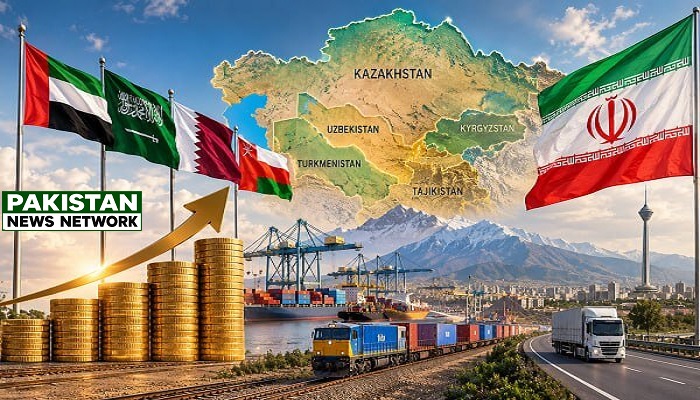
PNN – Increased investment by Arab countries in Central Asia has sparked a new competition for economic influence and transit routes across Eurasia.
The expanding economic presence of the Arab Gulf states in Central Asia is emerging as a significant geoeconomic development in Eurasia. While at first glance this trend appears primarily linked to investments in energy, infrastructure, and trade, at a deeper level, it has the potential to influence the economic and political balance among Iran, the Arab states, and the major powers located to the north of the region. A recent report by the Eurasian Development Bank, released on November 10, 2026, indicates that the stock of foreign direct investment from Gulf Cooperation Council (GCC) member states in Central Asia grew from $9.1 billion in 2020 to $31.1 billion in the first half of 2026—a more than threefold increase that underscores a shift in the standing of Arab investors within the economies of the five Central Asian republics.
Concurrently, trade between the two regions has grown from $1 billion in 2020 to $3.9 billion in 2025. These figures indicate that Central Asia is gradually emerging as a significant destination for capital from Arab nations.
It should be noted, however, that the $31.1 billion figure refers to the accumulated stock of foreign direct investment; it does not imply that this entire amount entered the region in recent months, nor that all of it represents new, ongoing investments. Nevertheless, the growth of this indicator over a six-year period—particularly when considering the shifting composition of these investments—points to the emergence of a long-term trend.
The UAE: A Key Driver of Capital Inflow into Central Asia
Among the Gulf Cooperation Council (GCC) states, the United Arab Emirates (UAE) holds the top position by a significant margin. According to a report by the Eurasian Development Bank, the UAE’s stock of investment in Central Asia reached $20.6 billion by mid-2026—accounting for approximately 66% of the total investment from Arab nations in the region. Saudi Arabia follows with $6.5 billion and Qatar with $3.1 billion. Consequently, contrary to the common perception that the expansion of Arab economic influence is primarily driven by Saudi Arabia’s investment policies, the UAE remains the dominant player in Central Asia.
The UAE’s primary advantage in this competition lies in its large international corporations, banking and financial networks, ports and logistics infrastructure, and experience in investing across diverse markets. Companies such as Dragon Oil, Masdar, DP World, and entities affiliated with the Abu Dhabi National Oil Company (ADNOC) maintain a presence in various sectors of the Central Asian economy.
Turkmenistan is one of the UAE’s most significant investment destinations. Dragon Oil has been operating in Turkmenistan’s offshore Cheleken (Jeytun and Jigalybeg) oil fields since 2000, with total investment in the project estimated at approximately $10 billion. Furthermore, in 2025, XRG—an entity affiliated with ADNOC—acquired a 38% stake in Turkmenistan’s offshore Gas Block 1. According to estimates by the Eurasian Development Bank, approximately 70% of the UAE’s investment portfolio in Central Asia is directed toward Turkmenistan, primarily within the oil and gas sector.
However, the significance of the UAE’s presence is not limited solely to the control of hydrocarbon resources. The country is also expanding its investments into renewable energy, the food industry, and transport infrastructure. The company Masdar is involved in major solar and wind projects in Uzbekistan; meanwhile, in Kazakhstan, the construction of a one-gigawatt wind power plant—with an investment of approximately $1.4 billion—has commenced in the Jambyl Region in the south of the country. This trend indicates that Emirati investors are seeking to establish a presence across various segments of the production chain and economic infrastructure in Central Asia.
Saudi Arabia: Expanding Influence through Energy and Infrastructure Development
In recent years, Saudi Arabia has also adopted a more proactive approach in Central Asia. The country’s investment stock in the region—which stood at approximately $300 million in 2021—has grown to about $6.5 billion as of the first half of 2026. The bulk of this investment is concentrated in Uzbekistan, with the company ACWA Power alone accounting for over 95 percent of Saudi Arabia’s direct investment portfolio in Central Asia.
ACWA Power is involved in wind power projects in the Karakalpakstan region of Uzbekistan, the Kungrad power plants, and several solar energy initiatives across Tashkent, Samarkand, and the Syrdarya region in eastern Uzbekistan. Beyond these projects, Saudi investors are also expanding cooperation in sectors such as data centers, cable manufacturing, and airport infrastructure in Uzbekistan.
The strategic significance of this policy lies in the fact that, alongside efforts to diversify its domestic economy under the “Vision 2030” framework, Saudi Arabia is seeking to develop new markets for its major corporations and capital. With its growing population, abundant mineral and energy resources, extensive need for infrastructure, and its position as a connecting hub between East and West, Central Asia offers a favorable environment for this objective.
Qatar and Oman: Investment in Telecommunications, Banking, and Industry
Qatar is also emerging as a significant investor in Central Asia. By the first half of 2026, the country’s stock of investments had reached approximately $3.1 billion—nearly double the level recorded a year and a half earlier. Unlike Saudi Arabia, which focuses primarily on the energy sector, Qatar’s investment portfolio is more diversified, encompassing telecommunications, banking, industrial manufacturing, power, and transportation.
One of the most significant examples is the acquisition of the Kazakhstani mobile telecommunications operator—comprising the Tele2 and Altel brands—by the Qatari firm Power International Holding, in a deal valued at approximately $1.1 billion. Similarly, the acquisition of Berke Bank by the Qatari institution Lesha Bank underscores the entry of Qatari capital into Kazakhstan’s financial sector. Oman has also expanded its presence, with cumulative investments totaling around $924 million, primarily across the natural resources, energy, logistics, and commercial real estate sectors.
These diverse approaches demonstrate that Arab nations are not merely seeking to acquire natural resources; rather, they are progressively expanding their footprint within the region’s banking, telecommunications, industrial, and infrastructure networks.
Why has Central Asia become significant for Arab countries?
The increase in investment by Gulf Cooperation Council (GCC) states in Central Asia should be viewed within the context of the evolving economic order in Eurasia. The war in Ukraine, extensive sanctions against Russia, the growing importance of alternative corridors, China’s economic growth, and the efforts of Central Asian nations to reduce their dependence on a single foreign power have created new opportunities for Arab investors.
Kazakhstan and Uzbekistan are major global producers of uranium, and the region possesses significant reserves of oil, gas, and strategic minerals. Furthermore, Central Asian nations require foreign capital to develop their energy, transport, industrial, and technological infrastructure. Meanwhile, the Arab states of the Persian Gulf are seeking to invest their energy-derived revenues into new economic sectors, aiming to reduce their reliance on oil and gas exports.
Consequently, the economic interests of both sides are largely complementary: Central Asia requires capital, technology, and access to global markets, while Arab nations seek investment opportunities, mineral resources, food security, and the expansion of their trade networks. Furthermore, the Gulf Cooperation Council and the countries of Central Asia initiated a joint strategic dialogue in 2022, which strengthens the institutional framework for these relations.
Another significant development is the establishment of a link between investment and the expansion of transit infrastructure. On November 10, 2026, the Eurasian Development Bank hosted over 80 investors, government officials, and representatives from financial institutions—hailing from the Gulf States and Central Asia—in Abu Dhabi. Concurrently, the bank inaugurated an office at the Abu Dhabi Global Market, designed to serve as a hub for attracting capital toward Eurasian projects. The bank also announced plans to establish investment funds focused on Central Asia and the Caucasus. In essence, the objective extends beyond financing a few isolated projects; it seeks to create an institutional pathway for channeling capital from the Gulf into the Eurasian economy.
Implications of This Shift for Iran: Competition for Markets, Capital, and Connectivity Routes
The growing economic presence of Arab nations in Central Asia carries multifaceted implications for Iran. The primary consequence is intensified competition to attract capital and secure market share. Geographically, Iran is well-positioned to serve as a key gateway for Central Asian states to access the Persian Gulf and the Sea of Oman; however, Arab investors are currently forging direct ties with regional governments and engaging in projects that could potentially link these nations to global markets without requiring transit through Iranian territory.
Should the UAE and Saudi Arabia participate in the construction of power plants, industrial facilities, logistics warehouses, airports, and transport networks in Central Asia, they will—beyond securing economic gains—also play a role in shaping the region’s trade routes and infrastructure. Under such circumstances, Iran risks ceding a portion of its investment and transit opportunities to its rivals.
This issue is particularly significant given the UAE’s substantial role in the development of the Middle Corridor and logistics infrastructure. In October 2026, DP World began the construction of a dry port and major logistics hub near Tashkent, designed with an annual handling capacity of 150,000 containers. Such projects have the potential to strengthen Uzbekistan’s connectivity to regional transport networks and foreign markets.
A second consequence is the potential for increased economic and political influence by Arab states in Iran’s surrounding region. Investments in energy, telecommunications, banking, and critical infrastructure can foster long-term relationships and bargaining power for the investing governments. While this does not in itself constitute the formation of a coalition against Iran, the expansion of such ties would enhance the economic and diplomatic weight of Arab states within the calculus of Central Asia.
The third implication concerns Iran’s economic relations with Central Asian countries. If Arab investors are able to offer a comprehensive package—encompassing financing, technology, insurance, and logistics services—Iranian companies may face greater challenges in competing for a presence in these markets. Particularly in the sectors of electricity, renewable energy, and technology-related industries, Iran needs to bolster its financial capacity and expand international cooperation to maintain its market share.
The Need to Re-evaluate Iran’s Economic Policy toward Central Asia
The reality is that the increase in investment by Arab nations in Central Asia highlights, above all, Iran’s weakness and sluggishness in transforming its geographical advantage into an economic one. Geographically, Iran is exceptionally well-positioned to connect Central Asia to the open seas; however, this potential will only become valuable once transportation costs, transit times, customs procedures, financial constraints, and investment risks along Iranian routes are reduced.
A report by the Eurasian Development Bank identifies high logistics costs, inadequate warehousing infrastructure, limited trade finance, and challenges in harmonizing standards as key obstacles to the development of trade between Central Asia and the Persian Gulf states. These are precisely the areas where Iran—through appropriate investment and policy-making—could establish a competitive advantage.
Furthermore, Tehran should elevate its economic relations with Central Asian nations, moving beyond limited bilateral trade toward collaboration on production, industrial, and infrastructure projects. Key components of such a strategy could include energy cooperation with Turkmenistan, expanded exchanges with Uzbekistan, the development of rail links with Kazakhstan and Tajikistan, and the utilization of the capacity offered by the port of Chabahar.
Ultimately, the expansion of investment by Arab countries in Central Asia should be viewed as a sign of emerging competition over resources, markets, and connectivity networks in Eurasia. This competition is not limited to Russia, China, Turkey, and the West; the Arab states of the Persian Gulf—leveraging their capital and major corporations—are also becoming increasingly influential players.