
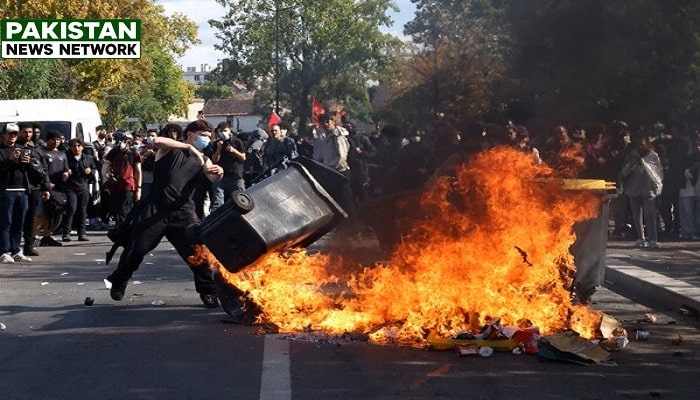
PNN – Student protests in France, which began with demands regarding education, have spread in less than two weeks and—marked by school closures and clashes with the police—have evolved into a serious challenge for the government.
Student protests in France—which began with demands regarding education and grievances over school conditions—have now evolved into one of the most serious challenges facing the government; a movement that, in less than two weeks, has spread from the Paris suburbs to various parts of the country, forcing the closure or disruption of hundreds of schools and—in some areas—leading to clashes between protesters and police, as well as arson and vandalism targeting school facilities.
In describing the current situation, the newspaper Le Monde employed a striking phrase, noting that the spread of youth protests has caused the government to break into a “cold sweat”—an expression that must be understood within the context of France’s historical experience with youth movements, rather than merely as a reference to the scale of the current unrest.
The protests began in schools but spilled out onto the streets.
The roots of these protests trace back about two weeks, when students at a high school in the Paris suburbs launched their protest. The initial demands were not particularly complex: teacher shortages, overcrowded classrooms, dilapidated school buildings, heavy curricula, and concerns regarding academic futures and university admission procedures.
However, what initially appeared to be a protest concerning professional and educational issues quickly expanded beyond the confines of a single school. On Thursday, more than a thousand high schools across France were involved in strikes, rallies, or protests, and approximately one-quarter of the country’s high schools were affected by these developments in some way.
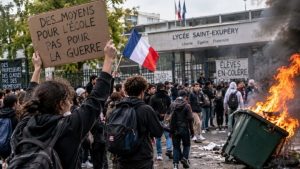
On Friday, more than 400 schools were closed or saw their educational activities disrupted. The protests also spread to universities, with a number of campuses experiencing rallies or blockades.
As the protests expanded, the nature of the movement shifted. Alongside peaceful gatherings and demands regarding education, some cities saw clashes with police, the throwing of objects, the burning of trash bins and buildings, and even fires set at school entrances. In Nantes, a fire at the entrance of a high school was among the incidents that heightened government concern.
The Scope of Unrest: From Arrests to Damage to Schools
Student protests in France—which began last week over a lack of educational resources, overcrowded classrooms, and teacher shortages—entered a new phase on Thursday as they spread to universities and the number of arrests rose.
The French Interior Minister announced that more than 5,000 people have been detained since Monday during student protests across the country. According to the minister, approximately 85 percent of those detained are minors, with the majority being school students. Nearly 2,000 people were detained on Thursday alone, and hundreds of police officers, gendarmes, and firefighters were injured during the unrest. Subsequent reports indicate a further rise in the number of arrests linked to these protests.
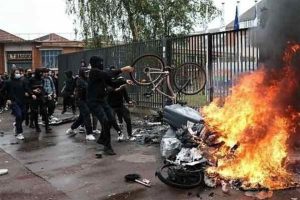
It has also been reported that 305 police and gendarmerie officers were injured during the protests.
Reports further indicate that approximately 400 schools have been closed due to the protests, with educational services now provided solely via remote learning. Additionally, 170 students sustained injuries during the unrest.
On Wednesday, around 600 people were detained; French authorities have accused them of arson and attacking police officers.
Protests in cities including Lyon, Lille, and Saint-Denis involved the blocking of school entrances; in some instances, trash bins were set on fire and objects were thrown at police officers.
Meanwhile, the French Prime Minister called for an emergency meeting on Thursday to examine the various aspects of this crisis.
Reaction of French officials: Protesters’ violence is unjustifiable.
As unrest spreads across various parts of France, the country’s politicians have adopted differing stances regarding the student protests and the ensuing clashes; some emphasize the need to address the students’ demands, while others condemn the violence that has occurred during the protests.
French President Emmanuel Macron stated that he could understand the concern and anger of protesting students but emphasized that none of these discussions or concerns justify violence.
French Prime Minister Sébastien Lecornu also remarked that “issues in high schools must be heard and addressed,” adding: Violence must be condemned unequivocally, and the perpetrators must be held accountable for their actions.
Marine Le Pen, the presidential candidate from the right-wing National Rally party, said: This is no longer a protest by high school students; rather, these are riots organized by professionals and overseen by representatives of the France Unbowed party.
In contrast, Jean-Luc Mélenchon, leader of the radical-left France Unbowed party, stated that his party “has called for non-violent methods of struggle” and urged the government to respond to the demands instead of waging a partisan political battle.
Has the nightmare of 1968 returned?
Yet, what makes these protests particularly sensitive for the French government is not merely the number of demonstrators or the intensity of the clashes; rather, it is France’s historical experience in dealing with youth movements.
In France’s political memory, “May 1968” remains a pivotal moment. Those protests began in universities but rapidly escalated into widespread labor strikes and a profound socio-political crisis, confronting Charles de Gaulle’s government with one of the most difficult challenges of his era.
The nightmare of 1968 is precisely this: that a protest by students and young people might transcend its initial, limited demands and draw other segments of society out into the streets.
For this reason, any widespread youth movement in France can trigger particular sensitivity within the government and political institutions—especially when protests spill beyond educational settings and draw in other social and political groups.
It is in this context that Le Monde’s use of the phrase “cold sweat” gains significance. The issue is not merely that hundreds of schools have closed or that groups of students have taken to the streets; the primary concern is that a generational protest—occurring while French society grapples with a host of economic and political challenges—could escalate into a broader crisis.
An Educational Crisis Overshadowed by Political Turmoil
However, the origins of the protests should not be attributed solely to the activities of a single political party. Reports from French media indicate that the initial protests in the Paris suburbs were driven primarily by the direct demands of students, with social media playing a significant role in their rapid spread.
Conversely, the French government and certain security agencies have alleged that the “France Unbowed” (La France Insoumise) party and far-left factions played a role in escalating and steering the protests. Some intelligence reports have also pointed to the involvement of these groups. Nevertheless, the party in question has denied these claims, and there remains disagreement regarding the extent to which political factions played an organized role in the protests.
Therefore, a distinction must be made between two realities: first, the students’ genuine grievances regarding the state of education and their academic futures; and second, the involvement of political actors and various groups in a movement that has expanded significantly since its inception.
Underlying these protests is a significant economic issue. The French government is facing demands for increased education spending at a time when it is simultaneously attempting to draft the 2027 budget through cost-cutting measures. The government has spoken of saving tens of billions of euros for the coming year, and France’s public debt remains at a very high level.
This means the government finds itself in a situation where protesters are demanding more resources for education, yet it is compelled to curb spending growth to control the budget deficit.
Meanwhile, the police response has also become a sensitive aspect of the crisis. While the government emphasizes the need to tackle violence and protect schools and staff, critics have taken issue with how security forces have handled the protesting teenagers.
The government is now attempting to pursue a dual approach: addressing violence while simultaneously opening channels for dialogue with students, parents, and education unions.
Conclusion
What is unfolding on the streets of France today is neither merely a student protest nor something that can be reduced to a specific political movement. A genuine demand regarding the state of education has intersected with a budgetary crisis, social discontent, and political rivalry ahead of the 2027 elections.
The experience of May 1968 demonstrated that the French government’s sensitivity to youth protests is not unfounded; under the right conditions, a limited protest can evolve into a much larger movement. Nevertheless, it is still too early to draw a direct comparison between today’s events and those of 1968.
The decisive factor for the French government will be whether it can separate educational grievances from violence and political strife. If the protests continue to spread and the government’s response remains primarily security-oriented, there is a possibility that an issue originating in the classroom could spill over into a broader arena—a scenario that, perhaps more than anything else, has revived memories of 1968 in Paris.