
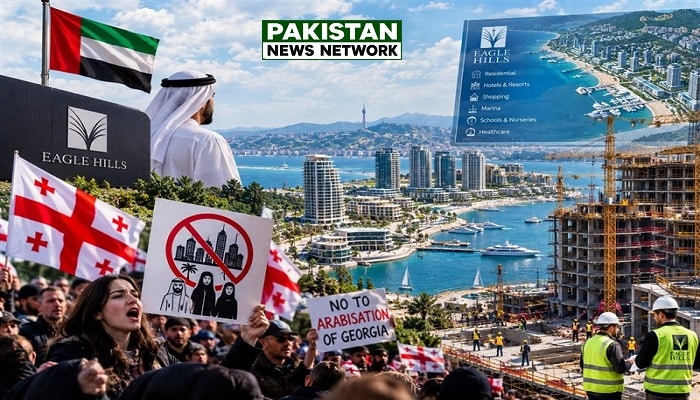
PNN – The launch of Georgia’s largest foreign investment project by the UAE has been met with a wave of protests and political controversy.
According to the report of Pakistan News Network; a fresh wave of protest activities and gatherings has recently emerged in Georgia regarding the commencement of major township development projects in the capital, Tbilisi, and along the coastline of the autonomous region of Adjara.
Protesters and critics have dubbed these massive construction projects the “creation of Arab cities”—a label that directly refers to the ambitious and expansive scheme led by “Eagle Hills,” the renowned UAE-based urban development and Real Estate Company.
With a staggering investment volume of $6.5 billion, this project represents the largest foreign investment in the history of independent Georgia, and its implementation will bring about a fundamental transformation in the country’s urban infrastructure.
The leaders and organizers of this protest campaign have extensively resorted to xenophobic slogans and racial rhetoric in their media and publicity efforts, focusing primarily on the ethnic and national backgrounds of the Emirati investors and the prospective buyers of the residential units within these complexes.
This approach and the incitement of public sentiment clearly recall similar events and tensions that arose a few years ago in Georgia against the Turkish engineering and contracting firm Enka—a company that was slated to build the country’s second-largest hydroelectric power plant in the Rioni River basin but was forced to halt the project due to similar protests.
Protest Organizers and Claims of the “Arabization of Georgia”
At the core of organizing this wave of protests in Tbilisi are a group known as the “Conservative Movement” (formerly operating as the Alt-Info media group), alongside several environmental NGOs and a number of hardline political activists.
Bolstered by news coverage and extensive support from media outlets aligned with the opposition, these groups organized a high-profile march and rally in the capital. The protesters’ primary objective was to voice their opposition to Eagle Hills’ construction projects in the “Krtsanisi” and “Ponichala” residential areas on the outskirts of the capital, as well as in the “Gonio” coastal area near the Black Sea in the Adjara region.
Although the march—attended by several thousand citizens—proceeded without physical confrontation, the tone of the speeches and slogans was highly aggressive and subversive. Invoking racial arguments, speakers claimed that the construction of these settlements signaled the start of an “Arabization” process in Georgia and a massive influx of foreigners into the region.
Accusing the ruling “Georgian Dream” party and its founder, Bidzina Ivanishvili, the protesters insisted on the immediate, uncensored release of the contract signed with the Emirati company and demanded the project’s complete cancellation.
Activists associated with this movement have warned that if work continues, they will block roads to prevent the delivery of construction equipment—a move that would trigger a repeat of the scenario where foreign investors flee.
Scope of the $6.5 Billion Investment by UAE’s Eagle Hills
Under the contractual framework between the Georgian government and the UAE-based company Eagle Hills, an 850-hectare tract of land has been placed at the holding company’s disposal, granting it rights of use and ownership transfer.
The company has committed to developing a wide range of modern facilities across this vast area, including premium residential complexes, exclusive villas, luxury hotels, shopping centers, yacht clubs, elite schools and kindergartens, and healthcare facilities.
Under this strategic partnership, the Georgian government’s stake is estimated at 33 percent, representing the value of the land allocated to the project.
Furthermore, the construction and operation of these facilities are expected to create approximately 3,000 sustainable jobs for Georgian citizens. The $6.5 billion investment in this project marks a historic milestone for the economy of this Caucasian republic.
According to the official schedule, major projects such as the “Tbilisi Waterfront” and the “Gonio Yacht Club” are set to become fully operational by 2040; however, commercial pre-sales for units within these developments have already commenced.
The bitter lessons of the Enka case and the $450 million compensation
Deep concerns regarding the consequences of cancelling this contract take on added significance when viewed against the backdrop of the bitter fate of Turkish investment in Georgia. In 2019, an agreement was signed between the Georgian government and the Turkish company Enka to construct the 430-megawatt Namakhvani hydroelectric power plant—a project that, following the 600-megawatt Enguri plant, ranked as Georgia’s largest energy initiative and a guarantor of the country’s energy independence.
However, protests by radical groups and non-governmental organizations—featuring racist slogans against the “Turkification” of the country—completely paralyzed this vital investment.
The halting of this project resulted in heavy financial losses. Recently, a U.S. court upheld a ruling by the International Court of Arbitration in Paris, ordering Tbilisi to pay substantial compensation—amounting to approximately $450 million—to the company Enka.
This massive liability has been imposed on Tbilisi at a time when Georgia’s total annual budget for 2026 stands at $14 billion. Currently, Irakli Kobakhidze’s government is compelled to pursue further legal negotiations to arrange for the payment of this compensation in installments over several years and thereby avert a financial crisis.
Georgia’s Firm Stance and Curbing the Financial Influence of Foreign Entities
In response to these developments, the Georgian government has characterized the protest gatherings as an anti-national provocation that undermines the country’s public interests. Official data from regulatory bodies indicate that—contrary to rumors—the vast majority of buyers and prospective homeowners in these projects are Georgian citizens and buyers from various European nations; thus, claims regarding foreign domination are baseless.
Georgian Prime Minister Irakli Kobakhidze reassured the public, declaring that destructive forces would never be able to halt the Eagle Hills project.
He emphasized that the destructive capacity of these groups has been drastically reduced compared to the Namakhvani Dam crisis, thanks to the enactment of new laws countering foreign influence and cutting off opaque funding sources for non-governmental organizations; unlike in the past, the injection of foreign funds into these circles has effectively ceased, and their leverage has been neutralized.