
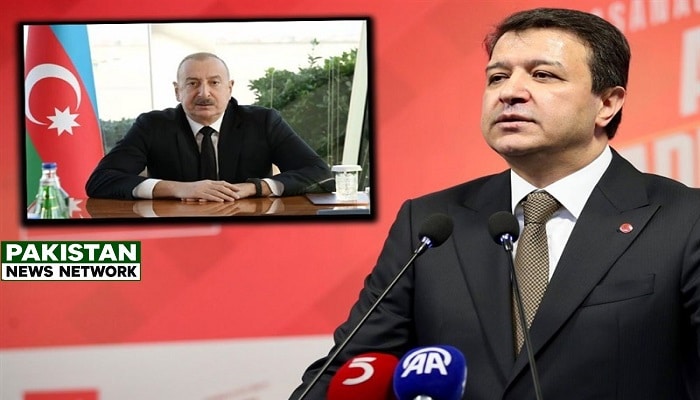
PNN – Baku’s move to ban girls wearing the hijab from schools has drawn criticism across much of the Turkish media.
According to the report of Pakistan News Network; a recent move by Mahmut Arıkan—leader of Turkey’s Islamist Felicity Party (Saadet)—marks the culmination of criticism from political elites in Ankara and Istanbul regarding Azerbaijani President Ilham Aliyev’s stance against the hijab and religious values.
Over the past two days, many Turkish newspapers have likened the ban on girls wearing the hijab in schools in the Republic of Azerbaijan to the difficult era of forced unveiling and hijab prohibitions, urging Baku to reverse the decision. Amidst this, however, Arikan—leader of the Felicity Party and a politician committed to the political and intellectual principles of the late Necmettin Erbakan—criticized Aliyev more vocally than the rest.

In an open letter addressed to Ilham Aliyev, the leader of the Felicity Party wrote: Mr. President! I would like to begin by expressing my affection for our beloved Azerbaijan. We have always stood shoulder to shoulder under the motto ‘two states, one nation,’ sharing in both joys and sorrows. The glorious victory achieved in Karabakh filled not only Azerbaijan but also Turkey with pride, transforming decades of sorrow into a source of great honor.
On this occasion, I once again reverently honor the memory of our dear martyrs who liberated Karabakh and express my appreciation to our heroic veterans. Mr. Aliyev! I write this letter to you drawing strength from the unshakable brotherhood between our nations and with deeply sincere sentiments. In recent days, the ban on headscarves in educational institutions in our brotherly Azerbaijan has caused us deep sorrow and concern.
Arikan continues: Many of the mothers who raised the heroes of the Karabakh battle, the wives who awaited their return, and the children, who are their most precious legacy, wear headscarves. Yet, it is with great sorrow that I must say: in your country, the children of martyrs who sacrificed their lives for their nation are now denied entry to schools because of the headscarf. This decision undoubtedly wounds the conscience and casts a shadow over the spirit of that great victory.
As Turkey, we know this pain all too well. During the events of February 28, we witnessed firsthand how the educational rights of our daughters—who covered their heads due to their beliefs—were stripped away, how artificial barriers were erected between the nation and the state, and how this situation inflicted deep wounds upon society.
History and experience have clearly taught us that such oppression has never yielded the slightest benefit for any country; on the contrary, it has undermined social peace and squandered the energy and years of nations.
The leader of the Felicity Party concluded his letter with these words: In this climate, where Zionism and imperialism are laying traps to divide our region along ethnic and sectarian lines, we will never allow our brother Azerbaijan to endure the suffering we experienced in the past.
We must move toward the future without falling into these divisive traps—whether within our own countries or across the region. Our greatest hope is that such actions—which cause the families of our martyrs and the children of our nation to bow their heads in sorrow—will come to an end as soon as possible.
We hope that these misguided actions will be abandoned as soon as possible, and on this occasion, I once again extend my warmest greetings and affection to the brotherly people of Azerbaijan.
Secular Authoritarianism in Azerbaijan
Taha Akyol, a renowned Turkish historian and analyst, also wrote in his column for the Karar newspaper today: If there is a strong tendency toward authoritarianism embedded in cultural DNA, then both secular and conservative governments—provided they have the power to do so—gravitate toward authoritarianism. It is a fact that authoritarian regimes in Azerbaijan and the Central Asian republics have seized power through rigged elections.
Given that democracy has faced challenges even in Eastern Europe, the situation in these republics is easily understood. Naturally, one cannot expect institutionalized democracy, as these societies had transitioned from feudal despotism to a totalitarian communist dictatorship.
Yet, Azerbaijan was one of the early hubs of the Turkish Enlightenment movement—centered on modernization and progressive thought—and has produced great thinkers. Now, however, the authoritarian regime in Azerbaijan has banned headscarves for students and teachers in schools, citing secularism.
The suppression of dissent, the manipulation of elections, and the restriction of freedom of thought and expression are other elements of that same authoritarianism. Had there been a strong opposition, robust civil society organizations, and a strong, free press, he would not have been able to do this.
Akyol continues: We must not get caught up in the question of who should rule; we must consider the how. What kind of regime? What kind of government? The correct answer lies in the separation of powers, judicial independence, strong public and civil institutions independent of the state, and an influential public opinion that values the ideal of freedom above all else.
Of course, we ourselves have not managed to achieve this goal in Turkey either. I do not know whether this writing will reach President Ilham Aliyev or not.
Someone in his inner circle will read it, or at the very least, it will be reported to them. Had his father, the late Heydar Bey, been alive, I would have gone to Baku in person to discuss this matter. I urge you: do not deprive young women of modern education—using the headscarf as a pretext—simply to indulge in a display of power. This ban is not only irrational; it inflicts deep wounds on the conscience. Open the doors; let them study, let them teach.
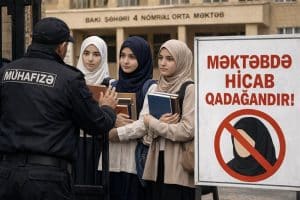
An examination of Turkish media reveals that the reaction to restrictions on Islamic attire in schools in the Republic of Azerbaijan has transcended a limited religious protest, evolving into a broader debate concerning individual freedoms, the nature of Ilham Aliyev’s government, the relationship between secularism and authoritarianism, and even the meaning of the “one nation, two states” concept.
Mustafa Yeneroğlu, a prominent politician and former member of the Turkish parliament, states: Barring girls who wear the hijab from education infringes upon both the right to education and religious freedom. We call upon the Baku government to respect constitutional guarantees, and we also expect the Turkish government to raise this issue in its discussions with Aliyev.
Furthermore, “Özgür-Der”—a Turkish civil society organization of religious and educational activists that had previously staged a protest outside the Consulate of the Republic of Azerbaijan in Istanbul—has once again emphasized that the ban on the hijab in schools in the Republic of Azerbaijan represents an attack on Islamic values and evokes the bitter experiences of veiled women in Turkey during the 1997 coup era.
Mahmoud Shahin, a deputy of the HÜDA PAR party, also protested against the hijab restrictions imposed on Azerbaijani students and teachers, calling on the Baku government to lift these measures. Citing Turkey’s “February 28” experience, Shahin argued that individuals should not be forced to choose between religious observance and the right to education or employment.