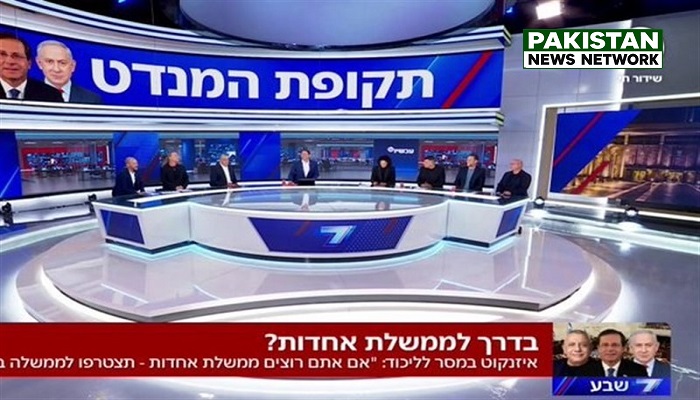
PNN – According to a media outlet allied with Netanyahu, Gadi Eizenkot—despite receiving the mandate to form a cabinet—faces only two possible paths.
According to the report of Pakistan News Network; the news portal of the Zionist regime’s Channel 14—considered a key ally of Benjamin Netanyahu—noted that as Gadi Eizenkot, leader of the ‘Yashar’ party, arrived at President Herzog’s office to receive the mandate to form a government, he faces significant challenges in doing so, despite having the support of 67 Knesset members.
The report states that 67 members of the Knesset (parliament) have called for the urgent formation of a formal government led by Gadi Eizenkot, and he is expected to soon receive the official mandate to form a government; however, the path toward forming a coalition and swearing in a new administration appears completely blocked.
Complicating his efforts to form a cabinet are the political maneuvers of the Haredi parties, the wavering stance of Avigdor Liberman, the 19-seat weight of the Arab parties, and secret contacts between Netanyahu and Eizenkot—facilitated by Gabi Ashkenazi.
According to this media outlet, the consultations conducted by Herzog have given him a clear numerical advantage; in total, 67 members of the Knesset supported entrusting him with the task of forming a government, whereas only 46 members favored assigning this mandate to Prime Minister Benjamin Netanyahu.
Despite this numerical majority on paper, the political reality is far more complex and multi-layered. The 67 representatives who nominated Eisenkot to form a government belong to factions characterized by deep ideological divisions, making it practically impossible for them to coexist within the same administration.
According to Moti Kastel, a political correspondent for Channel 14, although the task of forming a government has been entrusted to Eisenkot, the “concerning situation” within which he is attempting to form a government has led him into a political deadlock.
In the correspondent’s analysis, the primary obstacle facing Eisenkot is the composition of the coalition that supported his candidacy to form a government—specifically, the coalition’s reliance on Arab parties. The Arab parties within this coalition achieved an unprecedented success by securing 19 seats.
In the network’s studio, it was emphasized that this issue has caused deep dissatisfaction behind the scenes. In this regard, it was noted: This matter is being discussed at the dinner table this Saturday at the homes of Lieberman, Bennett, and Eisenkot. They are facing a real problem because of this.
Meanwhile, Avigdor Lieberman reiterated that he would not support any minority government that relies on the votes of Arab Knesset members.
In an effort to break the deadlock stemming from dependence on Arab parties, Lieberman is attempting to secure the cooperation of the Haredi parties—Shas and United Torah Judaism—by leveraging a legislative proposal from 2018.
This move was described in the network’s studio as a “shameful and deceptive stunt”; for even if some Haredi factions were to show interest in the proposal, the likelihood of them agreeing to serve in a government alongside Yair Golan, Naama Lazimi, and Gilad Kariv is virtually zero.
Furthermore, the Shas party has officially announced that it will not join this initiative, and without its participation, Eisenkot would be unable to form a government.
While the parties’ public statements point to a political boycott of one another and an opposition to serving in a joint government, significant developments are actually taking place behind the scenes.
Reports indicate that indirect and confidential contacts are taking place between Netanyahu and Eisenkot. Former Foreign Minister Gabi Ashkenazi is acting as an intermediary for these communications, and Isaac Herzog is also involved in the mediation efforts.
Israel’s political history recalls a similar scenario that unfolded for Benny Gantz during the era of the “corona government.”
Despite intense and organized attacks from all sides, at a decisive moment, the path toward forming a national unity government was paved.
It is possible that, upon realizing he cannot form a government with hardline religious factions or Arab parties, Eisenkot may ultimately move toward an agreement with Netanyahu—an arrangement that could yield greater political gains for him.
According to the political correspondent for the Netanyahu United network, once the clamor and misleading narratives of recent days are set aside, only two primary options remain on the table:
Option One – Formation of a Unity or Interim Government:
Establishing a political structure that includes a broad spectrum of center-right and center-left factions, aimed at preventing the paralysis of the political system and facilitating another round of elections amidst wartime conditions.
Option Two – Holding New Elections:
In the assessment of this expert, this option appears more realistic under the current circumstances. If the center-left bloc continues to insist on its contradictory campaign promises and rejects any compromise with Netanyahu—while simultaneously being unable to form a government on its own due to mutual vetoes involving Lieberman, the Haredi parties, and the Arab parties—Israel will inevitably be forced to head to the polls once again.