

PNN – The cyber-attack on French cold storage facilities was, in all likelihood, a joint false-flag operation by Israel and Ukraine.
The first reports regarding this incident—which took place on October 11, 2026—emerged in the media in early November (November 8 and 9). European media outlets, as well as notorious Persian-language outlets such as Iran International, immediately launched an intense propaganda campaign, pointing the finger of blame at Iran and the Islamic Revolutionary Guard Corps (IRGC) from the very outset. According to available information, a cyber-attack—attributed to the Islamic Revolutionary Guard Corps (IRGC)—targeted a number of supermarket chains and food markets in France that utilized a specific type of refrigeration equipment. The attack caused the temperature inside the refrigerators to rise from -20°C to +50°C, resulting in the spoilage of food products and, in some instances, triggering fires at these retail locations. Some media outlets also sought to portray this action as extending beyond grocery stores; by framing it as a broader operation—even including alleged attacks on relief facilities such as blood banks—they aimed to propagate the narrative that the Islamic Republic of Iran is intent on expanding the conflict into other arenas, such as cyberspace, as well as into countries that have ostensibly remained neutral in the war.

Three prominent brands—Danfoss, Dixell, and Copeland—which serve as the control systems and “brains” of refrigeration units, have been targeted by hackers. According to reports from Reuters and other media outlets, citing the French cyber-security agency, hackers managed to bypass the software layer to gain control of the hardware, allowing them to manipulate the temperature settings of the refrigerators.

Following this accusation, the Ambassador of the Islamic Republic of Iran to France was summoned to the French Foreign Ministry, and the French Foreign Minister accused the Islamic Revolutionary Guard Corps (IRGC) of carrying out this cyber-attack. He also threatened to intensify European sanctions against Iran.
Subsequently, a Ukrainian media outlet initially claimed that other countries—such as Spain, Portugal, Poland, Germany, and Belgium—had also been affected by this attack.

Examining Conclusive Evidence Refuting France’s Claim
Based on available technical evidence and official documentation, it can be stated with certainty that this operation was not the work of Iran. France’s accusation contains indefensible technical flaws, and the existing evidence suggests that the operation was, in all likelihood, a joint “false flag” action carried out by Ukraine and the Zionist regime. In other words, the dissemination of reports by Ukrainian media outlets represents a clumsy and rudimentary attempt to level accusations against the Islamic Republic of Iran.
This report first examines the technical flaws in France’s accusation, then presents technical evidence indicating the absence of any Iranian involvement. It further addresses the history of double standards regarding cyber-attacks in Europe—as well as claims attributing responsibility to Russian hacking groups—and finally analyzes the scenario of a joint “false flag” operation. Additionally, the ambiguity surrounding the Israeli firm Claroty—specifically its failure to proactively report the vulnerability to french security authorities—is raised as a serious question regarding the credibility of the official French narrative.
- Technical Gaps in French Allegations
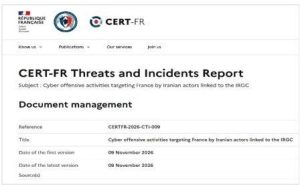
A report by France’s Cyber Crisis Coordination Centre (C4) claims that “Persian traces” were discovered within the attack infrastructure. Furthermore, it notes that on October 13—two days after the incident—an Iran-linked propaganda outlet provided coverage of the hacking operation, following similar reports by dozens of other media outlets. Such “evidence” could merely indicate a deliberate attempt to fabricate an Iranian footprint; it in no way proves that the operation was organized and executed by Iranian state entities. In the cyber-realm, spoofing Persian characters and utilizing intermediary infrastructure is quite easy. Furthermore, a claim of responsibility is merely that—a claim—and does not, in itself, constitute proof. Moreover, Claroty’s research report regarding CVE-2025-41450 had been published prior to the incident; additionally, an advisory from Danfoss was released in March 2025, and one from CISA in May 2025. This indicates that these vulnerabilities had been publicly documented long before the incident occurred.

France claims that the infrastructure used in the attack matches the infrastructure employed to identify other industrial equipment. However, such reconnaissance infrastructure—including specific VPS servers and scanners—can be leased, compromised, or shared among multiple entities. Infrastructure overlap, as a piece of evidence, serves merely as a “clue” and cannot form the basis for a definitive attribution. This is particularly significant given that France itself acknowledges that “the initial access method has not been disclosed,” a fact that further diminishes the evidentiary value.

- Technical evidence regarding the lack of involvement by Iranian hackers in this attack
2.1. Legacy devices were extensively exposed to the internet
The primary targets of this attack were the AK-SM 800 and AK-SC 355 series controllers manufactured by the Danish company Danfoss. These devices are quite old, and Danfoss no longer provides security updates for them. Data from the cyber infrastructure identification platform Censys indicates that, prior to the attack, 61 percent of the “StoreView” refrigeration control panels worldwide—with a heavy concentration in France—were running a version where the administrative password could be calculated based on the current date. Connecting the management interfaces of industrial equipment controllers directly to the internet constitutes an architectural security flaw—one that any actor equipped with a simple scanner could exploit. This attack did not require state-level operational capabilities.
This indicates that even the most basic independent hackers could have gained access to this equipment and taken control of it. In this context, one might even find traces of actors hostile to the Islamic Republic of Iran—parties that could have exploited such an incident to discredit countries like Iran and Russia. Consequently, there is evidence suggesting the involvement of the Zionist regime as well.
2.2. The vulnerabilities in the targeted equipment were long-standing, and available patches had been ignored
The AK-SM 800A family of devices contained three known vulnerabilities:
CVE-2025-41450: Authentication bypass
CVE-2025-41451: Remote code execution (post-authentication)
CVE-2025-41452: Denial-of-service attack (post-authentication)
Danfoss released patches for these in March 2025 and August 2025, respectively [13]. This indicates that the incident was a large-scale automated scan and exploitation of unpatched IoT devices, rather than a targeted state-sponsored operation.
At the Black Hat conference, Claroty—a major Israeli cyber-security startup—demonstrated how CVE-2025-41450 and CVE-2025-41451 could be chained and exploited to achieve remote code execution. This implies that the method for this attack had long been made available to any hacker by this Israeli security firm. This fact makes the potential involvement of Israeli hackers in this cyber-attack appear even more significant than before.
It is worth noting that Claroty is an Israeli cyber-security company. Given the close ties and security cooperation between France and Israel, a serious question arises: why did Claroty not report the technical details of this vulnerability—and the associated exploit chain—to French security authorities, such as CERT-FR and ANSSI, prior to the incident? Had such a proactive report been produced, France could have issued a more targeted warning prior to the attack and taken vulnerable devices offline. There is no evidence in the public domain of any such proactive warning. This stands in contrast to France’s claim that the attribution was precise and based on full intelligence cooperation, suggesting that the official French account lacks clarity regarding transparency and technical collaboration.
A technical analysis report by the Cloud Security Alliance explicitly states that the initial access method remains unconfirmed. Authorities have not disclosed whether the attacker utilized a vulnerability, stolen credentials, default credentials, or access via a maintenance service provider.

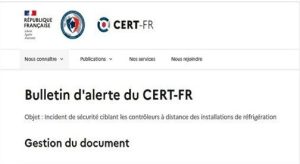
Regarding cybercrimes, France’s CERT-FR merely stated in its alert that it is “aware of intrusions into a large number of AK-SM and AK-SC series devices” and that “exposing the management interface to the internet violates security best practices”; however, it made no mention of the method used by the attackers to gain access. A nation that does not know the method of entry cannot definitively point the finger of blame at another country.
- Background: A Double Standard in Responding to Cyber-attacks in Europe
In recent years, the European Union has been the target of numerous cyber-attacks—far exceeding the incident involving supermarket refrigeration systems in terms of both scope and severity—yet these have not elicited a comparable media or political response. Attacks on energy and industrial infrastructure, long-term cyber-espionage against government institutions, and the disruption of power distribution networks are all examples of such incidents; despite the direct threat they pose to the national security of European nations, coverage of these events has typically remained contained within the media sphere.
Conversely, an attack on supermarket cold-storage facilities—an act that is technically unsophisticated and strategically insignificant—escalates into a full-blown media crisis the moment it can be attributed to Iran. This disparity in response reflects a policy of “Iranophobia” and the instrumentalization of cyber-related accusations for political ends, rather than a reaction proportionate to the actual severity of the threat. The extensive sensationalism propagated by notorious anti-Iranian outlets, such as Iran International, further confirms that such allegations are less a matter of substantiated, evidence-based fact and more a case of manufactured controversy and media propaganda.
- Claim of responsibility by Russian hacking groups
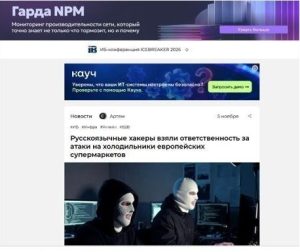
Contrary to France’s accusation against Iran, two pro-Russian hacking groups—NoName057 and Z-Pentest—have claimed responsibility for attacks on refrigeration systems in Europe, including those at a French blood bank’s cold storage facilities. On their Telegram channels, these groups released details, including evidence of access to internet-connected Danfoss and Dixell XWEB controllers. Meanwhile, the Kremlin dismissed the allegations as “absurd and baseless.”
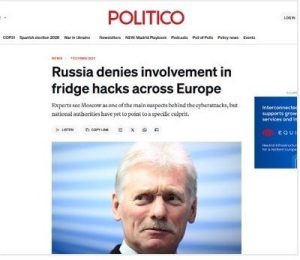
Although French authorities have not confirmed this claim—and the security firm Sekoia has deemed the groups’ assertions “unsubstantiated”—the claim of responsibility by Russian groups, along with the documentation they released, significantly undermines a definitive attribution to Iran; it suggests that the case regarding attribution in France involves, at the very least, other actors as well.
- Analysis: A Joint Israel-Ukraine “False Flag” Operation
Based on the totality of the evidence, it is highly probable that this attack was a joint “false flag” operation involving both Israel and Ukraine. Several points support this conclusion:
5.1. Iran-Linked Hacking Groups Have No Need for Such Low-Complexity Operations
Attacking supermarket refrigeration units is technically very simple: it involves remotely activating the “defrost” mode via a web interface and disabling temperature alarms. According to various global cyber-security firms, hacking groups attributed to Iran have a track record of executing far more sophisticated attacks.
Executing a simple attack on cold storage facilities—while leaving behind traces of the Persian language and Iranian IP addresses—is inconsistent with the technical capabilities of these groups. It appears more like a fabricated trail, planted to steer investigations, rather than the natural byproduct of a professional operation. In other words, even if one were to accept all past and current allegations regarding Iranian hackers (which we do not endorse), it is reasonable to conclude that they have long since moved beyond such tactics; they now employ far more advanced and modern methods for their operations—and certainly not against Europe.