
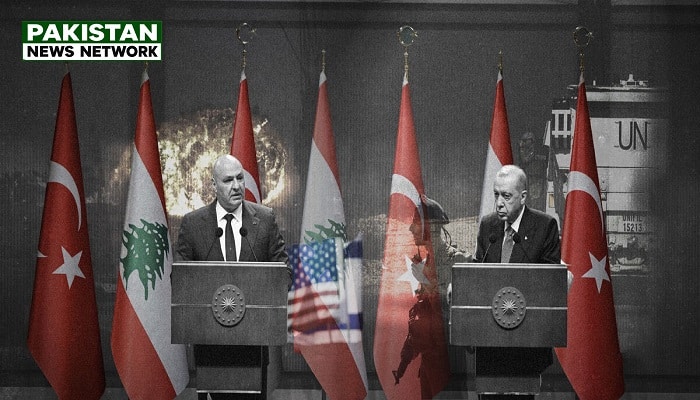
PNN – Lebanon is fragmenting without a single line being drawn on the map: Israel holds the south hostage to security conditions; Turkey is expanding its foothold in the north, and the central government—caught between the pressure of foreign actors and domestic deadlock—loses a portion of its sovereignty with each passing day.
Lebanon is undergoing a de facto partition—an unannounced division: the south is locked within the constraints of Israel’s security demands, the north is increasingly gravitating toward Turkey’s orbit, and Beirut is held captive by a government whose continued paralysis only deepens the rifts between the country’s constituent parts.
The partition of Lebanon begins where the state ceases to function.
As the departure of UNIFIL looms, Lebanon faces a strategic paradox: while virtually all stakeholders speak of the need for a strong Lebanese state, existing mechanisms effectively perpetuate that very state’s weakness. The September 17 meeting in Paris, the encounter between the Lebanese and Israeli ambassadors in Washington, and the talks between Recep Tayyip Erdoğan and Nawaf Salam in New York served as three snapshots of this very crisis.
Ankara and Tel Aviv do not envision the same kind of Lebanon. Turkey requires a government capable of signing agreements, authorizing projects, and exercising control over its territory; Israel, however, has conditioned a withdrawal from the south on terms that are difficult for a weak Lebanese government to fulfill. Thus, the issue is not merely a competition for influence; it is a question of the state’s ability to maintain national cohesion.
Ankara Operates in the North through the State
Turkey’s “Blue Homeland” doctrine views the Eastern Mediterranean as part of the country’s security and sovereign sphere. In June, Erdoğan stated that Turkey’s security begins in “Aleppo, Damascus, and Beirut.” However, Ankara’s instruments of influence in Lebanon rely on official state institutions.
Turkish activities at the Port of Tripoli, military training based on the 2010 agreement, the expansion of Qulayyat Airport, and any maritime agreements cannot proceed without the Lebanese government. On July 30, Erdoğan also declared that Turkey seeks to participate in “all initiatives” following the withdrawal of UNIFIL.
Alongside this state-led track, a social network has also emerged in the north. According to figures cited by Carnegie, by 2019, more than 9,600 Lebanese nationals had obtained Turkish citizenship out of approximately 18,000 applicants. Projects to restore Ottoman heritage and the Mersin–Tripoli shipping route have further strengthened these ties.
The text also highlights religious movements and civil associations, noting that the extent of their coordination and the identity of their ultimate backers remain unclear. The case of Idlib illustrates how service and administrative networks can evolve into power structures if a political vacuum persists.
The South Locked in an Endless Formula
In the south, the trilateral framework involving the U.S., Israel, and Lebanon—signed on June 26—aims to restore effective sovereignty over all Lebanese territory, yet it makes Israel’s withdrawal conditional upon verified disarmament.
This very sequence has created an impasse. The Lebanese Army faces the risk of internal conflict should it attempt to disarm Hezbollah, while the presence of Israeli forces complicates the establishment of a new security order. Consequently, each side can attribute the failure to meet conditions to the other, and the weakness of the Lebanese government becomes a justification for maintaining the status quo.
The pilot area of Zoutar al-Gharbiya was a clear example of this situation. The clearance, verification, and reconstruction plan was halted following the Rome negotiations in early August; Israel sought to verify the initial zones before expanding the operation. On September 14, Israel’s Channel 14 accused the Lebanese Army of coordinating with Hezbollah, and a political source described the mechanism as a failure.
Two days later, Eyal Zamir, the Director General of the Israeli Ministry of Defense, linked Hezbollah’s withdrawal from south of the Litani River to a “significant improvement” in the Lebanese Army’s performance. Formal negotiations have also been postponed until October.
When Temporary Arrangements Become Permanent
The primary danger lies in the widening rift between the North and the South. Reconstruction in the South has been stalled pending verification of disarmament, whereas the North is drawing closer to Turkey via the port of Tripoli, the Mersin line, and the Quliyat routes. Meanwhile, Beirut awaits financial aid from the Gulf and Europe—funds that remain contingent upon reforms and confidence in the government.
On September 15, Nawaf Salam stated in Parliament: Sustainable reconstruction is impossible without funding; funding is impossible without trust; and without a capable government, there can be no trust.
Meanwhile, the Exclusive Economic Zone agreement between Lebanon and Cyprus, reached in November 2025, faced opposition from Ankara and Northern Cyprus, thereby tying the future of Lebanon’s maritime relations to the Cyprus equation.
The UNIFIL mission is also set to conclude on December 31, 2026, with the withdrawal process extending until September 2027. While Joseph Aoun has prioritized preventing a security vacuum, disagreements persist regarding a replacement force. The Cyprus experience serves as a cautionary tale: the UN force deployed there in 1964 as a temporary measure remains on the island to this day.
Lebanon, too, could find itself on this same path without a new border ever being formally drawn. If the south remains awaiting reconstruction, the north moves closer to Turkey’s economic and political networks, and Beirut stays trapped in a cycle of negotiations and financial conditions, a de facto partition could take shape in reality before it is ever marked on a map.
The primary danger is not a new border, but the solidification of temporary arrangements—a scenario where the country’s north, south, and center no longer move according to a unified timeline.