
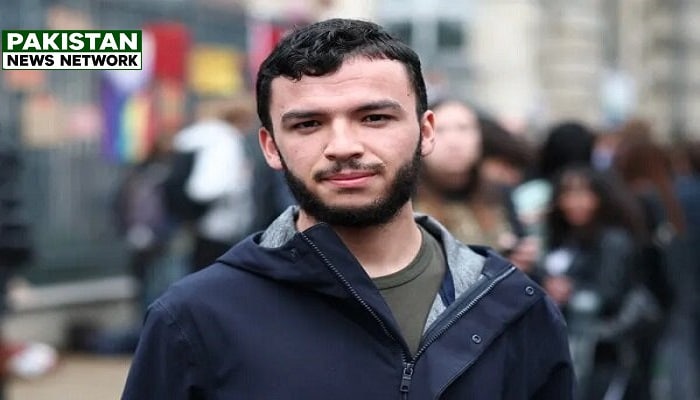
PNN – The French student movement—intensified by severe discrimination within the country’s education system and police repression—has turned a 19-year-old youth into a symbol of social protests.
Ryad Rany, a 19-year-old Frenchman, has transformed from a high school student activist into a prominent international figure amidst the student protests in France. Rany heads the high school students’ union—an organization that supports current movements and advocates for improved educational conditions in schools.
Rany was born in the city of Rouen in northern France. He lived with his mother until her sudden passing last January. His father is a Frenchman of Algerian descent who has spent years working in technical and manual trades.
After his mother’s death, he moved to Wattrelos, near Lille. He says his personal experience has enabled his to empathize with the struggles of low-income families, particularly in light of rising food and fuel prices and the impact of inflation.
Rany recently completed her secondary education; during her final year, she studied subjects including visual arts, history, geography, geopolitics, and political science, and also served on the school’s social council. Last September, she obtained her diploma after completing advanced coursework at the Émile Zola School in Wattrelos.
Rani assumed the presidency of the high school student union last April—a left-wing French organization established in 2023. The union advocates for anti-fascist, pro-women’s rights, environmental, and social causes, and maintains ties with university student unions and the General Confederation of Labour (CGT).
Rany Faces Threats Following Media Appearances
Rany’s prominent media presence has not been without personal consequences; he has reported receiving hundreds of death threats and racist insults since the recent student movements began.
As the union she leads continues to support the protests, Rany finds himself at the center of a debate that extends beyond school-related demands to address the role of young people and students in France’s social and political movements.
The Spark behind Student Protests in France
These protests involve the high schools where French teenagers spend their final years of schooling. Students have various grievances, but the most significant ones include a lack of teachers, poor classroom conditions, heavy academic schedules, and the length of the school day (from 8 a.m. to 6 p.m.), which some consider excessive.
French sociologist Valérie Pécaut notes that high school students—particularly those from low-income neighborhoods—feel they are receiving an inferior quality of education.

These protests began two weeks ago, on September 17, at the Saint-Exupéry High School in the Créteil suburbs southeast of Paris; the action was taken in support of teachers who had gone on strike to protest a shortage of staff and resources.
The movement gradually gained momentum and spread across France over the past week. Notably, while tensions have escalated in other parts of the country, the situation at Saint-Exupéry High School returned to normal after education officials agreed to hire additional staff, including a vice-principal and a nurse. This demonstrates that the protests in France are not politically motivated and that the demonstrators are genuinely criticizing the dire socio-economic conditions facing the most vulnerable segments of society.
What are the protesters’ demands?
Since the closure of several high schools began about ten days ago, the student union has supported the expansion of student movements. The main demands of these protests include addressing overcrowding and the pressure placed on students—specifically by reducing class sizes and adjusting academic schedules—as well as guaranteeing the replacement of absent teachers, renovating aging school buildings, and implementing measures to combat the effects of climate change within educational institutions.
As the protests have spread, Rani has emerged as one of the movement’s most prominent spokespersons in the French media.

The Role of Social Media in Shaping Protests
Impactful images and videos shared on social media platforms—particularly TikTok—help fuel protests. Students use their phones to record scenes such as burning trash bins or police deploying tear gas.
Sociologist Valérie Piqué notes that social media allows them to present a narrative that is close to reality and distinct from the one portrayed by traditional media—a narrative that is not pre-scripted.
Social Inequalities
Although France grants everyone access to secondary education, there are stark disparities in the quality of these schools—ranging from vocational schools to highly prestigious educational institutions.

Despite efforts to promote diversity, prestigious schools continue to attract primarily students from white, affluent families with college-educated parents. “There are stark disparities among students and schools, and this is a real problem,” says Piquet.
Political Accusations
These protests have also taken on a political dimension. As the presidential election approaches, the government has accused the radical left-wing party “France Unbowed” (LFI)—led by Jean-Luc Mélenchon—of being the driving force behind the movement.
In contrast, Manuel Bompard, one of the party’s leaders, accused the government of harboring conspiracy theories. Mélenchon has also backed the movement by supporting the protests and calling for peaceful action.
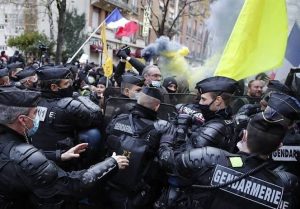
French Police Crackdown
Protesters have escalated tensions by blocking access to schools, setting fire to trash bins, and throwing objects at the police. In turn, police have used tear gas and rubber bullets to suppress the protests. As a result of the French police’s crackdown, a young man in the city of Tours lost sight in his right eye. Numerous videos showing security forces using harsh tactics against students have circulated online.