PNN – The newspaper Yedioth Ahronoth has predicted that the formation of a new cabinet for the regime will likely take weeks.
According to the report of Pakistan News Network; this Hebrew-language media outlet stated in an analytical report on its website that the primary scenarios for forming the cabinet are complex—a factor that will cause the negotiations to drag on for weeks.
According to this Zionist media outlet: Just as has been said about war, politics can also be an arena fraught with ambiguity.
Whatever the outcome on Tuesday, it could lead to various scenarios for the formation of a government.
The Ynet website—the online edition of the newspaper Yedioth Ahronoth—has examined the primary scenarios for forming a cabinet; however, it should be noted that Israel’s complex situation could give rise to a wide range of other scenarios as well.
- Scenario One: A Government of Change
According to most polls, none of the coalitions are expected to secure a majority of 61 seats; therefore, the realization of this scenario would come as a surprise.
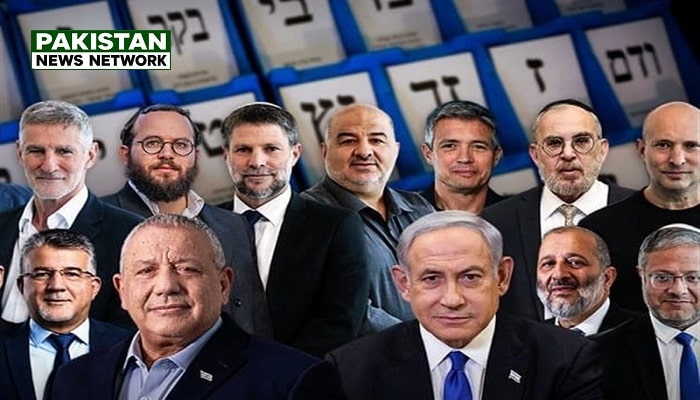
However, should the “Change” coalition defy expectations and manage to secure a 61-seat majority, it is anticipated that a government would be formed comprising the “Yashar” party (led by Gadi Eisenkot), the “Together” party (led by Naftali Bennett), the “Yisrael Beiteinu” party (led by Avigdor Liberman), and the “Democrats” party (led by Yair Golan).
Despite internal divisions within this coalition and the reluctance of Bennett and Liberman to support Eisenkot, if the coalition manages to secure a majority of 61 seats—and the “Yashar” party, led by Eisenkot, wins the highest number of seats—he is expected to become the next Prime Minister.
- Scenario Two: A Netanyahu-led Government
This scenario is the inverse of the previous one and, according to opinion polls, appears even less likely to materialize. In this scenario—contrary to polls and forecasts—the bloc led by Prime Minister and Likud party leader Benjamin Netanyahu would once again secure a majority of 61 seats.
Should this occur, a government would be formed based on a coalition comprising Likud, the Haredi parties (led by Aryeh Deri and Yaakov Asher), the “Jewish Power” (Otzma Yehudit) party (led by Itamar Ben-Gvir), and the Religious Zionist party (led by Bezalel Smotrich).
This scenario might also include the “Amah Yisrael” party, led by Ofer Winter. If this party fails to cross the electoral threshold, it will become more difficult for Netanyahu to secure the necessary majority.
- Scenario Three: A Minority Government
If the “Coalition of Change” succeeds in forming a Jewish majority, Eizenkot’s plan is to establish a minority government. Under the law, securing a majority of 61 Knesset members is not strictly required to form a government; a simple majority—even by a margin of a single vote—is sufficient.
Eizenkot has stated that he will not approach Arab or Haredi (ultra-Orthodox) parties, nor will he make any promises to them or sign any agreements with them. Nevertheless, for the “Coalition of Change” to prevail in the vote, the Arab parties would need to abstain and refrain from participating in the balloting.
Eisenkot believes that Arab parties will not pose an obstacle to ousting Netanyahu. The problem with this scenario is that any government—should one even be formed—would inevitably have to rely on the votes of either the Arab parties or the Ashkenazi Haredim; groups that do not rule out negotiating from outside the government, but in exchange, demand attention to budgetary allocations and the issue of mandatory military service.
If Eisenkot—as he has stated—refuses to accede to these demands, such a government would quickly collapse. Nevertheless, the “Coalition of Change” prefers to oust Netanyahu, even if it means forming only a transitional government.
The problem with this scenario is Avigdor Liberman, who has declared his opposition to the formation of a minority government; he believes that such a government would collapse quickly, allowing Netanyahu to return even stronger in the next election. If Liberman stands by his promise, this scenario will not come to pass.
- Scenario Four: A Unity Government
Another plausible scenario is that, due to an increase in the number of seats held by Arab parties, neither of the two blocs will come close to securing a majority of 61 seats. In such a case, Netanyahu and Eisenkot might reach an agreement to form a unity government featuring a rotating premiership—a scenario that sparked controversy today when raised by Ben-Gvir—even though both men have previously expressed their opposition to such an arrangement. The person likely to push them in this direction is Isaac Herzog, the President of Israel, though it is also reported that Donald Trump has made efforts to promote this plan.
- Scenario Five: New Elections
If Netanyahu’s coalition secures a larger Jewish majority than the “Change Coalition”—yet fails to reach the 61-seat majority required in the Knesset—and if no parties break away from their respective coalitions to join the opposing side, Israel may head toward new elections.
In this event, Netanyahu would continue to serve for several more months as Prime Minister of a transitional (caretaker) government.
- Expected Timeline
The Central Elections Committee has eight days from Election Day to submit the official results to the Knesset. In practice, the final deadline is Wednesday, November 4. However, the Committee expects the counting of all votes and the announcement of the final results to be completed by midday on Thursday.
Consequently, the 26th Knesset is expected to convene on Tuesday, November 10—two weeks after Election Day.
The real contest, however, will begin once the Central Elections Committee presents the official results to the President. Herzog will then begin summoning representatives from all parliamentary factions to his residence to hear their recommendations regarding whom they propose to form the next government.
Within a maximum of seven days, and in accordance with the law, he entrusts the task of forming a government to the candidate he deems most capable of successfully completing this mission. Typically, this individual is the one who has secured the greatest number of recommendations.
The candidate who receives the mandate to form a government in the first instance is granted 28 days to complete the task. The President may extend this period by a maximum of an additional 14 days.
Should this candidate fail, the head [of the regime] faces two options: either to entrust the mandate—for a period of 28 days, with no possibility of extension—to another candidate (usually a representative of the opposing bloc), or to declare that there is no prospect of forming a government.
In this scenario, a 21-day period begins, during which 61 members of the Knesset may submit a written request to the President, proposing that the task of forming a government be assigned to one of the representatives. The candidate who secures the signatures of 61 Knesset members will have 14 days to form a government.
If a government is not sworn in through any of these stages, the Knesset will be automatically dissolved, and new elections will be held in Israel. However, based on past experience, there is no guarantee that future elections will yield a significantly different outcome.