
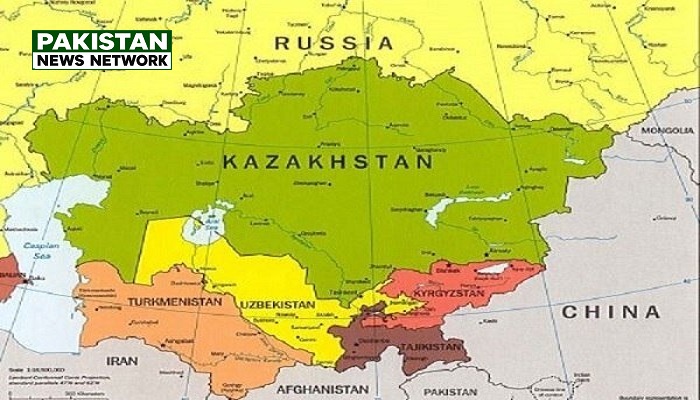
PNN – The Zionist regime’s influence in Central Asia—driven by political networking, technological cooperation, and the expansion of the Abraham Accords—is growing against the backdrop of Iran’s neglect.
Developments in Central Asia over recent years indicate that Israel’s influence in the region is no longer confined merely to the enhancement of bilateral relations or technical cooperation; rather, it is evolving into a “multilayered ecosystem”—ranging from the training of elites and social networking to the export of smart surveillance technologies and institutional penetration facilitated by the expansion of the Abraham Accords. The following analysis examines the mechanisms of this influence and the consequences of the Islamic Republic’s failure to pay it due attention.
The result of this transformation is a gradual shift in the nature of the strategic space to Iran’s north and northeast—from a “secure periphery” to an environment increasingly inclined toward cooperation with a hostile adversary. In this context, identifying the various layers of infiltration—elite, societal, intelligence, and diplomatic—is essential for accurately understanding the threat and devising a strategic response.
- MASHAV: A Key Tool for the Social Engineering of Elites
The Israel Agency for International Development Cooperation (MASHAV)—which has been active since 1958 and operates the Mount Carmel International Training Center (MCTC), established in Haifa in 1961—serves as the backbone of Israeli influence in Central Asia. However, the significance of MASHAV should not be reduced merely to “training”; its true function lies in the socialization and cultivation of elites, preparing them to assume executive positions.
Operational Model: MASHAV provides diverse training programs—not to the general public, but to government professionals, administrators, agricultural officials, and water experts. Upon completing their training and returning to their home countries, these individuals often assume positions where they oversee policy-making and resource allocation. For instance, in November 2025, on the outskirts of the capital of Kazakhstan, a Memorandum of Understanding was signed between the Ministry of Education of Kazakhstan and Israel’s Ministry of Regional Cooperation, Ministry of Education, Ministry of Foreign Affairs, and the Israeli Agency for International Development Cooperation (MASHAV). Subsequently, in February 2026, a group of Kazakhstani professionals completed a course titled “Innovative Approaches in Special Education” at the MASHAV-Carmel Training Center in Haifa and received certificates. In Uzbekistan as well, the Israeli ambassador explicitly stated in February 2025 that his country is prepared to provide “training and specialized courses” to Uzbek professionals—through MASHAV—in the fields of agriculture, pharmaceuticals, education, and innovation.
This pattern repeats on a broader scale: reports indicate that Israel’s economic cooperation with Tajikistan has grown by over 400 percent over the past five years, with 17 agricultural centers linked to MASHAV now operating across various regions of the country. In Turkmenistan, nine memoranda of understanding have been signed in the field of “smart agriculture.” Meanwhile, in Uzbekistan, Israeli companies have made significant progress in developing an agricultural technology park, a project for which they were granted 500 hectares of land free of charge starting in 2010.
Therefore, MASHAV is not a channel for technology transfer; rather, it is a network for cultivating loyal elite. Upon returning home, graduates of these programs carry with them a specific mindset, methodology, and network of connections that influence their countries’ major decision-making processes in favor of their Zionist partner—not necessarily out of treachery, but rather due to habit, technical dependency, and social capital. In the literature on influence, this is referred to as “institutionalized soft power.”
- Non-Governmental Organizations and the Creation of Non-Securitized Social Influence for Israel
Contrary to the common perception that NGOs serve merely as a cover for espionage, their more precise function is the “de-securitization” and normalization of Israel’s presence in Central Asia. When an Israeli non-governmental organization holds a workshop in Tajikistan or Kyrgyzstan—ostensibly to promote “family health” or “women’s rights”—Israel’s presence is redefined as “civil cooperation,” causing political and cultural resistance against it to collapse.
For instance, the National Coordinator for the Prevention of Domestic Violence in Haifa and the director of a crisis intervention center for sexual assault in Haifa have traveled to Tajikistan, Kyrgyzstan, Kazakhstan, and Uzbekistan several times over the past two years. During these visits, they conducted seminars for “women’s organizations and non-governmental organizations” focusing on family health, rights, and welfare. In Kyrgyzstan, more than 500 rural women participated in an “empowerment” program based on values promoted by the Zionist regime.
These activities may appear harmless—or even “humanitarian”—on the surface, but their cumulative effect is the creation of a social infrastructure oriented toward Israel: a network of civil society activists, journalists, and local organizations that, in the event of tensions between Iran and Israel, would lean toward the Israeli narrative rather than remaining neutral. Crucially, these networks can be mobilized—not as “spies,” but as generators of narratives and political pressure in Israel’s favor—a strategy that is highly beneficial to the Zionists while carrying minimal risk.
- Technology as an Informational Lever: From Agriculture to Pegasus
One of the missing links in common analyses regarding Israel’s influence in Central Asia is the connection between “technical cooperation” and “informational power.” Israel exports not only agricultural and water-related technologies but also infrastructure for surveillance, monitoring, and control—infrastructure that serves as a lever for gaining access to information.
A report by Privacy International indicates that Central Asian governments have deployed advanced surveillance systems within their territories—including monitoring centers capable of intercepting an entire nation’s communications—with Israeli companies playing a significant role in this regard. The “Predator” spyware, developed by Intellexa, has been utilized in countries such as Kazakhstan, Uzbekistan, and Tajikistan. Furthermore, there are reports that the government of Kazakhstan has employed the “Pegasus” spyware, created by the Israeli firm NSO Group.
Therefore, this is not merely a one-way relationship involving the “sale of technology.” When a Central Asian nation becomes dependent on Israeli technology to monitor its own citizens, the Zionist regime gains access to data and the operational logic of the technological and information systems within each of that country’s ministries and organizations—thereby creating a permanent form of leverage. This leverage can be activated during a crisis—for instance, if Iran were to attempt to use these countries as a channel to circumvent sanctions. The model of pressure applied by the United States and the Zionist regime against Iran has followed this exact same path: What began with agricultural and livestock projects near the Iran-Azerbaijan border has escalated to the establishment of military airfields and intelligence bases in close proximity to the Iranian border. For the Islamic Republic of Iran, the potential replication of this same pattern in Central Asia poses a fundamental risk—one that appears entirely serious.
- The Abraham Accords: From Bilateral Engagement to Multilateral Entrenchment
The development concerning the Abraham Accords in November 2025 represents a qualitative shift: during a meeting between the United States and the nations of Central Asia, Kazakhstan announced its decision to join the Abraham Accords—becoming the first Central Asian state and the sixth overall signatory to the pact. While Saudi Arabia has continued to refrain from joining, this new accession serves to partially restore the legitimacy and momentum that this treacherous agreement had previously lost.
But what are Kazakhstan’s motivations and constraints? Astana’s accession is less a product of an ideological alliance with Israel and more a tool for diversifying its geopolitical dependencies and fostering closer ties with Washington. This implies that Kazakhstan is not—at least explicitly—seeking to become part of an anti-Iranian coalition. Yet, the structural consequences exist independently of such intentions; Kazakhstan’s participation in the Abraham Accords establishes institutional influence and alignment. Even if Astana were to seek distance from Israel in the future, the cost of withdrawing from a multilateral agreement that includes the United States would be far higher than the cost of scaling back a bilateral relationship. Uzbekistan and Turkmenistan have also been mentioned as potential future candidates. Uzbekistan has been quietly expanding its ties with Jerusalem, while Azerbaijan, of course, already maintains extensive defense and energy cooperation with Israel. If these three nations—all of which have Muslim-majority populations—were to join the pact, the political environment would become significantly safer for other Islamic nations to join as well.
- The Consequences of the Islamic Republic of Iran’s Negligence: The Creation of a Gradual Encirclement
The core issue is not that Israel might launch an attack on Iran from Central Asian territory. Rather, the fundamental problem is that the strategic landscape to Iran’s north and northeast is undergoing a transformation—shifting from a “secure periphery” or “neutral zone” into an “environment leaning toward a rival.”
5.1. Erosion of Strategic Depth
For decades, despite the potential inherent in the concept of “Cultural Iran,” the Islamic Republic viewed Central Asia as a region offering limited scope for influence, yet one that posed no active threat. While Iran’s engagement with the region has failed to intensify—notwithstanding the various challenges involved—Israel’s influence in Central Asia is on the rise. The emergence of a security belt favoring the Zionist regime—stretching from the Caucasus to Central Asia and reinforced by political-security ties—could significantly undermine Iran’s balancing strategy along its northern and eastern borders, while imposing new security costs upon Tehran.
5.2. Land-Based Encirclement as a Supplementary Layer
The plans discussed between Washington and Tel Aviv for a land-based encirclement of Iran—which would entail asking neighbors, including Turkmenistan and Azerbaijan, to restrict or close their border crossings—demonstrate that influence in Central Asia is not a peripheral issue; rather, it is an integral component of the U.S. “maximum pressure” architecture.
Even if such a plan is never implemented, the mere fact that it has been proposed serves as a signal to Central Asian capitals that the cost of failing to align with Washington is high.
5.3. Turkmenistan: The Next Weak Link for Pressuring Iran
Should the current lack of attention persist, Turkmenistan—by virtue of its unique geographical position and shared border with Iran—is poised to become a key destination for Israeli investments aimed at containing Iran. Although Turkmenistan maintains an official policy of neutrality, it could easily shift from a buffer zone into a conduit for influence if subjected to economic and technical pressure—a transition that would not necessarily require an explicit political decision. The appearance of American military equipment in recent Turkmen military parades, the procurement and transfer of drones from Turkey and Israel, and reports regarding the infiltration of Zionist Jews into the inner circles of Turkmenistan’s ruling families are all causes for concern.
5.4. The Cultural-Civilizational Dimension
MASHAV and the network of Israeli-affiliated non-governmental organizations (NGOs) in Central Asia export not merely technology, but a narrative—a secular, liberal, and transnational narrative favorable to Israel. This narrative undermines Iran’s civilizational ties to a region that is home to Persian-speaking groups. In the long term, this cultural erosion proves more potent than any military threat; it steers local civil society and elites—from within—toward an Israeli-Western model, thereby establishing a social base for the advancement of anti-Iranian policies during moments of crisis. Such a moment of crisis could well mark the onset of a future war involving Iran, Israel, and the United States.
- Analytical Summary: Three Characteristics That Make Countering This Situation Difficult
First, its gradual nature: Israel is not launching a sudden “assault” in Central Asia; rather, it is building an ecosystem. Each individual project appears harmless—a training course, a memorandum of understanding on water issues, or a workshop for non-governmental organizations. Yet, the cumulative effect of these activities over a decade creates an infrastructure of dependency that cannot be dismantled without incurring a heavy cost.
Second, its multi-layered nature: MASHAV constitutes the layer of pro-Israel elites; non-governmental organizations (NGOs) form the social layer; surveillance and control technologies make up the informational layer; and the Abraham Accords represent the diplomatic-institutional layer. An attack on one layer does not weaken the others. If Iran focuses solely on mitigating the risk of “espionage” or exclusively on countering the “Abraham Accords,” it misses a significant portion of the broader picture and fails to gain a comprehensive understanding.
Third, legitimization through “development”: Perhaps the most challenging aspect is that Israel has redefined its presence in the region in terms of development assistance. Countering this so-called “development”—at a time when Central Asian nations have an urgent need for water technology, agricultural advancement, and education—poses a strategic dilemma for Iran, which itself faces economic constraints. Iran cannot merely issue “warnings”; it must offer alternatives. Indeed, if properly incentivized and guided toward investment in this region, Iran’s private sector possesses the capacity to address the needs of all five countries.
Ultimately, the Abraham Accords have not yet taken hold across Central Asia, and none of the region’s nations have explicitly joined anti-Iranian coalitions. What is currently unfolding is a gradual shift in structures toward Zionist-aligned frameworks, rather than an abrupt change in allegiances. Yet, if left unaddressed by a strategic response, this gradual drift could—within a five-to-ten-year horizon—severely constrain Iran’s room for maneuver to its north and east. Warnings such as the one presented in this article point precisely to this danger.
Israel is not launching a sudden “assault” in Central Asia; rather, it is building an ecosystem. Each individual project may appear harmless—a training course, a memorandum of understanding on water, a workshop for non-governmental organizations—but the cumulative effect of these activities, over the course of a decade, creates an infrastructure of dependency that cannot be dismantled without incurring a heavy cost.
Israel’s activities are multi-layered. MASHAV cultivates a layer of pro-Israel elites; non-governmental organizations (NGOs) form a social layer; surveillance and control technologies constitute an intelligence layer; and the Abraham Accords establish a diplomatic-institutional layer. An attack on one layer does not weaken the others. If Iran focuses solely on mitigating the risk of “espionage” or exclusively on countering the “Abraham Accords,” it misses a significant portion of the broader picture and fails to gain a comprehensive understanding.
Perhaps the most challenging aspect is that Israel has redefined its presence as “development assistance.” Opposing this so-called “development”—at a time when Central Asian nations have an urgent need for water technology, agricultural advancement, and education—creates a strategic dilemma for Iran, a country itself grappling with economic constraints.
Iran cannot merely issue “warnings”; it must offer alternatives. If properly incentivized and guided toward investment in this region, Iran’s private sector possesses the capacity to address the needs of all five countries.