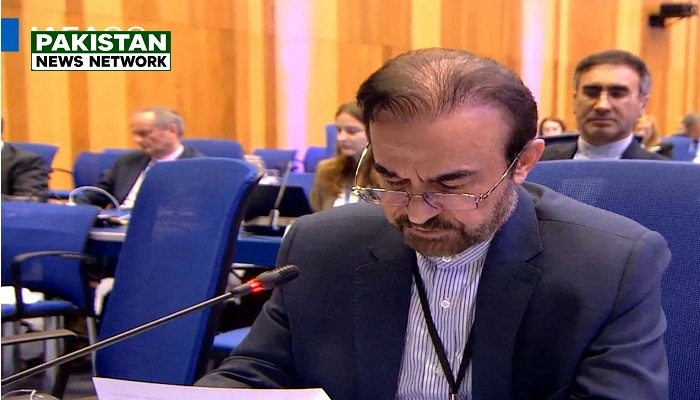
PNN – Iran’s representative to the IAEA Board of Governors stated that Iran will not share its sensitive information with others.
According to the report of Pakistan News Network; the Permanent Mission of the Islamic Republic of Iran to international organizations in Vienna emphasized in a statement today, during a meeting of the International Atomic Energy Agency (IAEA) Board of Governors: You cannot bomb nuclear facilities, continue to threaten further attacks, and then demand detailed information and unlimited access.
The mission added: Information collected by the Agency might serve the purpose of safeguards, but it will certainly be used to facilitate further attacks! No international obligation mandates unconditional cooperation at the expense of national security.
On Wednesday, during a meeting of the International Atomic Energy Agency (IAEA) Board of Governors regarding Iran’s nuclear program, Reza Najafi—Ambassador and Permanent Representative of the Islamic Republic of Iran—referred to the Director General’s report concerning the loss of the Agency’s continuity of knowledge regarding Iran’s nuclear materials and facilities. He emphasized that this situation cannot be assessed without considering its root cause: the military aggressions by the United States and the Israeli regime against Iran’s nuclear facilities that are subject to safeguards.
Recalling Iran’s history of extensive cooperation with the Agency, Najafi stated that, over many years, Iran has cooperated with the organization beyond its binding obligations. Pointing to the resolution of past issues in 2015, the voluntary implementation of the Additional Protocol, and the limitations accepted within the framework of the JCPOA, he noted that 16 consecutive reports by the Agency have confirmed Iran’s full compliance with its JCPOA commitments.
The Iranian representative also referred to remarks made by the then-Director General of the Agency in 2018, stating that the Agency possessed the world’s most robust verification system in Iran and had access to all locations requiring inspection. He added that, according to the Agency’s own statistics, verification activities in Iran increased by 152 percent between 2013 and 2017.
Criticism of the Agency’s Silence Regarding Attacks on Safeguarded Facilities
Noting that the military attacks by the United States and the Israeli regime against Iran’s nuclear facilities took place less than 24 hours after the adoption of a U.S.-proposed resolution by the Board of Governors in June 2025—and amidst ongoing negotiations—Najafi emphasized that these attacks have created an unprecedented situation for the Agency’s safeguards activities.
He strongly criticized the silence of the Agency’s Director General and the Board of Governors regarding these attacks, stating: Although Iran’s nuclear facilities were subject to the safeguards regime, the Agency has not even issued a formal condemnation of these attacks.
Comparing the Agency’s reaction to Israel’s 1981 attack on Iraq’s nuclear facilities with its current silence, Iran’s representative stated: At that time, the Board of Governors and the General Conference adopted nearly ten resolutions condemning the attack; yet this time—despite the attacks being more extensive and targeting operational facilities containing nuclear materials—the Agency’s response has been a deathly silence.
Najafi emphasized that one cannot demand cooperation and transparency from Iran while remaining silent regarding a military attack on facilities subject to safeguards. He added that attributing responsibility to Iran for the loss of the Agency’s “continuity of knowledge” amounts to confusing the effect with the cause—blaming the victim rather than the aggressor.
Iran Views Board of Governors’ Resolutions as Illegal and Illegitimate
Criticizing the resolutions adopted by the Board of Governors following the attacks, the Iranian ambassador stated that these resolutions not only failed to condemn the military aggression but also—disregarding the resulting security situation—demanded access to all of Iran’s nuclear sites.
He described the September 2026 resolution as a clear instance of the abuse of organizational authority and procedures, deeming it both illegal and illegitimate. Najafi further emphasized that issues formally closed by the Board of Governors in 2015 cannot be reopened based on political considerations.
Stressing the necessity for the Agency to maintain independence, impartiality, and non-discriminatory conduct, he noted that technical safeguards issues must not be transformed into tools for political pressure or geopolitical confrontation.
Iran Does Not Share Its Sensitive Information with Others
Elsewhere in his remarks, Najafi pointed to the persistent threats from the United States against Iran’s nuclear facilities, as well as the U.S. government’s offer of a multi-million dollar reward for information regarding Iran’s nuclear program, scientists, personnel, facilities, and equipment. He characterized the country’s security concerns as entirely concrete and grounded in existing realities.
Raising the question of what purpose—other than laying the groundwork for further attacks—the collection of intelligence on facilities that have already been targeted could possibly serve, he stated: Had the aggressors truly valued the safeguards regime, they would never have attacked facilities that had been under the supervision of the Agency [IAEA] for years.
Iran Warns of Possible Suspension of Safeguards Obligations
Emphasizing that the Islamic Republic of Iran—under international law—possesses the right to suspend the implementation of its safeguards obligations given the current circumstances, Iran’s ambassador stated that, should conditions warrant, Iran would unhesitatingly exercise this right in full.
He noted that while Iran remains committed to its obligations, cooperation with the Agency will be limited to the extent permitted by practical conditions and consistent with the country’s legitimate security considerations.
Najafi further indicated that requests from the Agency will be reviewed on a case-by-case basis, with decisions made regarding each individual request.
Rejection of the Claim Regarding the Revival of Terminated Resolutions
At the conclusion of his remarks, Iran’s Permanent Representative firmly rejected the claim that previously terminated UN Security Council resolutions could be revived. He stated that the Islamic Republic of Iran bears no obligations stemming from these terminated Security Council resolutions—or from the Board of Governors’ resolutions that refer to them—and will reject any demands based upon such resolutions.
At the same time, he emphasized that Iran will continue to resolutely pursue its inalienable right to the peaceful use of nuclear energy in all its aspects, including the development of a complete national nuclear fuel cycle.
In conclusion, Najafi called upon the Agency and the Board of Governors to base all their assessments and decisions on the Agency’s Statute, as well as on the principles of objectivity, independence, impartiality, and non-discrimination.