
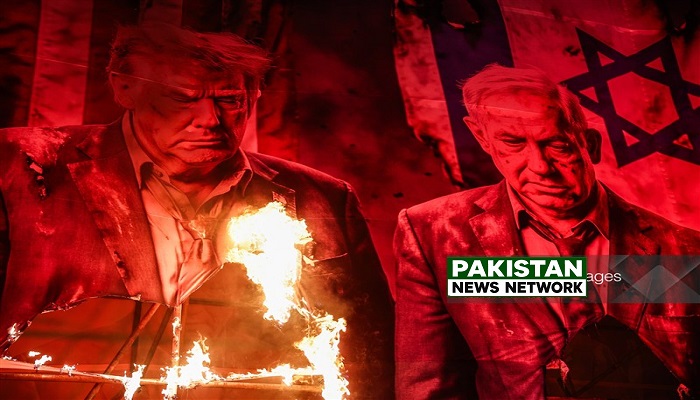
PNN – The current fates of Trump and Netanyahu is the consequence of a chain reaction triggered by the “Al-Aqsa Storm”—a process that reached its definitive turning point with the conflict involving Iran.
According to the report of Pakistan News Network; the global coalition of the far-right has suffered three consecutive defeats in recent weeks: the defeat of Jair Bolsonaro in Brazil’s presidential election and his subsequent flight from the country; the setback for Netanyahu, as his parliamentary seat count fell below the required threshold; and, finally, Trump’s major failure in the U.S. midterm elections—which cost the Republicans control of both the House of Representatives and the Senate, handing the Democrats the reins of Congress, alongside the loss of several state governorships.
What transpired in the United States stemmed from a defeat in the war against Iran—a point on which there is a consensus; beyond the opposition, Republicans—including Donald Trump himself and his running mate, J.D. Vance—have explicitly acknowledged this.
Nevertheless, these developments cannot be fully interpreted without considering the events triggered by October 7th. The rise of Zohran Mamdani—in the context of New York politics—is largely attributable to public opposition toward Netanyahu’s atrocities in Gaza and the support provided for them by American officials. Furthermore, the success of those who oppose the regime’s crimes within the Democratic Party’s internal contests, and their subsequent election to Congress, further illustrate the impact of October 7th.
How Did It All Begin?
The operation on October 7, 2023—which ignited the “Al-Aqsa Flood” war—marked a turning point that weakened various facets of life and power within the Zionist regime, affecting its inhabitants and Prime Minister Benjamin Netanyahu himself.
Eleven months prior to this operation, Netanyahu had secured a stunning electoral victory—one that shattered the opposition coalition—and was positioning himself for a lifelong reign as the undisputed leader of the right-wing bloc, which holds a majority within the regime’s society. Yet, men from Gaza suddenly dragged him from his “paradise” down into hell.
This note aims to provide a clear picture of the events that unfolded:
Five Consecutive Snap Elections and a Storm of Instability
Since late 2018, the Zionist regime has been gripped by political instability, which led to the collapse of the governing coalition and, following the dissolution of parliament, triggered a series of snap elections. This cycle repeated five times:
- April 2019: Ended inconclusively, leading to the next round of elections.
- September 2019: Ended inconclusively, leading to the next round of elections.
- March 2020: A national unity government was formed with a rotating premiership between Netanyahu and Gantz (who was leading the opposition); however, this heterogeneous administration collapsed after 13 months.
- March 2021: The opposition succeeded in ousting Netanyahu and forming a government, but this administration suffered from several undesirable characteristics:
– The coalition, comprising left-wing, centrist, and right-wing parties, was highly heterogeneous.
– The concept of a rotating premiership was associated with instability and the pursuit of political spoils.
– As the first prime minister in the rotation, Bennett held fewer parliamentary seats than Lapid, who served as the primary opposition leader.
– The administration was formed as a minority government; the opposition failed to reach the 61-seat threshold required in the 120-member parliament, and the government succeeded with only 60 votes in favor—a outcome made possible because the 59 votes against it were fewer than the votes in its favor.
- November 5, 2022: Netanyahu’s coalition secured 64 seats—three more than the 61-seat threshold. Subsequently, with Gideon Sa’ar returning to Netanyahu’s coalition following a period of separation, the number of seats held by the right-wing coalition reached 68.
The Trajectory of Developments
The Zionist regime endured four years of political instability before achieving a measure of stability—which subsequently strengthened—following its fifth election in November 2022. Eleven months later, the situation was transformed by the events of October 7. An emergency government was formed—an unusual arrangement that included the opposition—wherein major strategic decisions were made by a smaller, five-member cabinet. This group comprised three members from Netanyahu’s coalition and two from the opposition: Gantz and Eisenkot. The remaining ministers retained their positions within the broader cabinet. In this inner council, the Prime Minister, the Minister of Defense, and Gantz (serving as a minister without portfolio) held voting rights, while Eisenkot and Minister of Strategic Affairs Ron Dermer served as observers.
Netanyahu succeeded in completing the four-year parliamentary term, yet the situation appears to have reverted to the state that existed prior to November 2022. Three scenarios now present themselves: a deadlock leading to early elections; the formation of a rotation government—with Netanyahu serving as Prime Minister first, followed by Eisenkot; or the establishment of a heterogeneous opposition government, formed through an alliance that includes Palestinian-Arab parties.
Some of the consequences of October 7 became apparent immediately, while the full extent of its other repercussions remains to be seen. Much like the recent elections—which, three years after the events of October 7, cast the Zionist regime back into a stormy sea just as it had reached the shore—the situation remains volatile.
Had October 7th Not Occurred—or Had It Been Resolved
To assess the impact of October 7th on Benjamin Netanyahu’s political fate, one must consider what his standing would have been in the absence of this variable. Had October 7th not taken place—or had Netanyahu managed to overcome the challenges it created—he would have solidified his position as the unchallenged leader of the Likud party and the right-wing coalition. In such a scenario, figures like Naftali Bennett and Gideon Sa’ar would not have emerged to establish independent political entities, nor would individuals like Avigdor Liberman have broken away from the coalition.
Had Netanyahu followed the trajectory of the November 2022 elections, he could have—instead of recruiting controversial, high-profile extremists—integrated experienced bureaucrats into the Likud Party; individuals lacking personal partisan ambitions or a craving for fame. This would have enhanced the party’s efficiency while ensuring greater internal discipline and compliance.
Strengthening the Likud Party would have also reduced Netanyahu’s reliance on forming coalitions with leaders of hardline extremist factions, such as Itamar Ben-Gvir. Rather than being swayed or troubled by them, he would have been positioned to engage with these individuals and groups from a stance of strength.
How Was “Bibi” Outmaneuvered?
It is said that Netanyahu had been seeking to initiate a confrontation in Gaza since the spring of 2023; however, he pursued this objective gradually and incrementally, shifting the operational focus toward that region. Although the number of ground troops stationed around Gaza was not particularly high, the area was a top priority in terms of aerial activity, reconnaissance operations, and tactical movements.
The October 7 Operation and the Genetic Alteration of the Enemy’s Planned Offensive
This operation can be examined from various perspectives; however, its most significant impact was a fundamental alteration in the nature—or “genetic makeup”—of the enemy’s planned offensive. The Zionist regime had intended to deliver a severe shock through a surprise attack on Gaza and the assassination of commanders, subsequently finalizing the operation via intensive bombardment and ground maneuvers.
The next phase was to target Lebanon. The Zionist regime leveraged its deep intelligence penetration and operational reach to execute the pager explosions and assassinate key leaders. The extent of the enemy’s infiltration, situational awareness, and state of readiness was such that even the heightened vigilance resulting from a year of ongoing conflict failed to thwart their plans.
Following October 7, the enemy proceeded to implement its strategy; however, the ensuing war became a complex mix of both failures and successes, ultimately failing to yield the anticipated outcomes.
Regarding the fundamental shift in the nature of the enemy’s offensive—a shift precipitated by the preemptive operation of October 7—the following points are significant:
- Instead of initiating the war by catching the Resistance off guard, the enemy found itself taken by surprise.
- The enemy had envisioned a phased conflict; however, from the very outset, it was confronted by the preemptive engagement of various fronts—including Lebanon, Yemen, Iraq, and subsequently Iran—in support of Gaza, demonstrating a “unity of theaters.” Despite these developments, the enemy later attempted to decouple these fronts using various tactics; yet, by then, the critical window of time had already passed.
- The war disrupted the Zionist regime’s equilibrium and influenced its decision-making processes. Regarding the pagers, Yoav Gallant—the regime’s then-Minister of War—later revealed that they were originally intended to be detonated on October 11 (five days after the war began), as the enemy feared a surprise attack by Hezbollah. The fact that the Zionist regime held this “pager card” indicated the existence of an extensive war plan; however, the decision to activate it five days after the October 7 operation suggests that the enemy’s strategic balance had been upset, leading to a hasty, impulsive use of this “trump card.” Ultimately, Tel Aviv deployed this card a year later. The destabilization of such a well-equipped and conspiratorial adversary is a significant point, and its impact was reflected in the diminished effectiveness of the cards Tel Aviv sought to play.
- The regime’s operations were intended to be surprise attacks executed with great speed, delivering a series of successive shocks. Although the enemy later unveiled further “shock” tactics, the prolonged nature of the war allowed the Axis to absorb these blows and recover; had these tactics been deployed within a short timeframe—as originally planned by the enemy—adapting to the situation would have proven far more difficult for the Resistance.
The Deception of a Cunning Actor
Netanyahu is a cunning actor who has managed to outmaneuver a host of politicians, military figures, and intelligence operatives, remaining in power over the occupied territories for nearly two decades. He brought Gideon Sa’ar back into his fold and, through political maneuvering, effectively brought the political career of Benny Gantz—who had been leading the opposition—to a dead end, at least for the time being. Despite Netanyahu’s formidable capacity for navigating scenarios of survival, he fell into an “intelligence and cognitive trap.” Snaring an individual renowned for decades for his meticulous calculations is no easy feat. The events of October 7th thrust Netanyahu into a “domino effect of hasty decision-making,” forcing the Prime Minister to make a series of rushed choices with unpredictable consequences.
The Final Gambit in the 60-Day Countdown
In the 60 days leading up to the election, the release of documents and substantiated accounts regarding Netanyahu’s role in the October 7 catastrophe—and his contribution to the intelligence failure of Israel’s security apparatus—fundamentally altered the utility of his political tools. While Netanyahu sought to leverage the election to consolidate his power, his opponents—wielding sharp criticism of his conduct on October 7—made his situation significantly more precarious.
Furthermore, whereas Netanyahu once relied on manufacturing crises—or exporting them into the realm of foreign policy—to ensure his political survival, this strategy has effectively been exhausted by the conflicts of recent years, rendering it no longer viable.