
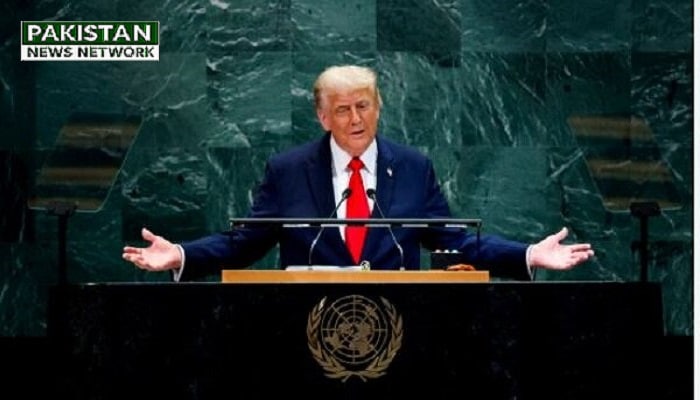
PNN – The list of Trump’s lies at the UN is not merely a collection of statistical errors; these figures and narratives paint a picture of an administration attempting to exaggerate its achievements beyond reality.
In his speech at the UN General Assembly, Trump sought to portray the United States as a victorious, wealthy power dominating global affairs—a depiction that, to a large extent, diverges sharply from statistical and on-the-ground realities and is effectively untrue. Analyses of the U.S. President’s claims by media outlets such as The New York Times and CNN reveal that, in various parts of his address, Trump either significantly exaggerated figures or presented ongoing developments—which have yet to reach a final outcome—as definitive achievements.
Claim Regarding Control of 60% of the World’s Oil
Trump stated that the United States and Venezuela control more than 60% of the world’s oil. This claim is inconsistent with data from the U.S. Energy Information Administration. According to the agency’s statistics, the combined oil reserves of the two countries account for approximately 22% of global reserves, and their share of global production is around 23%—figures far removed from the 60% mark.
Claim Regarding the End of the Gaza War
Trump cited the end of the Gaza war as one of his achievements; however, the reality on the ground does not support this conclusion. A ceasefire did not signify a complete cessation of hostilities, as Israeli attacks continued even after the truce was established. Therefore, merely securing a ceasefire cannot be equated with ending the war.
Claim of a 97% Halt in Drug Smuggling
Trump claimed that U.S. operations against drug-smuggling boats have halted 97 percent of maritime drug trafficking. However, there is no evidence to support such a massive reduction, and expert assessments indicate that parts of the smuggling network have simply shifted their routes. Consequently, the 97 percent figure is less a proven statistic than a sweeping claim lacking sufficient substantiation.
Claim of Ending Eight Wars
Trump claimed to have ended eight wars since returning to the White House. However, a CNN analysis reveals that at least some of the conflicts he included in this list were not actually wars during his presidency. Regarding the Democratic Republic of the Congo and Rwanda, peace agreements did not signify a complete end to hostilities, and attacks continued in Gaza. Furthermore, Trump himself has become the greatest threat to global security and has even instigated a major war against Iran.
Claim of Attracting $21 Trillion in Investment
Trump claimed to have attracted $21 trillion in new investment for the United States. However, CNN has reported that this figure cannot be substantiated; the amount listed on the White House website was approximately $11.2 trillion. Furthermore, that figure encompasses pledges, investments by U.S. companies, and commitments that do not necessarily equate to direct investment within the United States.
U.S. Claims of Virtually Unlimited Ammunition
Trump stated that the U.S. possesses so much ammunition that it is impossible to even imagine using it all. However, reports from the U.S. Department of Defense Inspector General and assessments by the Congressional Budget Office have highlighted shortages in certain types of ammunition, production issues, and the depletion of some stockpiles. Concerns have even been raised regarding the long timeframes required to replenish interceptor missile inventories.
Claim of 87% Drop in Crime in Washington
Trump stated that the crime rate in Washington, D.C., has dropped by 87 percent. CNN’s analysis of overall crime statistics does not support this claim. According to local police data, the number of recorded crimes as of Monday exceeded 15,000, representing an overall decrease of approximately 23 percent compared to the same period in 2024—not 87 percent.
Claim of Climate Change Based on “Global Cooling”
Trump stated that those who had warned about global warming later rebranded the issue as “climate change” because the Earth was actually cooling. Scientific data contradicts this claim. The World Meteorological Organization has reported that the eleven-year period leading up to 2025 includes the hottest years on record, with 2023, 2024, and 2025 ranking as the three hottest years ever recorded. CNN also noted that the well-known 2018 report did not claim “everyone would die within 12 years,” but rather warned of the urgent need to drastically reduce greenhouse gas emissions.
Claims of the Complete Destruction of Iran’s Nuclear Capability
In his speech, Trump once again made the nuclear threat posed by Iran the central justification for U.S. policy, speaking of the destruction of Iran’s capabilities. However, even within the United States, there has been disagreement regarding Washington’s initial claims about the destruction of Iran’s nuclear capacity. During a congressional hearing, U.S. administration officials were questioned about the success of the strikes and Iran’s ability to rebuild its nuclear program, and intelligence assessments differed from Trump’s maximalist claims.
Claiming Victory in the Iran Conflict
However, the most significant part of Trump’s remarks was his narrative regarding the conflict with Iran. The U.S. President sought to portray himself as the leader of a successful and decisive operation, even as the conflict enters its seventh month without having reached a conclusion. CNN reported that, while at the UN, Trump once again threatened Iran with “obliteration” while simultaneously speaking of the possibility of a deal—a contradiction illustrating that the Iran issue remains unresolved for Washington.
Even before his speech, when asked whether the U.S. was winning the war with Iran, Trump spoke of “great progress”—even though a CNN report cited a poll showing that only about a quarter of Americans approved of his handling of foreign policy, and a significant portion of the American public did not believe Washington had won the war with Iran.
In fact, the crux of Trump’s speech lies in the gap between the “narrative of victory” and the “reality of the war.” Had the United States achieved a clear and decisive victory over Iran, there would have been no need for the U.S. President to speak simultaneously of Iran’s destruction, negotiations, and the possibility of an agreement. The war—intended to be a display of American power—drags on after seven months, and Washington is still negotiating its conclusion.
For this reason, the list of Trump’s claims at the UN is not merely a collection of statistical errors. These figures and narratives portray an administration striving to inflate its achievements—ranging from oil and investment to concluded wars, military stockpiles, and, ultimately, the conflict with Iran. In this context, Iran represents the ultimate test of Trump’s narrative; the reality of the ongoing conflict and Washington’s inability to deliver a definitive outcome stands in stark contrast to the image of a decisive victory presented by the U.S. President.