
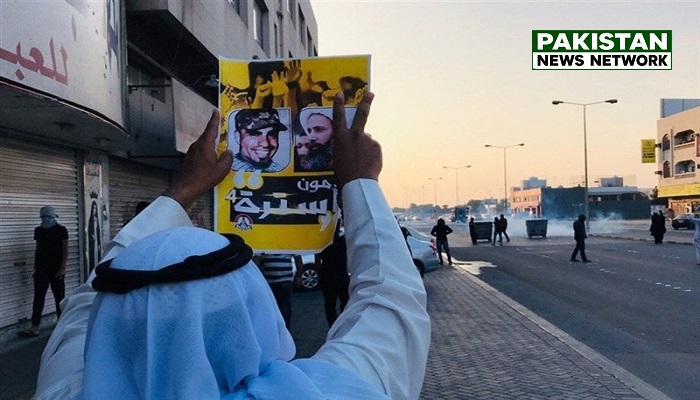
PNN – Legal sources have presented evidence that the Al Khalifa Judiciary proceedings against the scholars were fabricated, declaring the resulting verdicts unlawful.
According to the report of Pakistan News Network; repression and tyranny in the modern era consistently rely on sophisticated mechanisms designed to provide a semblance of legitimacy for autocratic rulers. While this is of lesser significance for the hereditary regimes in the region—given that their monarchs do not require popular endorsement—it remains important for maintaining the national image of these states.
One such sophisticated tool involves exploiting a flawed judicial system to provide a legal justification for the suppression of protesters—a practice pursued through biased interpretations of legal texts or by disregarding the individual freedoms enshrined therein.
In this context, the repressive Al Khalifa regime in Bahrain—ever since the onset of the conflict waged by the United States and the Zionist regime against Iran, which has since escalated into a regional war—has significantly intensified its crackdown on the Shia community (who constitute the majority of Bahrain’s population). This is carried out under the pretext of their alleged solidarity with Iran, effectively serving as an act of vengeance against the Shia population.
Unlawful Sentences Against Shia Scholars in a Sham Trial
In this context, on Monday, Bahrain’s High Criminal Court handed down sentences ranging from 15 years to life imprisonment to 69 individuals. These sentences affected 60 Shia clerics and 9 religious chanters. Authorities currently hold 56 of these individuals—comprising 47 clerics and 9 chanters—in custody.
The court also issued sentences in absentia against 13 religious scholars, most notably Ayatollah Sheikh Isa Qassim, the leader of Bahrain’s Shia community. He, along with 63 others, was sentenced to life imprisonment, while 5 additional individuals were sentenced to 15 years in prison.
The charges leveled by the Bahraini regime against these individuals are, as is typical, repetitive and baseless—such as alleged links to terrorism, including the formation of a “terrorist group aimed at overthrowing the constitutional order.”
In this regard, the Bahraini Prisoners’ Affairs Committee—citing information obtained from one of the religious scholars sentenced to life imprisonment—described details concerning the proceedings of this case and the hearing in which the aforementioned sentences were handed down: Upon entering the courtroom, Judge Jassim Mohammed Jassim Al-Ajlan and his team appeared disoriented. As soon as the session began, Judge Al-Ajlan produced a slip of paper, called out specific names, and briefly addressed them, stating: You are sentenced to 15 years in prison, and all other defendants are sentenced to life imprisonment. Immediately after announcing the verdicts, he and his team left the courtroom in a hurry, appearing visibly confused.
The Al Khalifa judicial system is merely a tool for repression.
The Bahraini Prisoners’ Affairs Committee emphasized that this demonstrates the predetermined nature of these harsh sentences, as well as the absence of even the most basic standards of a fair trial and due process.
Jaafar Yahya, the head of this committee, stated in an interview with the newspaper Al-Akhbar that the unjust verdict against a group of clerics could be reviewed through the judicial system and referred to an appellate court; however, this process would be extremely time-consuming.
He added that the judicial system under the rule of the Al Khalifa family will yield no results unless international pressure—encompassing human rights, political, and diplomatic spheres—is brought to bear on the authorities to bring about change. Otherwise, this political establishment will persist in upholding the verdict and aims to keep the clerics behind bars.
Ibrahim al-Aradi, director of the political bureau of the February 14 Coalition in Bahrain, stated in an interview with the newspaper Al-Akhbar that the verdicts against the religious scholars were politically motivated and predetermined. He noted that the Al-Khalifa authorities intend to target the Shia community with the harshest possible sentences, as this matter is directly linked to regional developments and the war against Iran.
The Al-Khalifa regime seeks to demonstrate its subservience to the Americans and the Zionists.
He warned, however, that the ruling regime’s repressive policies would prove counterproductive, as these verdicts will only intensify public discontent and popular uprising.
In this regard, the Political Council of the February 14 Youth Coalition emphasized that these rulings demonstrate the utmost delusion and stupidity on the part of the Bahraini regime’s officials, as well as their inability to accurately assess regional events and developments.
The Council stated that the Al Khalifa authorities are incapable of coexisting with the will of the Bahraini people and their religious scholars—who reject alignment with the “normalization” camp and refuse to be subservient to the Americans and Zionists.
The Political Council of the February 14 Youth Coalition asserted that these rulings are part of the Bahraini regime’s strategy to demonstrate its subservience to the United States and the Zionist regime, to engage in extortion against Iran, and to isolate the latter’s supporters in their sacred struggle to defend their land and dignity; however, these efforts will ultimately prove futile.