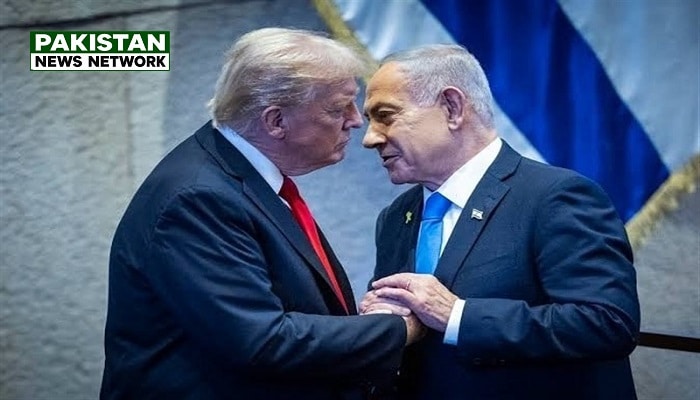
PNN – Some media sources have revealed a secret request by the Israeli Prime Minister to Trump, aimed at ensuring his continued hold on power.
According to the report of Pakistan News Network; with the Knesset elections in the occupied territories approaching on October 27 time is running short, and opinion polls have placed Benjamin Netanyahu in a precarious position. In most polls, the Likud party—led by Netanyahu—is projected to secure fewer seats than its rivals. Should this trend persist through the election, it would mean the loss of the premiership, likely the acceleration of his ongoing legal proceedings and trials, and ultimately, the removal of “Bibi” from the political landscape of the Zionist regime. Under these circumstances, Donald Trump—who recently remarked that the Israeli Prime Minister “doesn’t trust anyone”—has ultimately decided to extend his support to Netanyahu.
Recent reports in Zionist and American media reveal a complex political game in which the elections in the occupied territories, Benjamin Netanyahu’s corruption cases, and U.S. foreign policy in the Middle East are deeply intertwined. Netanyahu, having fallen behind his electoral rival Gadi Eizenkot in recent polls, is searching for a way to survive. Meanwhile, Donald Trump—seeking a compliant and controllable partner to advance his policies regarding Iran and the normalization of relations between Tel Aviv and Saudi Arabia—has leaned toward the prospect of Netanyahu remaining as Prime Minister. At the same time, however, Gadi Eizenkot, Netanyahu’s primary rival, has emerged as a figure whom Washington cannot afford to ignore.
Polls Sound Alarm for Netanyahu
According to polls released in recent weeks, the “Yashar” party—led by Gadi Eizenkot, the former Chief of the General Staff—is leading the Likud by a significant margin. A survey by the *Times of Israel* website, conducted ahead of the anniversary of the October 7th operation, indicated that Yashar would secure 24 seats, compared to 20 for the Likud.
More critically for Netanyahu, neither the bloc supporting him nor the one opposing him holds the 61-seat majority required to form a government. This implies that smaller parties and Arab parties will play a decisive role in the composition of the next cabinet, and Netanyahu cannot simply rely on his traditional coalition.
In recent months, Trump had repeatedly refrained from explicitly declaring his support for Netanyahu. When asked whether he trusted the Israeli Prime Minister, he even remarked, “I don’t trust anyone in the world of politics.” Ultimately, however, in one of his recent messages, he openly expressed his support for Netanyahu—a move that even drew opposition from members of his own cabinet.
Meanwhile, a Western media outlet reported that Mike Huckabee, the U.S. Ambassador to the occupied territories, held a secret meeting with Gadi Eizenkot in recent days. This report emerged amidst the election race, at a time when any sign of U.S. interference in the elections is a highly sensitive matter.
Huckabee, however, strongly denied this report. In a post on the social media platform X, he wrote: This claim is absolutely not true. Not at all. The U.S. government does not seek to manipulate Israel’s elections, nor does it tell the Israeli Prime Minister what to do. Period. End of story. This firm denial itself underscores the sensitivity of the matter. Even if such a meeting did take place, the U.S. could not confirm it, as doing so would amount to overt interference in the elections of a close ally.
Trump’s “Unity Cabinet” Plan and Eisenkot’s Conditions
Meanwhile, in another controversial report, the newspaper Israel Hayom claimed that Trump intends to form a coalition cabinet comprising the Likud party—led by Netanyahu—and the party led by Eisenkot, while sidelining figures such as Ben-Gvir. Under this plan, Netanyahu would remain Prime Minister for a maximum of two years, after which he would retire and power would be transferred to Eisenkot.
In exchange for this proposal, Eisenkot’s party has demanded guarantees regarding Netanyahu’s retirement, the cancellation of judicial reforms, and the establishment of an investigative committee into the events of October 7. These conditions touch upon the very issues Netanyahu has sought to avoid for years, as he views the acceptance of any responsibility in this regard as tantamount to facing culpability for the October 7 disaster. Meanwhile, the new cabinet would be tasked with bringing an end to conflicts on various fronts and advancing the normalization of relations with Saudi Arabia.
Why does Netanyahu need this agreement?
According to sources close to the Israeli Prime Minister, Netanyahu perceives a grave threat. His opponents from various political parties are determined to topple him at any cost; despite their internal disagreements, there are reports suggesting they may be forming a coalition. It is quite possible that Netanyahu himself has asked Trump to leverage the U.S. administration to intervene within this opposition bloc—specifically by co-opting his most significant rival—to form a new coalition that would allow him to remain in power, at least temporarily. Furthermore, during this period, Netanyahu might be able to implement reforms that could shield him from potential prosecution related to his corruption cases.
Conclusion
What is certain is that there is a clear contradiction between media reports and official denials from the United States. On one hand, numerous media reports reveal the existence of a U.S. plan to form a unity government. On the other, the U.S. ambassador categorically rejects these reports. This contradiction cannot be explained away simply as “fake news”; the reality is that Washington has specific interests regarding the composition of Israel’s future government and cannot remain indifferent to the possibility of a cabinet coming to power that is less aligned with its own policies.