
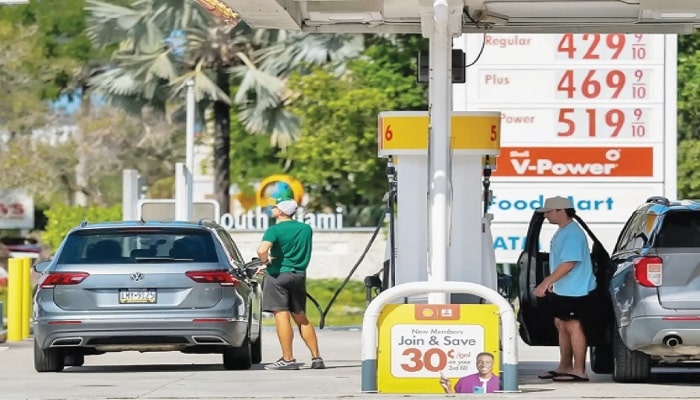
PNN – The average price of a gallon of gasoline in the United States hit $4.45 on Saturday, the highest since the start of the war with Iran. While Fox News reports that gasoline prices have increased by more than 47 percent since the start of the war, The Economist predicts that gasoline prices will reach $5 a gallon, a figure that the American public also expects. In a poll conducted by Ipsos, about half of respondents expect gasoline prices to get worse next year, while only 21 percent expect things to get better.
According to the report of Pakistan News Network; the economic strain of the war has seriously affected Iran, but now the other side of the war coin is also becoming apparent for Trump’s Americans. A war with Iran, with the closure of the Strait of Hormuz, is likely to cause deep and perhaps even greater damage to the US economy than previously thought. Some economists are calling the current situation the worst recession since the 2007-2008 recession, and CNN has warned in a reflective report that the US risks a five-stage crisis leading to “demand collapse.”
Under such circumstances, it seems that in the first days of May 2026, gradual but serious signs of the negative impact of the war with Iran on the US economy have become so apparent that even the most optimistic analysts are calling it “the worst situation since the 2008 financial crisis.” Steve Keane, an economist who is referred to as a post-Keynesian economist, predicts the greatest crisis in modern economic history and emphasizes that the war with Iran has acted as a catalyst and revealed the vulnerabilities of the global economy. The Australian economist, who has always predicted the 2008 recession, believes that the war has triggered a process of “inflation followed by deflation,” in which energy and fertilizer prices first surge, and then, as industries shut down and unemployment rises, demand in other parts of the economy collapses, creating severe downward pressure. CNN reported on Friday in a report titled “Demand Destruction: How War with Iran Could Destabilize or Break the U.S. Economy,” that a six-step mechanism is taking place. The concept of “demand destruction,” as CNN reports, refers to a process in which the magnitude of a price shock is so large, persistent, and costly that it fundamentally changes consumers’ spending behavior. According to CNN, in the first stage, rising oil prices act as a heavy tax on households, causing consumer confidence to collapse in the second stage: When people fear things will get worse, they cut back on their discretionary spending. In the third stage, large purchases are halted, millions of households default on their loans, businesses lay off workers, and finally, in the fifth stage, the strain on the banking system sets off a vicious cycle of recession and inflation. The International Energy Agency has called this “the most severe oil supply shock in history” and warned that the demand collapse will spread as shortages and higher prices persist.
The evidence supports this analysis. While the University of Michigan Consumer Confidence Index has fallen to its lowest level since 1952 and half of Americans spontaneously cite inflation as a factor in their lives becoming worse, a joint poll commissioned by The Washington Post and ABC News from Ipsos found that 44 percent of Americans have cut back on their driving because of rising gas prices, 42 percent of respondents said they have cut back on other household expenses, and 34 percent said they have changed their travel or vacation plans, another sign of cost-cutting. The Council on Foreign Relations (CFR) warns in its latest report, published on May 1, that the closure of the Strait of Hormuz has sparked a supply shock whose damages could exceed the disruptions caused by the Ukraine war in 2022.
Inflation rose 0.9 percent in March (the biggest one-month jump in four years) and the annual rate hit 3.3 percent, the highest since Trump took office. CNN analyst David Goldman warns that if the war continues and the strait is not opened in the next few weeks, “this situation could get a lot worse.”
First victim: Are there others in line?
On Friday, the first major victim of the crisis emerged: Spirit Airlines, which effectively shut down on May 2, 2026, after 34 years in business. The airline had been struggling to survive bankruptcy for some time and had filed for bankruptcy once before, but the jump in jet fuel prices from $2.24 to $4.51 per gallon disrupted its plan to exit its second bankruptcy, and the Trump administration’s $500 million bailout package failed due to opposition from key creditors. About 17,000 employees were laid off and more than 9,000 flights were canceled, an event that could have a ripple effect on other companies. Frontier, a key member of the Value Airlines coalition, formally requested $2.5 billion in emergency aid from the Trump administration last week, along with several other companies, and if the situation continues at this rate, it may be the first candidate.
A report from the Council on Foreign Relations a few days ago reveals another dimension of the vulnerability of the US economy: The sovereign wealth funds of the Gulf countries (with assets of $4 to $6 trillion) are directing their capital inward due to the war, which means a reduction in capital flows to American technology companies, especially in the field of artificial intelligence. In April 2026, Saudi Arabia canceled its $200 million donation to the Metropolitan Opera in New York and also cut its sponsorship of the LIV Golf League. “Time is not on the US economy’s side,” says economist Joe Brussouellas. Even if the war ended immediately, the economic recovery would take at least six months, and in some cases years. He says the US economy is facing a stronger customer for the first time in decades;
Turning Economic Pressure into Political Lever
Adding to the concerns is the fact that economic pressure is rapidly becoming political pressure. A Reuters/Ipsos poll shows that Trump’s approval rating has fallen to 34 percent, the lowest level of his presidency. Only 22 percent of Americans approve of his handling of the cost of living. 80 percent blame Trump for the high cost of gasoline. Reuters admitted that Washington was caught off guard by Iran’s response and that the economy, once a cornerstone of Trump’s political rhetoric, has now become his main weakness.